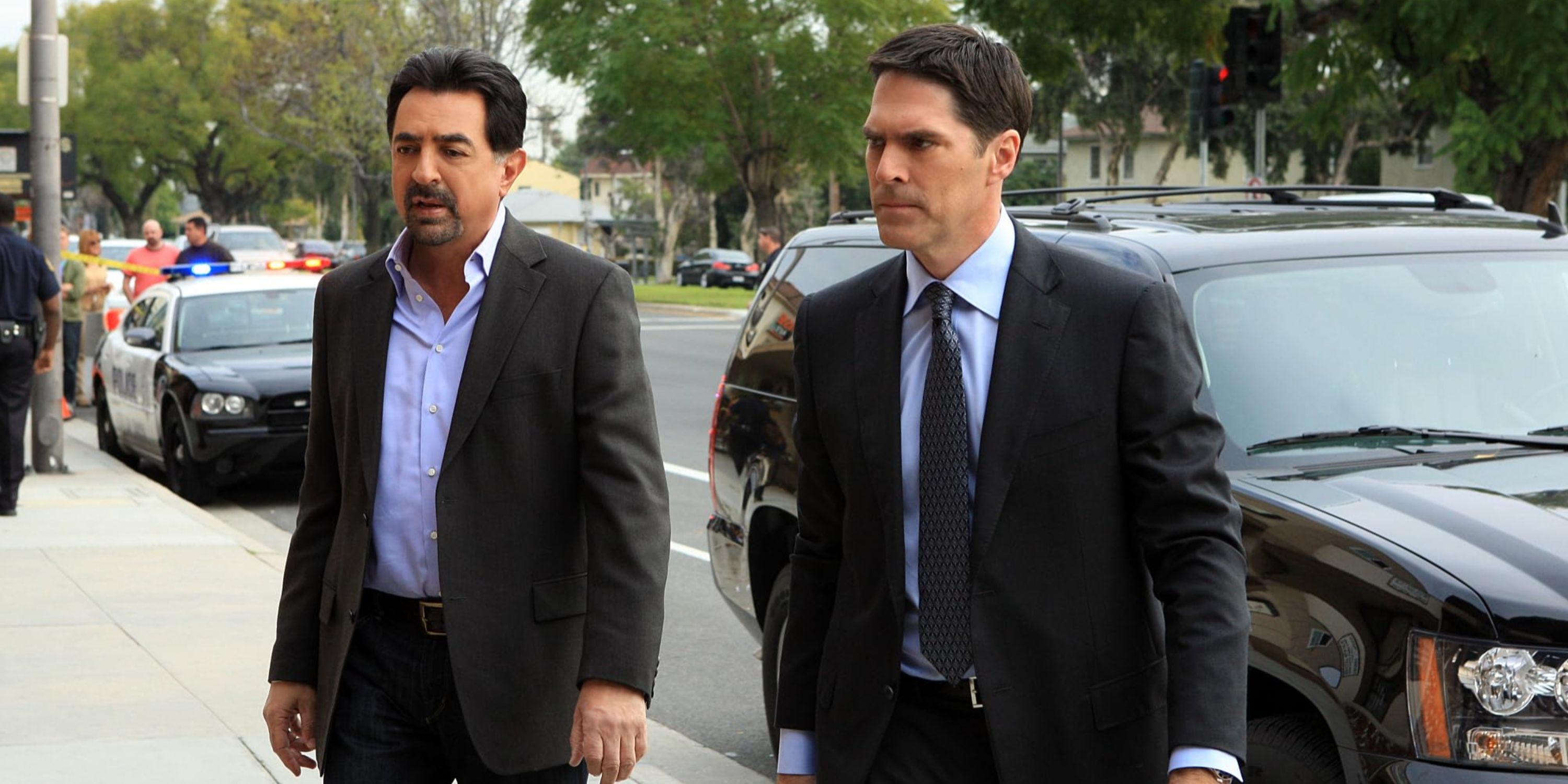
Let’s be real for a second. If you grew up watching procedural dramas in the mid-2000s, there was one face that defined the genre: the unsmiling, suit-clad intensity of Aaron Hotchner. He wasn't just a boss. He was the anchor. Even years after his sudden exit from the show, fans are still dissecting every grimace, every tactical decision, and every rare, flickering smile that Thomas Gibson brought to the screen.
Why? Because Hotch in Criminal Minds represented something we don't often see in modern TV anymore. He was the stoic leader who actually felt the weight of the world, rather than just acting like a superhero. He was human. He was flawed. And honestly, he went through more trauma than almost any other character in the history of the Behavioral Analysis Unit (BAU).
The Stoic Architecture of Aaron Hotchner
People often mistake stoicism for a lack of emotion. With Hotch, it was the opposite. It was a dam holding back a flood. From the very first season, it was clear that his "unit chief" persona was a shield. He had to be the one to tell the team to get back to work while a serial killer was still on the loose. He had to be the one to face the bureaucratic nightmares of the FBI's upper management.
Think about his background as a prosecutor. That legal precision never left him. He didn't just want to catch bad guys; he wanted to build cases that were airtight. It’s why he was so hard on Reid sometimes, and why he trusted Prentiss’s instincts even when she was keeping secrets. He understood the stakes better than anyone else because he knew exactly what happened when the system failed.
The dynamic between Hotch in Criminal Minds and his team was built on a foundation of "earned" respect. He wasn't the guy cracking jokes at the round table. He was the guy making sure everyone stayed alive.
The Foyet Arc: When the Shield Finally Cracked
You can't talk about Hotch without talking about George Foyet, a.k.a. The Reaper. This wasn't just another "case of the week." It was a tectonic shift for the series. Before "100," the landmark 100th episode, the BAU felt somewhat invincible. Sure, they got hurt, but they always went home.
Foyet changed that.
The tension leading up to the death of Haley Hotchner is still some of the most harrowing television ever produced. I remember watching it live—the phone call, the realization that he couldn't get there in time, and that final, brutal fight in the hallway. It changed the character forever. He went from being a man trying to balance a family with a career to a single father fueled by a very specific, very quiet kind of grief.
Interestingly, Thomas Gibson played those post-Foyet episodes with a haunting stillness. He didn't have a big "breakdown" scene in the way most actors would play it. He just became more focused. More insular. Jack became his entire world outside of the office. It made the moments where he did show vulnerability—like his relationship with Beth later on—feel so much more earned.
The Realistic Burden of Command
Most TV bosses are caricatures. They’re either the "mean boss" who gets in the way of the hero or the "cool boss" who lets everything slide. Hotch was neither. He was a middle manager in a high-stakes government agency.
He dealt with:
- Constant budget threats from Section Chief Erin Strauss.
- The psychological fallout of his subordinates (like Elle Greenaway’s departure).
- The legal ramifications of the team's "off-book" actions.
- His own deteriorating personal life.
His leadership style was "lead by example," but it came at a massive personal cost. The show subtly suggested that the reason Hotch was so good at profiling was because he lived it. He understood the darker impulses because he spent every waking hour suppressing his own anger and grief to stay professional.
Why the Exit Still Stings for Fans
We have to address the elephant in the room. The way Hotch in Criminal Minds left the show wasn't planned. It wasn't a narrative choice; it was a production decision following an on-set altercation involving Thomas Gibson.
Because of this, the character didn't get a "hero's send-off." He didn't get a final case that tied up his loose ends. Instead, he was written into Witness Protection to protect Jack from Mr. Scratch. For a character who had been the heartbeat of the show for over a decade, it felt... abrupt. It felt wrong.
Fans spent years hoping for a cameo in the series finale or a mention in the Evolution revival on Paramount+. The fact that he’s still mentioned in hushed, respectful tones by the current BAU members shows just how much gravity the character possessed. He wasn't just a character; he was the foundation. Without Hotch, the BAU felt a little less "official."
The Enduring Legacy of the BAU's "Dad"
There’s a reason TikTok and Tumblr are still flooded with Hotch edits. It’s the "competence porn" aspect of his character. In a world that feels increasingly chaotic, there is something deeply comforting about a man in a crisp suit who knows exactly what to do when things go south.
He represented the idea that you can be broken and still be useful. You can lose the love of your life and still be a good father. You can see the worst things imaginable and still get up the next morning to stop them from happening to someone else.
Hotch wasn't a perfect man. He was a workaholic. He was often emotionally distant. He arguably prioritized his job over his marriage until it was too late. But those flaws are exactly why we’re still talking about him in 2026. He felt like a real person trapped in a nightmare world.
Re-watching with Modern Eyes
If you go back and watch early seasons now, you’ll notice things you missed. Notice how he always stands slightly apart from the group in crime scenes. Notice how he uses his height and his voice to de-escalate situations without ever drawing his weapon unless absolutely necessary.
His relationship with Derek Morgan is particularly fascinating in hindsight. Morgan was the muscle and the heart, but he looked to Hotch for the "moral North Star." When Hotch left, Morgan’s eventual exit felt inevitable. The hierarchy had crumbled.
How to Appreciate the Hotch Era Today
If you're looking to dive back into the best of Hotch in Criminal Minds, you don't need to binge all fifteen seasons. Focus on the character-defining arcs that showcase Gibson's range and the character's depth.
- Watch the Reaper Saga in Sequence: Start with "Omnivore" (Season 4, Episode 18) and follow it through to "100" (Season 5, Episode 9). This is the gold standard for procedural storytelling.
- Analyze the "Fisher King" Episodes: These early episodes show Hotch's tactical mind under extreme pressure when the team is personally targeted.
- Observe the "Silent" Moments: Pay attention to scenes where Hotch isn't speaking. The way he watches his team during the "round table" briefings tells you more about his character than any monologue ever could.
- Check the Commentary: If you have the physical DVDs or access to behind-the-scenes features, listen to the writers discuss how they crafted Hotch’s dialogue. They purposely gave him fewer words to make the ones he did speak carry more weight.
The character of Aaron Hotchner remains a masterclass in "less is more" acting. He didn't need to scream to be the most powerful person in the room. He just had to be Hotch. That's why, no matter how many spin-offs or revivals we get, there will never be another unit chief quite like him.