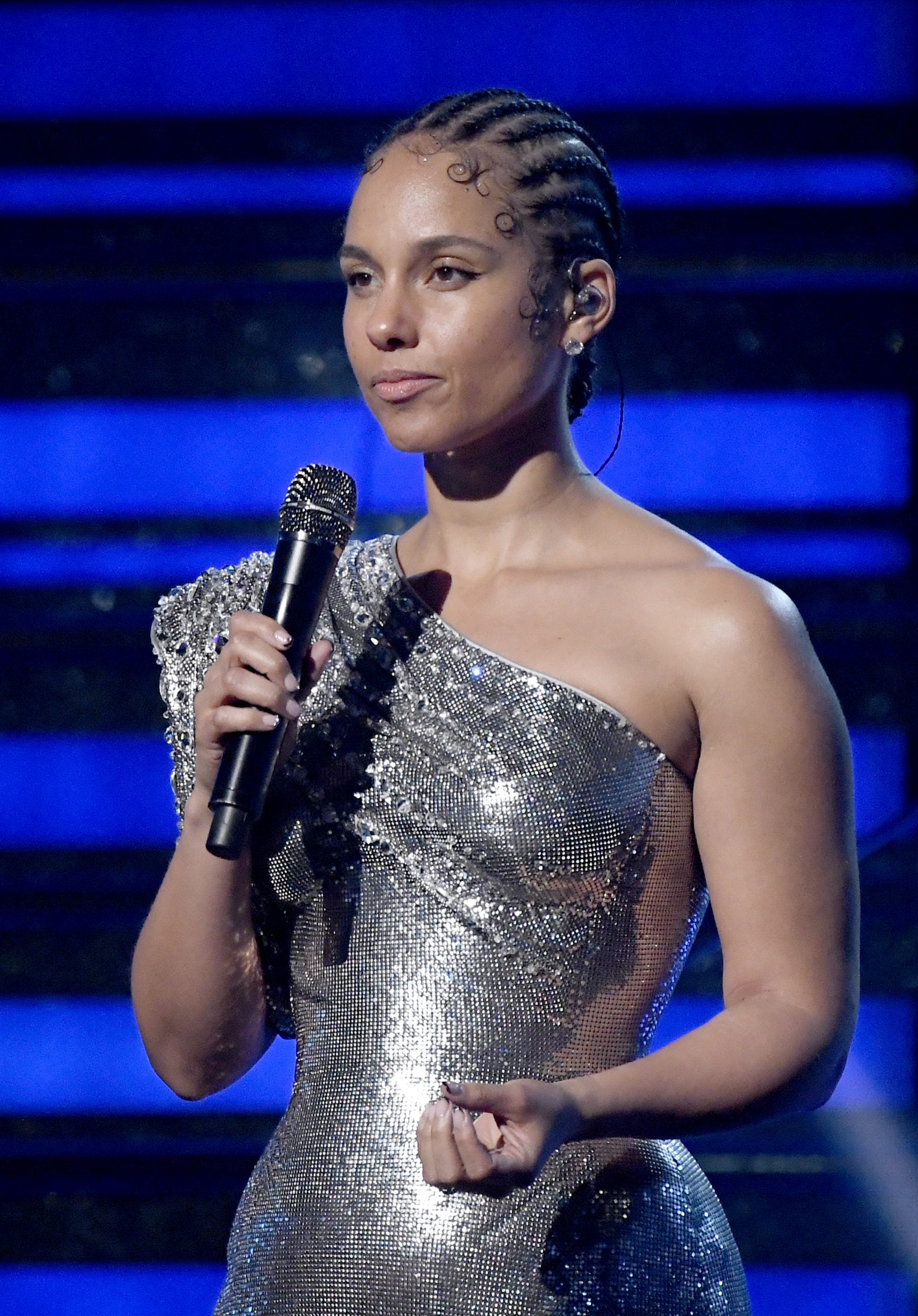
Honestly, if you close your eyes and think about the Grammys, you probably hear Alicia Keys' voice. Maybe it’s that Husky, soulful tone or the image of her sitting at a piano—or two. She’s basically the unofficial queen of the Recording Academy at this point.
Most people know she’s won a lot of hardware. But when you actually look at the history of Alicia Keys on the Grammys, it’s not just about the trophies. It’s about how she fundamentally changed what it looks like to be a "Grammy Darling." She didn't just show up; she took over the building.
The Night That Changed Everything
Let's go back to 2002. It was the 44th Annual Grammy Awards. Alicia was this 21-year-old kid from Hell's Kitchen with cornrows and a fedora. She walked into the Staples Center and walked out with five awards. Five.
She won Best New Artist, Song of the Year, and Best R&B Song for "Fallin’." It was a sweep that felt like a shift in the tectonic plates of the music industry. Usually, the Academy is kinda slow to embrace new artists who play their own instruments and write their own stuff, but Alicia was undeniable.
She didn't just perform; she commanded the stage. That night established a "gold standard" for her. Ever since, every time she’s nominated, there’s this feeling of, “Well, of course she’s going to win.” ## Why the "Two Pianos" Moment Still Matters
If you ask a casual fan about her best moment, they’ll probably bring up 2019. That was the year she hosted. Usually, hosting is a thankless job where you tell a few jokes and keep the show moving.
Not Alicia.
She sat down between two grand pianos—literally playing both at the same time—and performed a medley of "Songs I Wish I Wrote." She covered everyone from Nat King Cole to Lauryn Hill and Drake.
"Music is just one language," she told the crowd, basically proving she’s a virtuoso while everyone else was just trying to remember their teleprompter lines.
This wasn't just a flex. It was a tribute to Hazel Scott, a legendary Black jazz pianist from the 1940s who used to do the same thing. By bringing that history to the Grammy stage, Alicia wasn't just entertaining; she was educating a Gen Z audience that might’ve never heard of Scott. That’s the nuance she brings. She’s a historian of soul.
The Stats: 17 Wins and Counting
By the time the 2026 Grammys rolled around, Alicia’s tally sat at a staggering 17 wins. That puts her in the top tier of female artists of all time.
Here is the breakdown of how those wins actually look when you get into the weeds:
- Debut Era: 5 wins for Songs in A Minor.
- The Sophomore Peak: 3 wins for The Diary of Alicia Keys, including that iconic win for "If I Ain’t Got You."
- Collaborations: She’s won for "Empire State of Mind" (obviously) and even won a Grammy for Best Immersive Audio Album for her 2020 self-titled project, ALICIA.
What’s crazy is that she has 33 nominations total. That’s a roughly 50% hit rate. In the world of the Recording Academy, where people like Beyoncé and Taylor Swift often face "snubs" in major categories, Alicia has remarkably consistent support from the voters.
The Global Impact and the Dr. Dre Award
At the 2025 Grammys, things got even bigger. Alicia was honored with the Dr. Dre Global Impact Award.
Her speech was... a lot. In a good way. She didn’t just thank her team; she went after the industry’s lack of female producers. She cited a pretty depressing stat from the Annenberg Inclusion Initiative: only about 6% of producers on popular songs are women.
"DEI is not a threat, it’s a gift," she told the room.
It was a bold move. Usually, winners play it safe. But Alicia has reached a level of "Elder Stateswoman" status where she can say the uncomfortable stuff. She used her platform to highlight her musical Hell’s Kitchen and her work with the Black Music Collective.
That 2024 Super Bowl/Grammy Confusion
There’s been some weird Mandela Effect stuff lately regarding her 2024 performance. Because it happened right around Grammy season, a lot of people misremember her duet with Usher as a Grammy moment.
It wasn't. It was the Super Bowl LVIII Halftime Show.
You remember the "voice crack" heard 'round the world? Alicia started "If I Ain't Got You" and her voice broke slightly on the first note. The NFL famously edited it out for the YouTube upload, which sparked a massive debate about "fixing" live history.
But here’s the thing: her husband, Swizz Beatz, didn't care. The fans didn't really care. Why? Because Alicia Keys has banked so much "musical equity" over twenty years at the Grammys that one missed note doesn't touch her legacy. She’s human.
What We Can Learn From Her Longevity
Alicia’s relationship with the Grammys teaches us a few things about staying relevant in an industry that loves to throw people away.
- Be a "Multi-Hyphenate": She isn't just a singer. She’s a producer, a host, and a songwriter. This gives the Academy more "angles" to nominate her.
- Respect the History: She always pays homage. Whether it’s Ray Charles in 2005 or Hazel Scott in 2019, she positions herself as part of a lineage, not just a pop star.
- Vulnerability Wins: Whether it's the "No Makeup" movement or being honest about vocal struggles, people connect with her because she feels real.
If you want to track her impact yourself, start by watching her 2005 tribute to Ray Charles with Jamie Foxx. It’s arguably the most "pure" musical moment in the show's history. Then, go back and watch her 2025 Global Impact speech. The growth from a nervous 21-year-old to a powerhouse industry leader is the real story of Alicia Keys on the Grammys.
Check out the full list of her 17 wins on the official Grammy website or watch the archived performances on the Recording Academy’s YouTube channel to see the evolution for yourself.