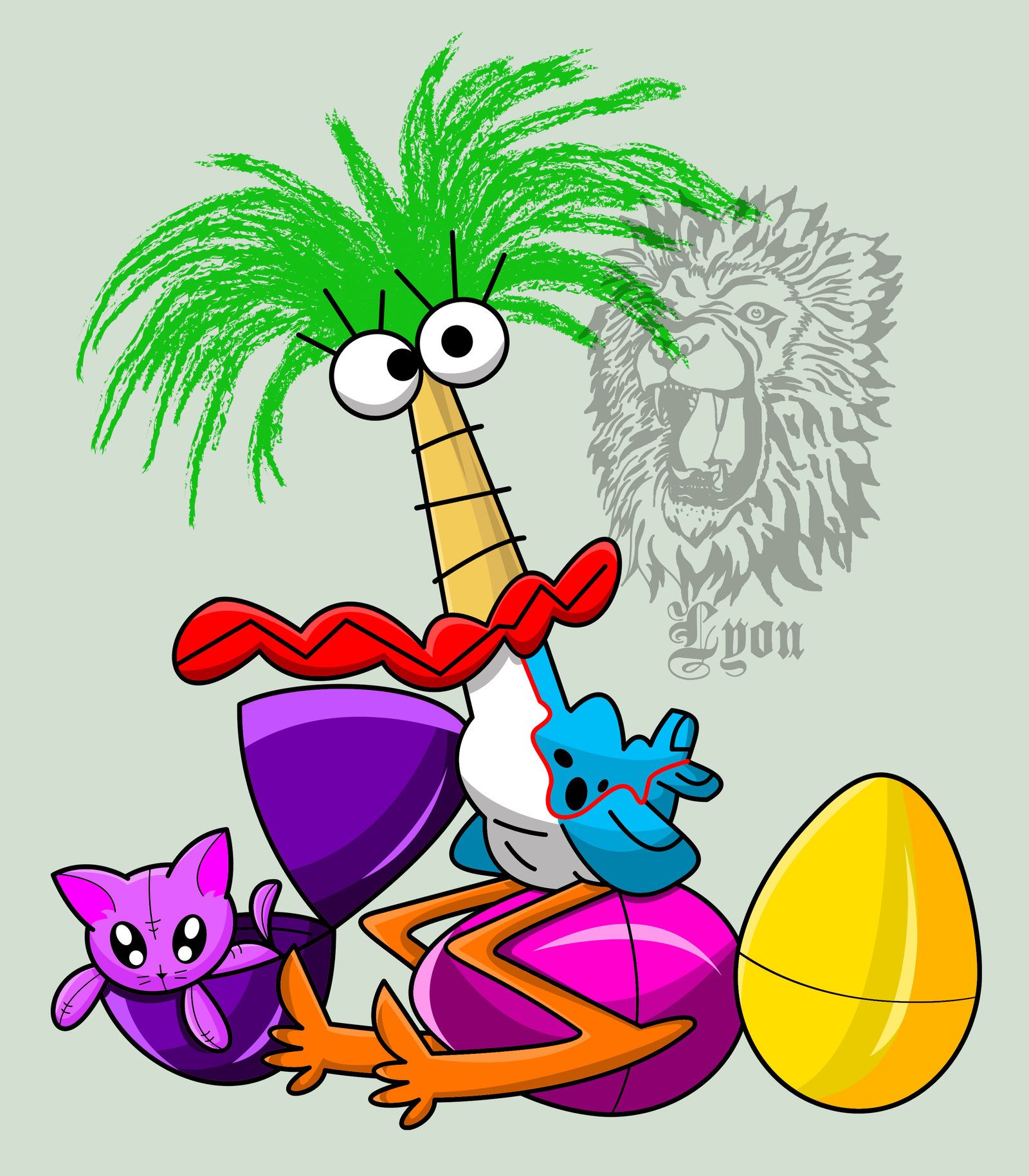
Honestly, if you grew up in the early 2000s, you probably have a weirdly specific memory of a bird-thing that only says "Coco" and lays plastic eggs filled with everything from anvils to sandwiches. We’re talking about Coco from Foster's Home for Imaginary Friends. She was easily the weirdest resident of Madame Foster's mansion. While Bloo was busy being a selfish jerk and Wilt was apologizing for existing, Coco was just... there. Doing her thing.
But there is a lot more to this character than just "crazy bird lady." If you look closely at her design, it’s actually pretty dark. Most of us didn't realize it as kids, but Coco is basically a walking, squawking traumatic memory.
The Grim Reality of Coco’s Design
Craig McCracken, the creator of the show, eventually confirmed what a lot of fans suspected on his DeviantArt page years ago. Coco wasn’t just a random mashup of objects. She’s a composite of what her creator saw while being stranded on a deserted island. Think Cast Away, but with more glitter and less Tom Hanks.
Her head is a palm tree. Her beak is a deflated rubber life raft. Her body? That’s the crashed wreckage of the plane that brought her creator to the island in the first place. Even her legs, which look like scrawny orange bird legs, were meant to represent the sunburned legs her creator stared at while waiting for rescue.
It’s heavy.
When you realize Coco was "imagined" by someone who was likely starving and losing their mind in the middle of the ocean, the fact that she lays eggs filled with helpful (and unhelpful) supplies makes total sense. Her creator was desperate for tools, food, and a way out.
She’s Smarter Than She Looks
Don't let the "Coco coco coco" talk fool you. She’s often the most capable member of the gang. In the episode Good Wilt Hunting, we actually meet the people who "found" her—two scientists named Douglas and Adam. They didn't create her; they discovered her alone on that island.
This brings up the big question: what happened to the kid who actually imagined her?
Fans have debated this for decades. Some think the kid was rescued and just couldn't take Coco back to civilization. Others, who like to ruin childhoods, assume the kid didn't make it off the island at all. McCracken has suggested that the kid was likely rescued and Coco just stayed behind because she’s an "odd bird."
Regardless of her origin, Coco represents a specific kind of imaginary friend—the one born out of a survival instinct rather than just a bored rainy afternoon.
Why We Still Love Her
Coco works because she’s the ultimate wild card. You never know if she’s going to lay an egg that contains a vital plot device or just a pile of dirty socks.
- The Voice: Candi Milo did the voice work for Coco (and Madame Foster, and Cheese). It’s impressive how much emotion she could pack into a single word repeated over and over.
- The Comedy: She’s the perfect foil to Bloo’s ego. You can’t argue with someone who only says their own name.
- The Loyalty: Despite her chaotic energy, she’s fiercely protective of Mac and the others.
She wasn't just a gag character. Coco was a reminder that imagination is a tool for coping with the world. Sometimes, when things are at their worst, your brain builds a palm-tree-airplane-bird to help you get through the day.
What to Do With This Nostalgia
If you're looking to revisit the world of Foster's Home for Imaginary Friends, start with the movie Destination: Imagination. It’s probably the peak of the series' creativity.
Also, keep an eye on the upcoming reboot news. Hanna-Barbera Studios Europe has been working on a new version of the show aimed at a preschool audience. While it might be a different vibe than the original 2004 run, the legacy of characters like Coco is clearly still alive.
Go back and watch the original pilot. Look at Coco’s design again. Now that you know about the plane crash and the life raft, she’s not just a funny bird anymore—she’s a survivor.