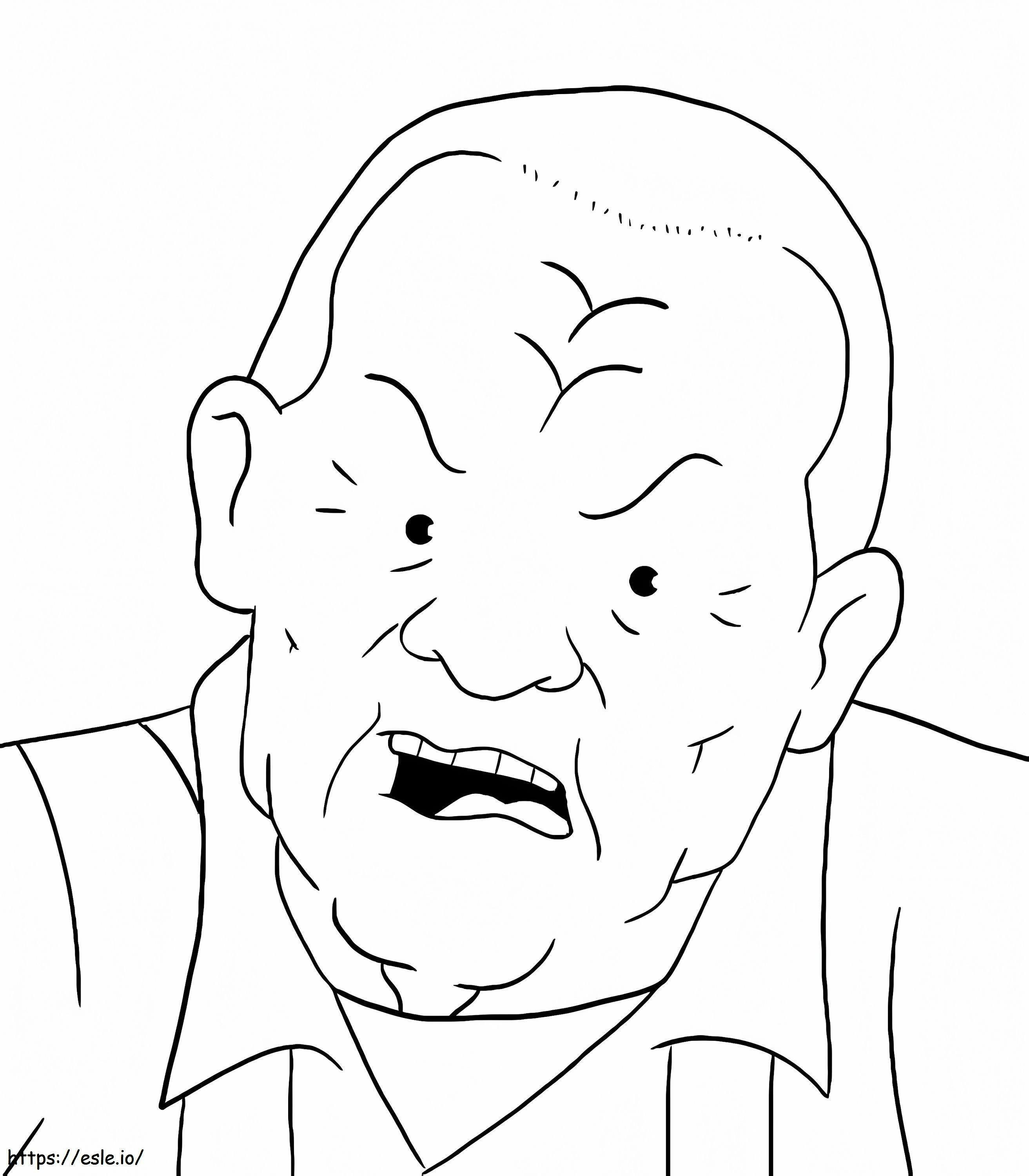
He’s short. He’s loud. He’s got no shins. Honestly, Cotton Hill might be the most abrasive character ever written for a primetime animated sitcom, but that’s exactly why he works. If you’ve spent any time in Arlen, Texas, you know that King of the Hill isn't just a show about propane and propane accessories. It’s a show about generational trauma, mostly masked by BBQ smoke and "yep" sessions. Cotton is the epicenter of that trauma.
Most people see him as a one-note caricature of a World War II vet. They're wrong.
Mike Judge and Greg Daniels didn't just create a villain; they created a hyper-realistic (if exaggerated) look at a specific type of American masculinity that was already fading when the show premiered in 1997. Cotton Hill is a man defined by a single moment in 1945. Everything else—his failed marriages, his weird relationship with Bobby, and his constant belittling of Hank—is just debris from that explosion.
The Legend of the Shins
Let's get the "fictional fact" out of the way first because it’s the bedrock of his entire identity. Cotton claims he "killed fitty men" in the Pacific Theater. While the show never explicitly confirms the body count, we know the cost: his shins. During an encounter with Japanese forces, his legs were blown off by machine-gun fire. He survived, but the surgeons had to sew his feet directly to his knees.
It’s ridiculous. It’s physically impossible. But in the world of King of the Hill, it’s the source of his literal and figurative stature.
Because he’s "shorter" than everyone else, he overcompensates with a personality that takes up the entire room. He doesn't just walk; he waddles with intent. This physical deformity serves as a constant reminder to Hank—and the audience—that Cotton sacrificed his body for his country, a debt he believes can never be repaid.
Why He Hates Hank but Loves Bobby
If you watch the series chronologically, the dynamic between Cotton and Hank Hill is painful. Cotton calls his son "Hankie" or just "BH" (Bad Hank). He treats him like a disappointment because Hank is a sensitive, rule-following, bureaucratic man. Hank represents the "soft" world that Cotton’s generation supposedly saved.
But then there’s Bobby.
Cotton absolutely adores Bobby Hill. It’s one of the weirdest, most endearing parts of the show. Why? Because Bobby doesn't care about Cotton’s expectations. Bobby is funny, he’s comfortable in his own skin, and he’s not intimidated by the old man's barking. In a way, Cotton sees Bobby as a "clean slate." He doesn't see the "failure" he sees in Hank. He sees a kid who actually enjoys life—something Cotton hasn't done since before he went to Iwo Jima.
The Reality of the "Greatest Generation" Trope
The writers were incredibly smart about how they handled Cotton’s service. They didn't make him a "hero" in the traditional, polished sense. He’s a misogynist. He’s racist toward his neighbor Kahn (though, interestingly, he’s the only one who correctly identifies Kahn as Laotian while everyone else assumes he's Japanese or Chinese).
Cotton is a subversion of the "war hero" trope.
Real-life veterans groups have often debated characters like Cotton Hill. On one hand, he’s a jerk. On the other, he captures the very real bitterness of men who returned from horrific violence only to find a world that wanted them to "settle down" and mow the lawn. He can't settle down. He needs a conflict. If there isn't a war, he’ll start one with the local zoning board or his ex-wife, Tilly.
The Tragedy of Didi and G.H.
In the later seasons, we see Cotton marry Didi, a woman roughly Hank’s age who is, quite frankly, not very bright. They have a baby named G.H. (Good Hank). This was a turning point for the character. It showed that Cotton was desperately trying to "redo" his life. He wanted a son he could mold into a soldier from day one, rather than a son who liked shop class and manners.
But you can't outrun age.
Cotton’s decline is one of the few things in King of the Hill that feels genuinely dark. Watching a man who defined himself by strength become physically weak is a classic trope, but seeing it happen to a guy who "killed fitty men" feels different. It’s a reminder that even the loudest voices eventually run out of breath.
What Most Fans Miss About His Death
Cotton Hill died in the 12th season, in the episode "Death Picks a Cotton." He died in a Japanese restaurant, of all places, after an argument with Peggy.
His death wasn't peaceful. It wasn't "noble." He basically died out of pure spite.
There’s a deep irony there. He spent his whole life talking about dying on the battlefield, but he ended up dying because he ate a piece of shrimp he was allergic to (or just general internal collapse—the show keeps it a bit vague). His final words to Hank were characteristically cruel, but they served a purpose: they freed Hank. By never giving Hank the validation he craved, Cotton inadvertently forced Hank to become his own man.
Assessing the Legacy of the Character
Is Cotton Hill a "good" character? If you mean "is he a good person," the answer is a hard no. If you mean "is he well-written," he’s a masterpiece.
He acts as the perfect foil to Hank’s rigid morality. Hank believes in the system, in the rules, and in the American Dream. Cotton knows the system is broken because he saw it break. He knows the rules don't apply when you're in a foxhole. He’s the chaotic element that keeps the show from becoming too much of a "dad-com."
Real-World Parallels and Influences
Writer Mike Judge has often mentioned that the voices and personalities in King of the Hill came from his time living in Texas and Albuquerque. Cotton isn't just one person; he’s a composite of that prickly, older neighbor who has a flagpole in his yard and yells at kids to get off the grass, but also has a Bronze Star tucked away in a dusty drawer.
He represents a specific era of American history that is now almost entirely gone. With the passing of the World War II generation, Cotton Hill has transitioned from a contemporary satire to a historical artifact of how we used to view our veterans: as complicated, damaged, and fiercely independent people who didn't always fit back into the society they fought to protect.
Actionable Takeaways for Fans and Writers
If you're looking back at the series or studying character development, there are a few things Cotton Hill teaches us about storytelling and perspective:
- Flaws make the man: A "perfect" war hero would have been boring. Cotton’s toxicity is what makes his rare moments of vulnerability (like when he helps Peggy learn to walk again) so impactful.
- Contrast is king: To understand Hank Hill, you have to understand Cotton. Always look at the parents of a character to see what they are either emulating or running away from.
- Vary the stakes: Cotton’s "battles" in Arlen—like trying to be buried in a cemetery for heroes or winning a dance contest—are treated with the same life-or-death intensity as his actual war stories. This is a great tool for building comedic tension.
- Acknowledge the era: When watching old episodes, recognize that Cotton is a product of 1940s socialization. It doesn't excuse his behavior, but it explains the rigid, "tough guy" shell he refuses to crack.
Cotton Hill remains one of the most polarizing figures in animation. You love to hate him, you hate to love him, but you can't look away when he's on screen. He’s the short king of Texas, and television is a lot quieter without his shouting.
To truly understand the impact of the character, re-watch the Season 6 episode "Returning Japanese." It’s a two-parter that dives into Cotton's past in a way that feels surprisingly grounded and emotional for a show about a man with no shins. It’s the closest we ever get to seeing the man behind the "fitty men" myth.
Next Steps for Deep Dives:
Search for the "King of the Hill" production notes regarding Toby Huss, the voice actor for Cotton. His range is incredible—he also voiced Kahn and Joe Jack. Understanding how Huss developed that gravelly, aggressive bark adds a whole new layer of appreciation for the physical toll it took to bring Cotton to life. If you're a writer, analyze the "Cotton-isms" in the script; notice how he never uses "I" or "me" when he can use "Cotton" or a command. It’s a masterclass in linguistic characterization.