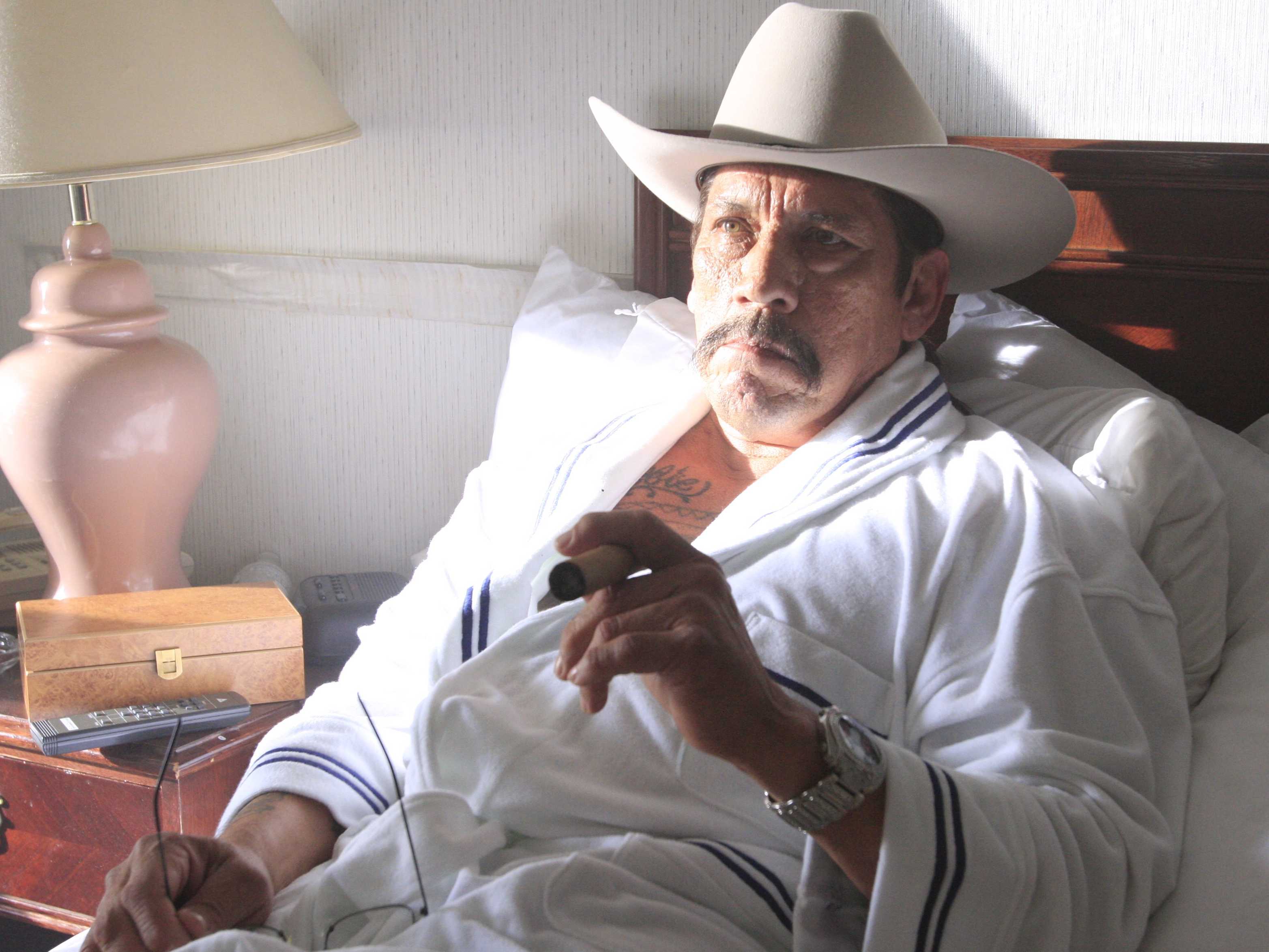
Danny Trejo. Just saying the name brings up images of leather vests, machetes, and that weathered face that looks like a topographical map of a desert canyon. When he showed up in Breaking Bad, fans lost their minds. It felt right. But here is the thing: his stint was short. Really short.
He didn't need seasons of character development to leave a scar on the show's legacy. He just needed a tortoise.
In the gritty world of Vince Gilligan’s Albuquerque, Trejo played Tortuga. He was a cartel informant with a big mouth and an even bigger ego. Most actors would have played him as a sniveling rat. Trejo? He played him with this weird, laid-back arrogance that made his eventual, gruesome exit feel like a genuine shock to the system. People still talk about that scene in "Negro y Azul" like it happened yesterday. It’s one of those "where were you when you saw it" moments in television history.
Why the Breaking Bad Danny Trejo Cameo Changed Everything
Before Tortuga, the cartel felt like a distant, looming shadow. We knew they were bad. We knew they were dangerous. But Danny Trejo in Breaking Bad gave the cartel a face—and then a very literal lack of a body.
His character, Tortuga, was a high-level guy within the Juan Bolsa organization. He was "the tortoise" because he took his time, but he always won. Except, well, he didn't.
Vince Gilligan and the writing team knew exactly what they were doing when they cast Trejo. By hiring one of the most recognizable "tough guys" in Hollywood history, they signaled to the audience that no one was safe. If Danny Trejo—the guy who survived Con Air and Heat—could be taken out that easily, then Walter White and Jesse Pinkman were playing a game they had no hope of winning. It raised the stakes instantly.
The show needed that. At that point in season two, Walt was still a chemistry teacher playing dress-up as a drug dealer. Seeing what happened to a seasoned veteran like Tortuga served as a massive reality check. It wasn't just a guest spot; it was a tonal shift.
The Mechanics of the Tortoise Scene
Let's talk about the logistics of that decapitated head.
In the episode "Negro y Azul," DEA agent Hank Schrader is struggling with PTSD in El Paso. He’s out in the desert with a bunch of local agents who think he’s a joke. Then, they see it through the binoculars. A tortoise walking through the sand. On its back? Danny Trejo’s severed head.
It’s iconic.
The special effects team, led by Greg Nicotero (who would later go on to basically run The Walking Dead), had to create a mold of Trejo’s head. It had to look heavy. It had to look real. When the tortoise walks by and the head explodes because it’s rigged with C4, it’s not just a jump scare. It’s a statement of intent. The cartel isn't just killing people; they’re sending messages.
Trejo has often joked in interviews about how he has "died" more than almost any other actor in Hollywood. He’s fine with it. Honestly, he seems to love it. He once mentioned that if he’s the bad guy, he has to die, because that’s the moral of the story. In Breaking Bad, his death was the catalyst for Hank’s entire character arc regarding his mental health and his fear of the border.
The Real-Life Background of the World's Favorite Bad Guy
You can't talk about Danny Trejo in Breaking Bad without looking at the man himself. His life is crazier than any script.
He spent years in and out of California prisons like San Quentin and Folsom. He was a champion boxer in the yard. He got clean. He became a drug counselor. He literally stumbled into acting while trying to help a kid on a film set stay away from cocaine.
When he appeared as Tortuga, he brought that lived-in energy. You can't fake the way he stares at a camera. When Tortuga is sitting in that bar, bragging about his connections and asking for an "Edgar Allan Poe" (a poet/payday), he feels like a guy who has actually spent time in the shadows. Because he has.
Most people don't realize that Trejo actually returned for a flashback in season three. In the episode "I.F.T.," we see the lead-up to his execution. We see him sitting with Juan Bolsa and the Cousins (the silent, terrifying Salamanca twins). It’s a masterclass in tension. He’s trying to play it cool, but you can see the walls closing in.
What Most People Get Wrong About Tortuga
There is a common misconception that Tortuga was a "good guy" because he was working with the DEA.
Let's be clear: Tortuga was a criminal. He was selling out his friends because he wanted to be the top dog. He was greedy. He thought he was smarter than the Cousins. That’s the irony of his name. He thought his slow, methodical betrayal would go unnoticed.
The writers used him to show the gray areas of the drug war. The DEA wasn't working with a saint; they were working with a monster to catch a bigger monster. Hank’s disgust with the whole situation is palpable.
Another weird detail? People often forget that Trejo’s head was mounted on a real tortoise. They had to be incredibly careful with the animal. They didn't just glue a fake head to a shell. They used a harness and made sure the weight was distributed so the tortoise wasn't harmed. It’s a weirdly wholesome behind-the-scenes fact for such a gruesome scene.
Trejo’s Legacy in the "Gilliverse"
Even though he was only in two episodes, Trejo’s impact is felt through the rest of the series and even into Better Call Saul. He established the "rules" of the cartel:
- Betrayal is a death sentence.
- The message is more important than the kill.
- Don't underestimate the quiet guys (like the Cousins).
If you watch Better Call Saul, you see the groundwork for the world Tortuga inhabited. You see the power struggles that eventually led to his head ending up on a turtle. It makes his brief appearance in the original series feel even more significant. He was a small cog in a massive, bloody machine.
How to Appreciate the Tortuga Arc Today
If you're re-watching the show, pay attention to the lighting in Trejo’s scenes.
In "Negro y Azul," the sun is oppressive. Everything is yellow and washed out. It feels hot. It feels like something is rotting. When we finally see Tortuga, he’s the only thing that looks cool and collected. That contrast is intentional. He thinks he’s untouchable.
Then, compare that to his flashback in "I.F.T." The lighting is cooler, more clinical. The dread is higher. You see the moment he realizes the tortoise isn't going to win the race this time.
Honestly, Trejo is the king of the "memorable death." Whether it’s getting his head blown up on a tortoise or his legendary exit in Heat, he knows how to go out with a bang.
Final Insights for Fans
If you want to really dive into the history of this character and the actor, here are the steps you should take:
- Watch the "Inside Breaking Bad" featurettes: The crew goes into detail about the prosthetic head and how they managed to sync the tortoise's movements with the shot.
- Read Danny Trejo's autobiography: It’s called Trejo: My Life of Crime, Redemption, and Hollywood. It gives incredible context to why he plays these roles with such authenticity.
- Re-watch Season 2, Episode 7 and Season 3, Episode 3 back-to-back: Seeing the death and then the "why" behind it provides a much more cohesive look at the character than seeing them months apart.
- Check out the "Negro y Azul" music video: The Narcocorrido that opens the episode mentions the cartel's reach and sets the stage for Tortuga’s downfall.
Danny Trejo in Breaking Bad remains a high-water mark for the show's ability to use celebrity cameos without breaking the immersion. He wasn't Danny Trejo the movie star; he was Tortuga, the man who moved too slow and paid the ultimate price. In a show filled with monsters, he managed to be one of the most memorable, even if he spent half his screen time as a prop.
The lesson of Tortuga is simple: in the world of Heisenberg, even the biggest legends can lose their heads. It’s a brutal, necessary reminder of the stakes that made the show a masterpiece. Don't just look at the explosion; look at the character work that made you care about the head on the turtle in the first place. That is the real magic of Trejo's performance.