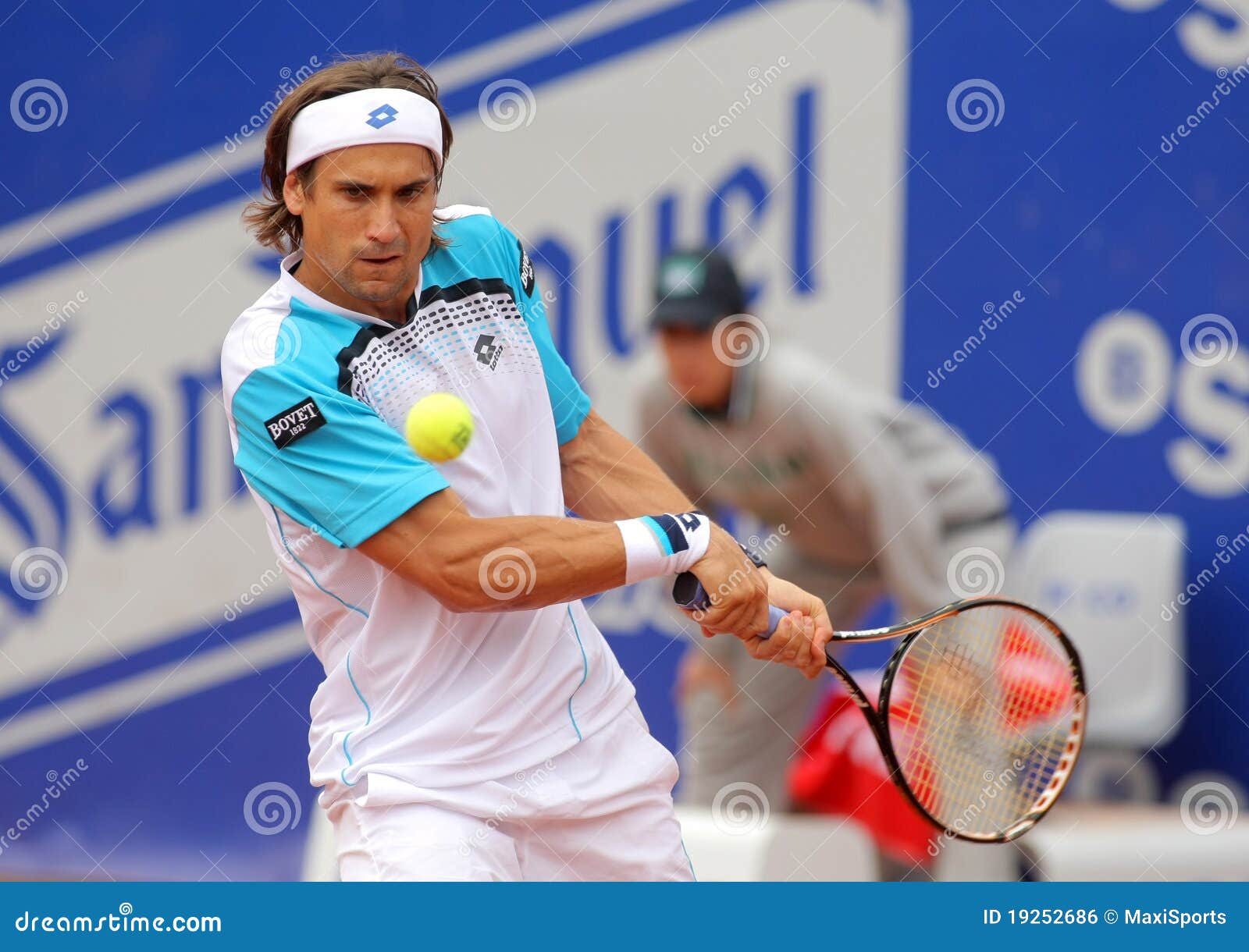
If you were watching tennis in the mid-2010s, you saw a guy who looked like he was running for his life in every single point. That was David Ferrer. He didn't have the effortless glide of Federer or the physics-defying slide of Djokovic. He just had a motor that wouldn't quit and a pair of legs that seemed to be made of reinforced steel. People called him "The Little Beast" (Ferru), and honestly, it’s the most accurate nickname in sports history.
You've probably heard the "best player never to win a Slam" debate a million times. Usually, Ferrer’s name is at the top of that list. But calling him that feels like a backhanded compliment, doesn't it? It ignores the fact that he managed to climb to World No. 3 in an era where three of the greatest players to ever touch a racket were gatekeeping every trophy. He didn't just participate; he made their lives miserable.
The Closet, the Construction Site, and the Comeback
Most people think pro athletes are born with a silver racket. Not this guy. There’s a legendary—and totally true—story about his teenage years that sounds like something out of a gritty movie. His longtime coach, Javier Piles, once got so fed up with Ferrer’s lack of focus during practice that he locked him in a dark, 2x2 meter equipment closet.
He stayed there for hours with nothing but a bit of bread and water.
Understandably, the young David Ferrer was done. He quit. He literally went to work on a construction site for a week to see what "real" work felt like. It took exactly seven days of hauling bricks in the Spanish sun for him to realize that running around a tennis court wasn't so bad after all. He went back to Piles, apologized, and the rest is history. That week on the job site basically forged the work ethic that defined his entire career. He never complained about a long match again. Why would you, when you've spent ten hours a day doing manual labor?
Breaking Down the David Ferrer Tennis Player Blueprint
What made him so dangerous? It wasn't power. Standing at 5'9", he was usually the smallest guy on the court. In a sport where 6'4" is the new average, Ferrer was a statistical anomaly. He survived—and thrived—on a diet of:
- Insane Fitness: He didn't just run; he sprinted to balls he had no business reaching.
- The Return of Serve: Since he couldn't blast 140mph aces, he had to break you. He was consistently at the top of the leaderboard for return games won.
- Mental Torture: Playing Ferrer was like trying to hit a wall that hits back. Eventually, opponents would just crack because they were tired of hitting "winners" that kept coming back over the net.
He won 27 titles. That’s more than most "Hall of Fame" players. His biggest moment was probably winning the Paris Masters in 2012. It was a massive deal because, at the time, the Big Four (Federer, Nadal, Djokovic, Murray) were winning every single Masters 1000 event. Ferrer breaking that streak at age 30 was a huge "told you so" to everyone who thought he’d never win a big one.
The 2013 French Open: A Bittersweet Peak
The 2013 French Open was the pinnacle. He reached the final without dropping a single set. Think about that for a second. In a draw full of the world's best clay-courters, he was untouchable for two weeks.
Then he ran into Rafael Nadal.
Look, losing to Rafa at Roland Garros isn't a failure—it's an inevitability for 99% of the tour. Ferrer lost in straight sets (6-3, 6-2, 6-3), but the scoreline doesn't tell the whole story. The match was interrupted by a protester with a flare, it was raining, and the tension was thick. Ferrer fought, but Nadal on clay is a different species. Still, that final cemented Ferrer’s legacy. He finally got his moment on the biggest stage in his home country's favorite sport.
What’s He Doing Now? (Life in 2026)
If you’re wondering where he is today, he hasn't exactly slowed down. He just traded the racket for a clipboard. As of early 2026, he’s still a massive figure in Spanish tennis. He spent six years as the Tournament Director for the Barcelona Open (the Trofeo Conde de Godó), but he actually just stepped down from that role after the 2025 edition to focus on other things.
The big one? Davis Cup Captain.
Ferrer took over the Spanish Davis Cup team in late 2022. It’s a perfect fit. He was always a "team first" guy, helping Spain win the trophy in 2008, 2009, and 2011. Just recently, in November 2025, he led a short-handed Spanish squad all the way to the Davis Cup final in Italy. They lost a heartbreaker to the Italians, but Ferrer’s leadership was the talk of the tournament. He managed to get incredible performances out of guys like Jaume Munar even when Carlos Alcaraz was sidelined with an injury.
He also runs the Ferrer Tennis Academy in Alicante. He’s basically molding the next generation of "Beasts" using the same principles he learned in that tiny equipment closet decades ago.
The Weird Federer Stat Everyone Forgets
You want a truly bizarre stat? Ferrer has a winning or respectable record against almost everyone... except Roger Federer.
He played Federer 17 times. He lost all 17.
It’s one of the strangest head-to-heads in tennis history. He could beat Nadal on clay (he did it 6 times). He could beat Djokovic (5 times). But for some reason, Federer’s variety and slice just neutralized everything Ferrer wanted to do. It’s a reminder that even the most relentless "Gladiator" has an Achilles' heel.
Why You Should Care About His Legacy
In a world obsessed with GOAT debates and Grand Slam counts, David Ferrer is a reminder that excellence isn't just about the trophy case. It’s about the process. He was the ultimate "overachiever" in a sport that usually rewards natural giants.
If you're looking for actionable takeaways from Ferrer's career, it’s basically this:
- Preparation is the only equalizer. If you aren't the biggest or most talented person in the room, you have to be the fittest and the best prepared.
- Short-term memory is a superpower. Ferrer lost a lot of big matches to the Big Three. He’d wake up the next day and practice harder. He didn't let the losses define his worth.
- Respect the grind. Whether it's a construction site or a baseline rally in the fifth set, your attitude toward the "boring" work determines your ceiling.
David Ferrer didn't need a Wimbledon trophy to prove he belonged. He proved it every time he chased down a ball that everyone else had given up on. If you're a young player today, don't just watch Alcaraz’s highlights—watch Ferrer’s footwork. That’s where the real lessons are.
Next Steps for Tennis Fans:
If you want to see the "Little Beast" in action today, keep an eye on the 2026 Davis Cup Qualifiers. Spain is set to face either Chile or Serbia in the second round, and Ferrer’s tactical mind will be front and center as he tries to bring the trophy back to Spain. You can also visit his academy in La Nucía if you’re looking for a training camp that emphasizes his signature "never-say-die" defensive style.