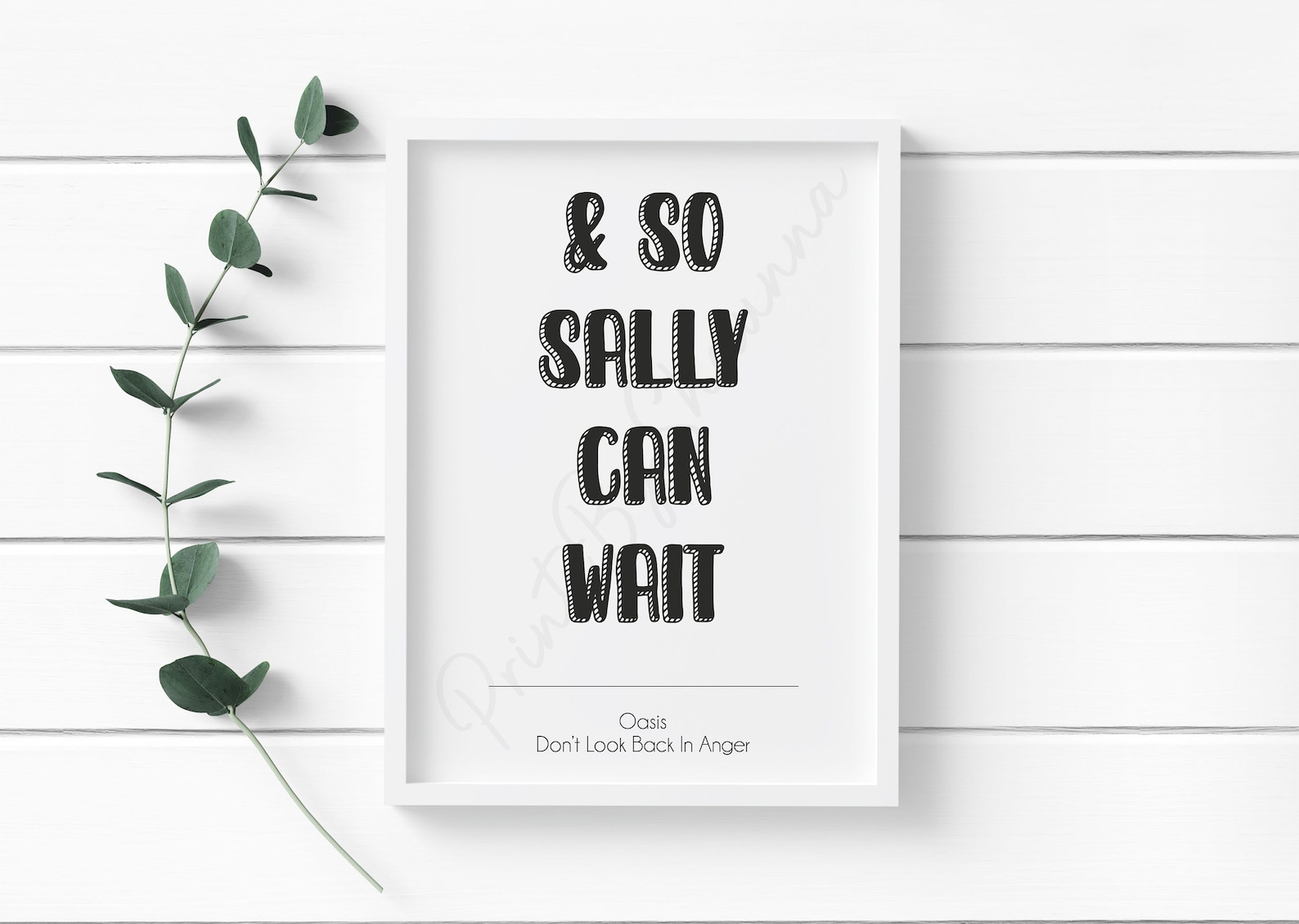
You've heard it a thousand times. That piano opening—stolen straight from John Lennon’s "Imagine"—kicks in, and suddenly you’re in a 1990s time capsule. It is the definitive anthem of Britpop. But here’s the thing: people rarely call it by its actual name. They search for the Sally can wait song because that specific line carries more weight than the actual title, "Don't Look Back in Anger."
It’s a weirdly personal song for something written by a guy who, at the time, was mostly known for being a loudmouthed rockstar from Manchester. Noel Gallagher wrote it. Liam Gallagher sang… well, actually, Liam didn't sing this one. This was the first time Noel took the lead on a single, and it changed the trajectory of Oasis forever.
Who is Sally anyway?
Let's get the biggest mystery out of the way. If you’re looking for a real-life Sally who broke Noel's heart, you’re going to be disappointed.
There isn't one.
Noel has admitted in multiple interviews, most notably with Clash Magazine and during his Lock the Box sessions, that "Sally" was just a word that fit the meter of the verse. During a soundcheck in Paris, Noel was humming the melody. He didn't have the lyrics yet. Liam, sitting nearby, shouted out, "Is that 'Sally can wait'?" Noel liked the way it sounded. He kept it.
It’s a classic example of "phonetic songwriting." The vowels matter more than the dictionary definition. But that hasn't stopped millions of fans from projecting their own lives onto her. To some, Sally is a woman who missed her chance. To others, she’s a personification of the past itself, sitting there and waiting for you to stop obsessing over what went wrong.
The Verve, the Vibes, and the 1995 Sessions
The Sally can wait song didn't just appear out of thin air. It was recorded at Rockfield Studios in Wales during the What's the Story (Morning Glory)? sessions. The atmosphere was chaotic. The Gallagher brothers were at each other's throats.
Noel gave Liam a choice. He said, "You can sing 'Wonderwall' or you can sing this." Liam chose "Wonderwall." Noel took "Don't Look Back in Anger." It was a pivotal moment. It proved Noel wasn't just the "brains" behind the scenes; he was a frontman in his own right.
The song captures a specific type of British nostalgia. It feels like a rainy Tuesday in Manchester, but somehow hopeful. It’s got that "Life’s a bit rubbish but we’re all in it together" energy. That’s why it became a secular hymn.
Why the "Imagine" Piano Intro?
If you think the intro sounds like John Lennon, you’re right. It’s a blatant tribute. Noel Gallagher has never been shy about "borrowing" from his idols. He calls it an "homage." Critics call it something else.
But it works because it grounds the song in musical history. By the time you get to the chorus—the part where everyone screams about Sally—you’ve already been primed by the familiarity of that piano. It feels like a song you've known your entire life, even the first time you hear it.
The lyrics are mostly nonsense, honestly. "Take me to the place where you go / Where nobody knows if it's night or day." What does that even mean? It doesn't matter. You feel it. The imagery of "standing on the edge of the porch of my mind" is nonsense poetry at its best. It creates a mood of psychedelic reflection that fits the mid-90s drug culture without being explicitly about drugs.
The 2017 Manchester Connection
The Sally can wait song took on a much heavier meaning in 2017. Following the tragic bombing at the Manchester Arena, a crowd gathered at St. Ann’s Square for a vigil.
A woman named Lydia Bernsmeier-Rullow started singing it softly. Then the whole crowd joined in.
It wasn't a party anthem anymore. It was a defiant stance against grief and hatred. When thousands of people sing "Don't look back in anger" in the face of tragedy, the song transcends Britpop. It becomes a piece of cultural armor. Noel Gallagher later said he was moved to tears by the footage, noting that the song now belonged to the city of Manchester more than it belonged to him.
The Evolution of the Live Performance
If you see Noel Gallagher's High Flying Birds today, he usually plays an acoustic version. It’s slower. Stripped back. He lets the audience sing the chorus.
- 1996: Electric, loud, arrogant, full of swagger.
- Present Day: Melancholic, communal, a shared memory.
The way the song has aged is fascinating. It hasn't become a "golden oldie" that feels dated. Instead, it has gathered more weight. The "Sally" in the lyrics has become every person who ever waited for a life that didn't quite happen the way they planned.
Technical Brilliance in Simplicity
Musically, the song is a masterclass in C Major. It’s easy to play on guitar, which is why every teenager in 1996 learned it. But the arrangement is what makes it "big."
The way the drums kick in after the first verse is iconic. Alan White’s drumming provided a swing that the band’s previous drummer, Tony McCarroll, probably couldn't have captured. It’s got a "stadium" scale to it. It’s designed to be heard from the back of a field with 125,000 people, which is exactly what happened at Knebworth.
The solo is also pure Noel Gallagher. It isn't technically complex. It’s melodic. You can hum the guitar solo. That is the secret to a great pop-rock song—when the instruments are just as "singable" as the vocals.
Common Misconceptions About the Lyrics
People argue about the "Lennon" references all the time.
"So I start a revolution from my bed."
That’s a direct nod to John and Yoko’s Bed-In for Peace. Noel was obsessed with the Beatles. But he was also obsessed with the idea of being a working-class hero. The song bridges that gap. It takes the high-art concepts of the 60s and drags them into the pubs of the 90s.
Some fans think the song is about a specific breakup. It isn't. Noel was actually in a pretty good place when he wrote it. He was just trying to write a song that sounded "important." He succeeded.
Impact on the Britpop Narrative
Without the Sally can wait song, the "Battle of Britpop" between Oasis and Blur might have looked very different. While Blur was doing clever, satirical songs about "Country House" living, Oasis was doing something earnest.
They weren't trying to be clever. They were trying to be massive.
This song was the peak of that ambition. It’s the centerpiece of an album that sold over 22 million copies. It defined an era of "Cool Britannia" where British guitar music was the center of the universe.
Even now, in a world of streaming and TikTok hits, "Don't Look Back in Anger" pulls numbers. It’s a staple on "All-Time Greats" playlists. It’s the song that plays at 2:00 AM in every Irish pub from Boston to Bangkok.
How to Appreciate the Song Today
To really get why this song still hits, you have to listen to the remastered 2014 version. The production on the original 1995 release was famously "compressed"—everything was turned up to 11 to sound good on the radio. The remaster lets the layers breathe.
Listen for the mellotron. Listen for the way the backing vocals (all Noel) layer up in the final chorus. It’s a much more sophisticated piece of studio work than the "lads with guitars" reputation suggests.
What you should do next:
- Listen to the "G-Mex 1997" live version. It’s arguably the most "Oasis" performance of the song ever recorded—loud, slightly out of tune, and absolutely electric.
- Check out the "Lock the Box" interview. If you want to hear Noel Gallagher himself explain how he "stole" the bits and pieces to make this track, it’s a goldmine for music nerds.
- Learn the chords. If you play guitar, the chord progression (C, G, Am, E, F, G, C) is a foundational lesson in how to use a "passing" E major chord to create emotional tension.
- Watch the music video. It features Patrick Macnee (from The Avengers). It makes absolutely no sense in relation to the lyrics, which is very 90s.
The Sally can wait song is more than just a radio hit. It’s a piece of cultural furniture. You might not notice it’s there all the time, but the room would feel empty without it. Whether Sally is a person, a memory, or just a rhyme for "late," she’s stayed in our collective heads for thirty years. And honestly? She’s probably going to stay there for another thirty.
The next time it comes on the radio, don't change the channel. Let the piano play. Scream the chorus. And whatever you do, don't look back in anger.