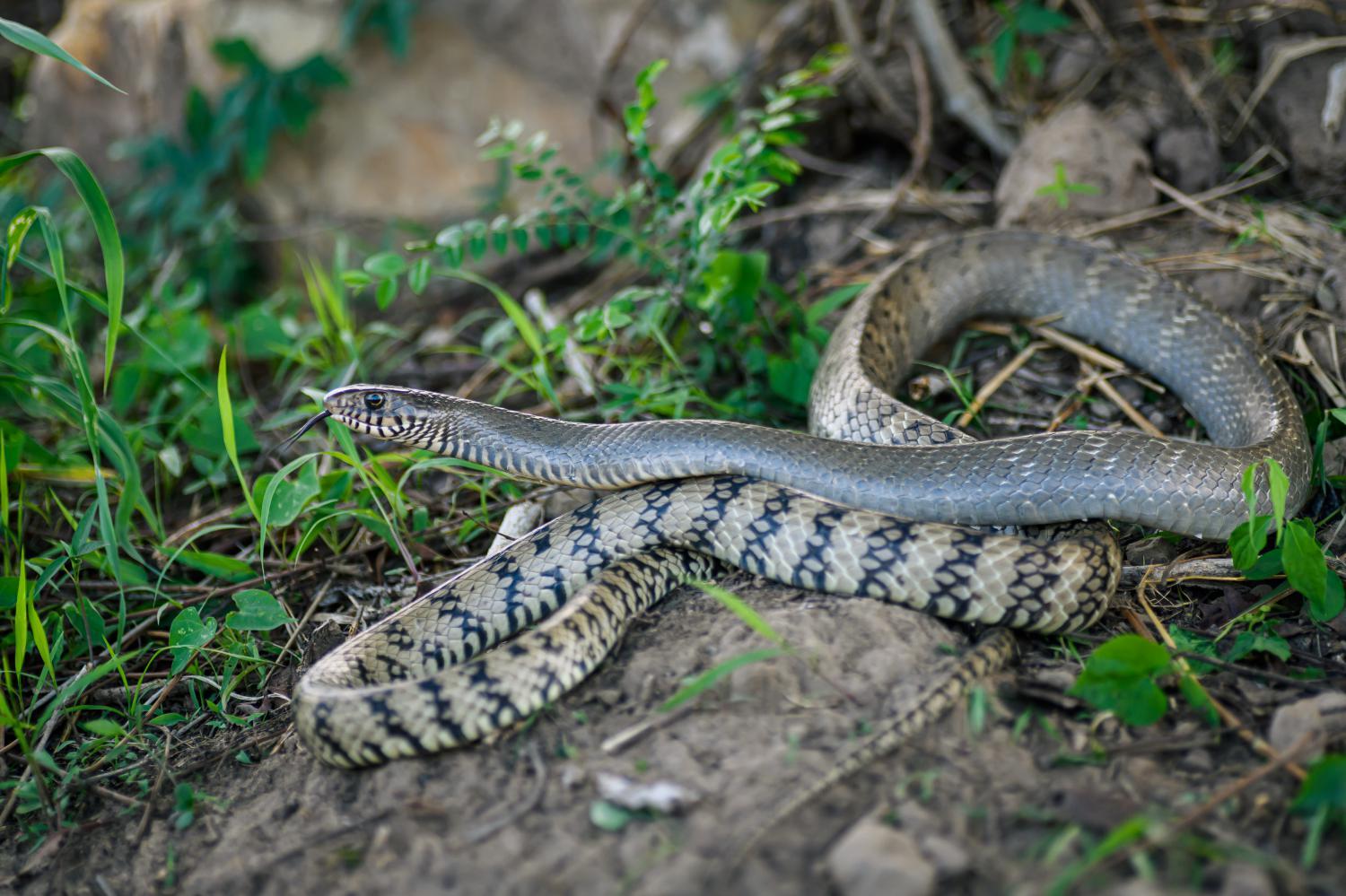
You’re staring at a tangled coil near your garden shed. It’s dark, it’s long, and your heart is currently doing a drum solo against your ribs. Naturally, the first thing you do is whip out your phone to find an image of rat snake species to see if you’re dealing with a friend or a hospital bill. Most people panic. They see a large, dark serpent and immediately jump to "Black Mamba" (unlikely in Ohio) or "Water Moccasin" (possible, but maybe not).
Rat snakes are arguably the most common "scary" snake people encounter in North America. They’re everywhere. From the suburban sprawl of Georgia to the rocky woods of New England, these guys are the ultimate opportunistic survivors. They climb brick walls. They hang out in rafters. Honestly, if you find a snake in a place where a snake shouldn't be—like a birdhouse ten feet off the ground—it’s probably a rat snake.
Why that image of rat snake you found looks so weird
One of the biggest frustrations when looking at an image of rat snake online is the sheer variety. They don't all look the same. Not even close. Depending on where you live, a "rat snake" could be jet black, bright orange, or covered in gray blotches. Taxonomists actually threw the whole Elaphe genus into a blender a few years back, reclassifying most North American species into the genus Pantherophis.
Take the Eastern Rat Snake (Pantherophis alleghaniensis). If you’re in the deep South, specifically Florida, these guys are often yellow with dark longitudinal stripes. They look nothing like the "Black Rat Snakes" people talk about in the North. If you go further west into Texas, you hit the Texas Rat Snake, which is often a muddy brown with darker blotches and a white or cream-colored belly.
The "Kink" Factor
Ever see a snake that looks like it’s been bent in several places like a crooked stick? That’s a classic rat snake move. When they feel threatened or just want to blend into a leafy background, they "kink" their bodies. It breaks up their silhouette. If you see a photo of a snake that looks like a series of right angles, you can almost guarantee it’s a member of this family.
Identifying the Black Rat Snake vs. The Racer
This is where everyone gets confused. In much of the Eastern U.S., you have two big, black snakes: the Black Rat Snake (now mostly referred to as the Central Rat Snake, Pantherophis spiloides) and the Northern Black Racer (Coluber constrictor).
Racers are sleek. They’re fast. They look like they’ve been polished with car wax. Their scales are smooth, giving them a matte or slightly satiny finish. Rat snakes, however, have weakly "keeled" scales. This means there’s a tiny ridge down the center of each scale, making them feel a bit rougher and look less shiny than a racer.
Another dead giveaway is the chin. Look at an image of rat snake head-on. They almost always have a white or cream-colored chin and throat. Racers have this too, but the rat snake’s belly is usually checkered with white and black or gray, especially near the head. Also, rat snakes are much thicker. A five-foot racer is like a piece of rope; a five-foot rat snake is like a sturdy garden hose.
The "Is it a Copperhead?" Panic
Let’s be real. Nobody looks for an image of rat snake because they’re curious about herpetology; they do it because they’re terrified there’s a Copperhead in their mulch.
Juvenile rat snakes are the primary victims of this identity crisis. While adults might turn solid black or gray, baby rat snakes are heavily patterned with dark blotches on a lighter gray background. To the untrained eye, this looks like the "hourglass" or "Hershey kiss" pattern of a Copperhead.
But look closer.
- The Head Shape: Rat snakes have a "loaf of bread" shaped head. It’s slightly distinct from the neck, but not overly dramatic. Copperheads have a distinct, broad, triangular head characteristic of pit vipers.
- The Eyes: This is a big one. Rat snakes have round pupils. Copperheads have vertical, cat-like slits. If you're close enough to see the pupils, though, you're probably closer than you need to be.
- The Tail: If it’s a baby, look at the tip of the tail. Baby Copperheads have a bright sulfur-yellow or chartreuse tail tip used to lure frogs. Baby rat snakes have a boring, camouflaged tail.
Behavior that scares people (but shouldn't)
Rat snakes are performers. If you corner one, it’s going to try to convince you it’s a rattlesnake. They will vibrate their tails against dry leaves, creating a buzzing sound that is shockingly similar to a real rattler. They’ll also puff up their heads to look bigger and hiss.
They’re also the world’s best climbers. I once saw a photo of a rat snake going straight up the corner of a brick house. No ledges. No grip. Just pure muscle pressing into the microscopic texture of the brick. They do this to raid bird nests or find squirrels in attics. If you see an image of rat snake dangling from a gutter, don't worry—he’s just looking for breakfast, not a way into your bedroom.
The real value of having them around
You might not want a six-foot serpent in your garage, but having a rat snake on your property is basically free pest control. They are named "rat snakes" for a reason. They have an incredible metabolism and can decimate a local population of mice or rats in a single season.
A study by the Savannah River Ecology Laboratory highlighted how these snakes are vital for keeping rodent-borne diseases in check. They don't just eat the rodents; they outcompete other, perhaps less desirable, predators for that food source.
What to do if you find one
- Give it space. Most "attacks" happen when a human tries to move or kill the snake.
- Spray it with water. If it’s on your porch and you want it gone, a gentle mist from a garden hose will usually make it move along.
- Check for entry points. If you find one inside, it followed the scent of a mouse. You don't have a snake problem; you have a rodent problem that the snake was trying to fix.
Moving forward with your ID
If you're still looking at that image of rat snake and you're not 100% sure, look at the environment. Is it near water? Is it in a tree? Rat snakes are generalists, but they love verticality.
Next Steps for Identification:
- Compare the snake's length to nearby objects; rat snakes can easily top five feet, making them some of the longest snakes in the U.S.
- Look for the "kinked" body posture, which is a signature of the Pantherophis genus.
- Check the belly pattern if possible—black and white "checkered" scales are a classic indicator of a Central or Eastern rat snake.
- Observe the scales; if they look "grainy" or have a ridge (keeled) rather than being perfectly smooth and shiny, you're likely looking at a rat snake rather than a racer.
- Search for local herpetology groups on social media; these communities are usually incredibly fast at providing a definitive ID based on a single photo.