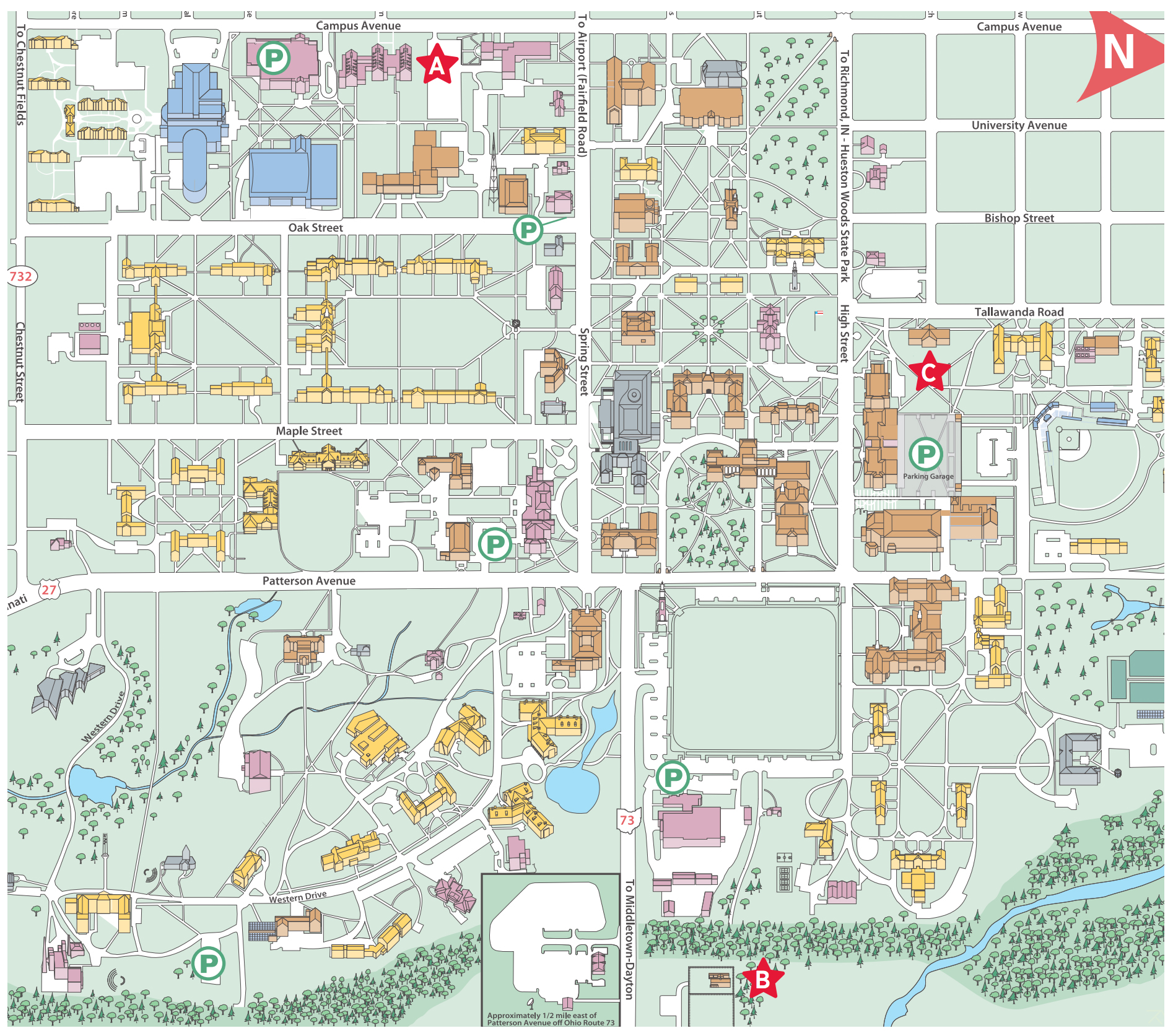
You’re standing in the middle of the Foote Green. It’s 92 degrees, the humidity feels like a wet wool blanket, and you’re pretty sure your next meeting is in a building that doesn't actually exist. Or maybe it does, but the university of miami campus map you pulled up on your phone is spinning in circles because the GPS near the Shalala Student Center is acting glitchy. Welcome to Coral Gables.
It’s a gorgeous campus. Honestly, the "Sunbelt Ivy" reputation makes sense when you see the Lake Osceola fountain catching the light, but the layout is a beast if you aren't prepared. The University of Miami (UM) isn't just one big square of grass. It’s 239 acres of winding paths, hidden courtyards, and a surprising amount of palm trees that all look identical when you’re lost.
If you're a freshman, a visiting parent, or a local just trying to find the Lowe Art Museum without getting a parking ticket, you need more than just a PDF. You need to understand the logic of the place.
Why the Digital University of Miami Campus Map is Your Only Real Hope
Don't bother with those printed brochures they hand out at orientation. Seriously. They’re outdated the second the ink dries. The university moves fast. Construction on the Centennial Village or renovations at the Knight Physics Building can turn a shortcut into a dead end overnight.
The official interactive map is the gold standard here. It’s hosted on the ArcGIS platform, which is basically the Ferrari of mapping software. You can toggle layers for everything: accessible entrances, gender-neutral bathrooms, bike racks, and even where the "Hurry 'Canes" shuttle stops are currently located. It’s responsive. It works on your phone. But more importantly, it shows you the "Zones."
UM is split into distinct neighborhoods. The Coral Gables campus has the academic core, the residential lakeside, and the athletic facilities near the Watsco Center. If you think you can walk from the Rosenstiel School on Virginia Key to the Gables campus, think again. That’s a common mistake for newbies who don't realize the "campus" is actually spread across three main sites in Miami-Dade County.
Decoding the Gables: The Main Hub
Most people looking for the university of miami campus map are focused on the Coral Gables site. This is the heart of the "U."
The Richter Library is your North Star. It’s massive. If you can see the library, you know where you are. To the north, you’ve got the Memorial Building and the older, more traditional academic halls. To the south, you hit the residential colleges. Stanford and Hecht are the big names there, though the new housing projects are rapidly changing the skyline of the campus.
Let's talk about the "U" statue. It’s right by the bookstore and the Shalala Student Center. This is the ultimate meeting spot. If someone tells you "Meet me at the U," this is where they mean. Navigating this area is easy because it’s heavily pedestrianized, but be careful—the skateboards and electric scooters fly through here.
The Lake Osceola Loop
Lake Osceola is the center of the universe at UM. It’s not just for scenery. The path around the lake is the primary artery for getting between the Whitten University Center and the Cox Science Center.
If you’re using the map to find a specific lab, check the building codes. UM loves its four-letter abbreviations. "ASHE" is the Ashe Administration Building. "MCM" is the McArthur Engineering Building. If your schedule says "UNGAR," you’re heading to the Ungar Building on the northeast side of the lake. It's a bit of a hike from the dorms, so leave early.
Parking: The Map's Greatest Lie
Okay, maybe not a "lie," but the university of miami campus map makes parking look way easier than it actually is.
Look at the color coding on the parking maps. It’s strict.
- Pink/Purple zones are usually for faculty and staff.
- Yellow/White zones are for students, depending on the permit.
- Visitor parking is primarily in the Pavia and Levante Garages.
Do not park in a permit spot without a permit. The UM parking enforcement is legendary. They move fast. They will find you. If you're a visitor, just head straight for the Pavia Garage near the Lowe Art Museum. It’s central, usually has space, and saves you from the frustration of circling the surface lots near the intramural fields.
The "Other" Campuses You Might Forget
The university of miami campus map isn't just one map. It’s a trilogy.
- The Medical Campus (Miller School of Medicine): This is located in the Health District (Overtown/Civic Center area). It’s dense, urban, and frankly, a bit confusing. You’ve got Jackson Memorial Hospital, UHealth Tower, and the Schoninger Research Quadrangle all packed together. If you’re going there, use the Metrorail. The "Civic Center" station drops you right at the doorstep.
- The Marine Campus (RSMAS): This is out on Virginia Key. It’s gorgeous. It’s right across from the Miami Seaquarium. The map for this site is simple because it’s smaller, but you need a car or the shuttle to get there from the Gables.
- South Campus: This is a bit further out in Richmond Heights. It’s mostly used for research and isn't a place typical students visit daily, but it’s on the map if you’re looking for the Global Environmental Center.
Navigating the "Hidden" Spots
Every campus has them. UM has the "Rat" (The Rathskeller), which is tucked into the Shalala Student Center building. It’s the soul of the campus. Then there’s the Gifford Arboretum, a literal forest in the middle of the academic buildings.
If you’re looking at the university of miami campus map and see a green space that looks "empty," it’s probably one of these gardens. The Arboretum is located near the Cox Science Center and is a legitimate botanical garden. It’s a great place to hide between classes if you need to escape the noise.
Then there’s the bridge. The bridge over Lake Osceola is iconic, but it’s also a bottleneck. Between 11:50 AM and 12:10 PM, it’s a sea of humanity. If you’re trying to cross the lake quickly, sometimes going around the back of the library is actually faster, even if the map says otherwise.
Accessibility and "The Cane Express"
UM has done a decent job with ADA compliance. The university of miami campus map has a specific "Accessibility" filter that highlights ramps, elevators, and power-assist doors.
If you have mobility issues, the "Hurry 'Canes" shuttle is your best friend. It’s free. It runs in a loop. There’s an app called "Ride Systems" that shows you exactly where the buses are in real-time. Don't trust the static schedule; trust the live GPS. The "Miller Circle" stop is the most popular, as it’s right by the main administrative offices.
Tips for Parents and Visitors
Coming for a tour? Don't just wander. Start at the Newman Alumni Center. It’s on the corner of San Amaro Drive and Blue Road.
- Download the "UMiami" App: It has the map integrated and includes dining hall hours.
- Check the Weather: If the map says it's a 10-minute walk, add 5 minutes for "Miami pace" and another 5 for "finding shade."
- Hydrate: There are water bottle refilling stations all over. The map usually marks these near the restrooms in the newer buildings like the Shalala Center.
Honestly, the best way to learn the campus is to get lost once. Just once. Walk past the Iron Arrow mound (the highest honor society at UM—don't walk on the mound itself, it's sacred ground). Find the secret garden behind the architecture buildings. Look at the bizarrely cool "U" benches near the law school.
Making the Map Work for You
When you're looking at the digital university of miami campus map, use the search bar. Don't scroll. If you need "Dooly Memorial," type it in. The map will drop a pin and, more importantly, give you the walking directions.
The wayfinding signage on campus has improved significantly over the last five years. Look for the silver and orange pylons. They match the digital map exactly. If the pylon says you’re in the "Lakeside" area, you can orient yourself toward the water.
Actionable Steps for Navigating UM
- Sync your schedule with the Map: Take your class list or meeting itinerary and pre-pin the locations on the Google Maps app or the UM Interactive Map.
- Bookmark the Shuttle Tracker: If you’re moving between the Gables and the Medical campus, the shuttle is essential. Keep the "Ride Systems" link open.
- Identify your "Safe Garage": If you’re a regular visitor, stick to one garage (like Pavia) so you never forget where you parked in the heat.
- Use the Metrorail: The University Station is literally across the street from the baseball stadium (Mark Light Field). It’s the easiest way to get to the campus from the airport or downtown without dealing with US-1 traffic.
- Verify the Building Code: Before you start walking, ensure you aren't confusing the "Knight Physics Building" with the "James L. Knight Center" (which is downtown). Total rookie mistake.
UM is a sprawling, tropical, sometimes chaotic place. But once you get the hang of the university of miami campus map, it starts to feel like a small town. Just a very, very warm small town with a lot of orange and green.
The most important thing to remember? The campus is designed to be walked. Put on some comfortable shoes, grab an iced coffee from the Breezeway, and just follow the lake. You’ll find where you’re going eventually, and even if you don’t, you’ll probably find a pretty cool spot to sit and watch the iguanas. Residents know the iguanas own the campus anyway; we’re just visiting.