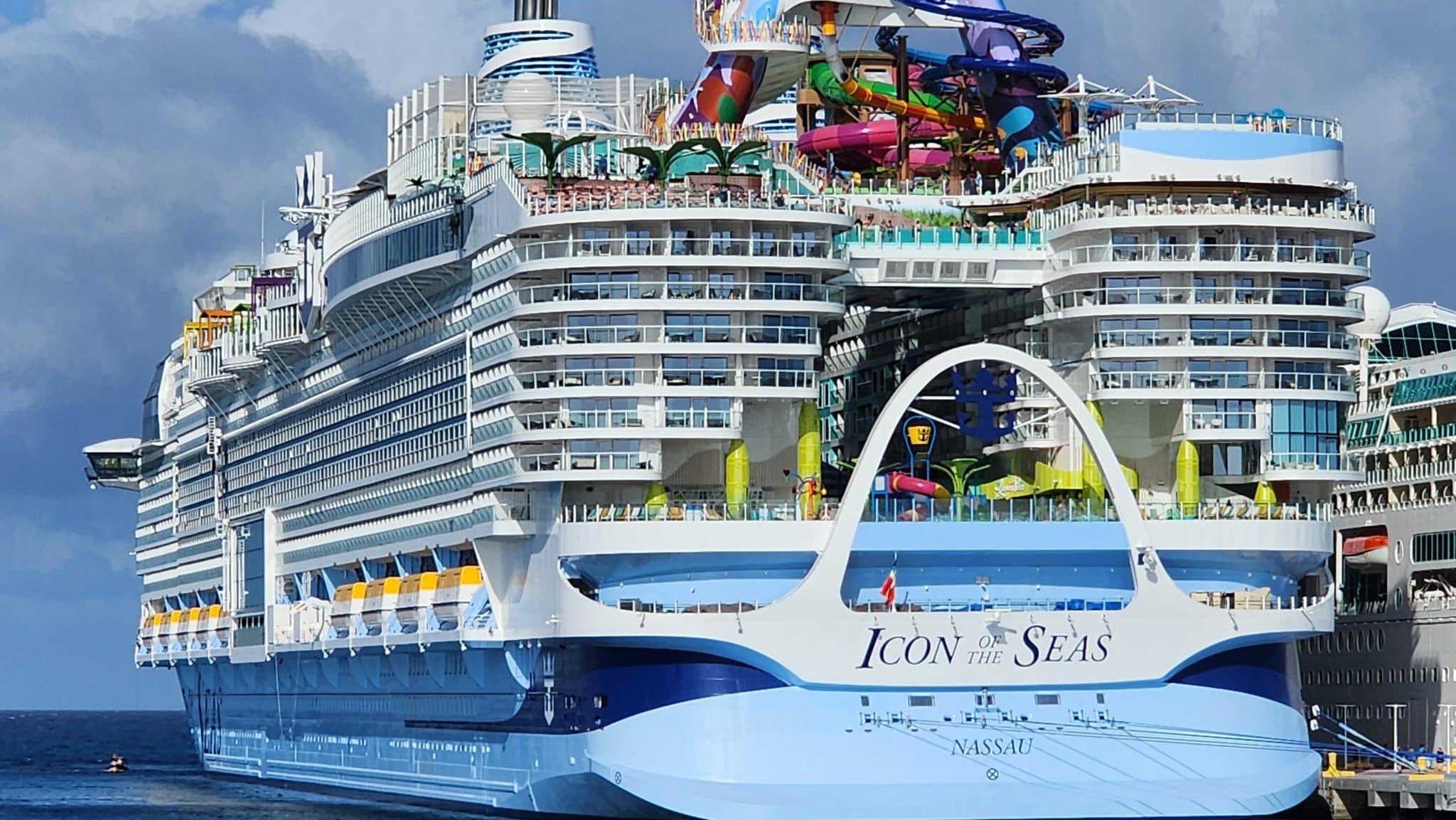
You've seen them. Those glossy, high-contrast images of Royal Caribbean cruise ships that make the water look like Gatorade Frost and the ships look like floating neon cities. It’s hard to look away. These vessels are massive. In fact, when the Icon of the Seas first started making rounds on social media, people literally thought it was a CGI fever dream. It wasn't.
I’ve spent an unhealthy amount of time staring at deck plans and high-resolution drone shots. What's wild is how much the "official" photography differs from what a passenger actually snaps on their iPhone 15 while juggling a melting soft-serve cone. There is a specific art to how these ships are documented. From the way the Wonder of the Seas is angled to hide the sheer scale of the crowds to the long-exposure shots that make the Perfect Day at CocoCay look like a private island paradise, there is always more than meets the eye.
The visual evolution from Sovereign to Icon
Back in the late 80s, the Sovereign of the Seas was the queen of the ocean. If you look at vintage images of Royal Caribbean cruise ships from that era, they look like toys compared to today. They were sleek, white, and mostly focused on the sea. Now? The ships look like they’ve swallowed a shopping mall and a waterpark.
Take the Oasis class. When Oisais of the Seas debuted in 2009, it changed the literal silhouette of what a cruise ship looks like. Suddenly, there was a hole in the middle. The "split" superstructure was a technical marvel that allowed for the Central Park area—a literal park with thousands of live plants in the middle of the ocean. If you look at a top-down aerial shot, it looks like the ship has a canyon running through it. This design choice wasn't just for aesthetics; it was a clever way to increase the number of "balcony" rooms without making the ship a solid, claustrophobic block of steel.
Then came the Icon class. Honestly, the first time I saw the renders of Icon of the Seas, I thought it looked top-heavy. It looks like a stack of colorful Legos. The "Aquadome" at the front—a massive glass and steel structure—is a 363-ton feat of engineering that completely changes the profile of the ship. It’s no longer about a "ship" shape; it’s about a "destination" shape.
Why the lighting in cruise photography is a lie (sorta)
Ever noticed how the sunset in every professional Royal Caribbean photo looks purple? Or how the pool deck is always sparkling but never has a single stray flip-flop? That’s the "hero shot." Photographers like Jeffrey Milstein, who is famous for his dead-on overhead shots of cruise ships, show the geometric beauty of these vessels, but the marketing teams at Royal Caribbean HQ use a different playbook.
They use a technique called "blue hour" photography. They shoot right after the sun goes down but before it’s pitch black. This allows the internal lights of the ship—the blues of the slides, the yellows of the cabins—to pop against the deep indigo of the sky. It makes the ship look warm and inviting.
In reality, if you take a photo at 2:00 PM on a sea day, it’s a lot of glare, a lot of sunblock-slicked skin, and maybe a stray towel or two. But that’s the charm. Real-life images of Royal Caribbean cruise ships captured by guests often show the "hidden" corners, like the Solarium at night, which is arguably the most peaceful place on the ship, even if it doesn't make the front page of the website.
The "Mega-Ship" scale problem
Scale is hard to photograph. You can say a ship is 1,188 feet long, but that doesn't mean much until you see it next to something familiar. There’s a famous photo circulating of the Icon of the Seas docked next to a smaller, older ship in Cozumel. The older ship looks like a lifeboat. It’s comical.
When you're looking for authentic images of Royal Caribbean cruise ships, search for "scale comparison" shots.
- The Wonder of the Seas has a gross tonnage of 236,857.
- The original Titanic was about 46,000.
- You could basically fit five Titanics inside one Oasis-class ship.
Seeing the Ultimate Abyss slide—a 10-story dry slide—from the aft of the ship gives you a better sense of height than any wide-angle lens ever could. The slide looks like a giant translucent sea monster clinging to the back of the vessel. It’s terrifying and beautiful at the same time.
Navigating the "Central Park" vs "Boardwalk" aesthetic
One of the coolest things about the newer Royal Caribbean designs is the "neighborhood" concept. This creates two very different visual styles within the same ship.
Central Park is all about greenery and upscale vibes. Photos here are often mistaken for a high-end hotel in Manhattan. There are over 20,000 plants on the Symphony of the Seas. The lighting is soft, the paths are winding, and there’s a distinct lack of "ocean" in the background. It’s a surreal visual disconnect.
Flip over to the Boardwalk, and it’s loud, colorful, and nostalgic. You’ve got a hand-carved carousel, the AquaTheater with its deep-dive pools, and the smell of popcorn. When people share images of Royal Caribbean cruise ships on Instagram, the Boardwalk is usually where they get those high-energy, "I'm on vacation!" shots. The contrast between the quiet green of the park and the neon flash of the boardwalk is what makes these ships so photographable.
The technical side of the glass
Let’s talk about the glass. The amount of glass used in the Quantum class—like Odyssey of the Seas—is staggering. The "North Star" is a glass observation capsule that lifts you 300 feet above the ocean. Taking photos from inside that pod gives you a perspective that was previously only available to seagulls or helicopter pilots.
But there’s a challenge: reflections. If you’re trying to get that perfect shot of the wake behind the ship from a glass balcony, the glare is your enemy. Pro tip: if you're taking your own images of Royal Caribbean cruise ships, put your phone lens directly against the glass to eliminate the bounce-back light.
What the "Ship Spotters" know
There is a whole community of people called ship spotters. These aren't casual vacationers; these are enthusiasts with 600mm lenses who wait at the Port of Miami or Port Everglades for the perfect light. They track IMO numbers and know exactly when a ship is going into dry dock for a "Royal Amplification" (the brand's term for a massive renovation).
If you want the most honest images of Royal Caribbean cruise ships, look at ship-spotting forums or sites like MarineTraffic. You’ll see the ships in all states: being tugged into port, sitting in a rainy harbor, or even the rare "dead ship" look when they are in a cold layup. It’s a reminder that these aren't just vacation resorts; they are massive, complex machines that require a small army of engineers to keep running.
Visualizing the "Perfect Day"
No discussion of these images is complete without CocoCay. Royal Caribbean spent $250 million transforming this private island in the Bahamas. The images you see of "Thrill Waterpark" with its 135-foot "Daredevil’s Peak" slide are designed to look like a tropical theme park.
The color palette here is strictly controlled. Everything is bright yellow, lime green, and teal. It’s a photographer's dream because the colors are already "pre-edited" for the human eye. But the most striking photos from CocoCay are actually the ones taken from the ship's balcony looking down at the pier. Seeing two Oasis-class ships docked side-by-side at the island is a visual representation of nearly $3 billion worth of maritime engineering sitting in one spot.
Identifying the ship by its "Tail"
If you're looking at a bunch of images of Royal Caribbean cruise ships and can't tell them apart, look at the funnel. The "Viking Crown Lounge" is the signature circular structure wrapped around the funnel. On older ships like the Vision or Radiance class, it's very prominent. On the newer, larger ships, it’s been integrated more into the deck structure, but that silhouette is still the "DNA" of the brand.
Another tell-tale sign? The "FlowRider" surf simulators. If you see a photo of someone wiping out on a continuous wave with a giant rock-climbing wall in the background, you’re looking at a Royal Caribbean ship. No one else does that specific visual combo quite like them.
Actionable ways to find and use ship imagery
If you’re planning a trip or just a maritime nerd, don't just settle for the first page of Google Images. The best stuff is buried.
- Check the "Creative Newsroom": Royal Caribbean has a specific press site where they upload high-res, b-roll, and "infographic" style photos that explain how the engines work or how much flour they use for bread (it's a lot).
- Search by "Hull Art": Some ships have specific hull designs or "Godmother" plaques that make for great detail shots.
- Look for "Dry Dock" footage: Seeing a ship out of the water, showing the massive "Azipods" (the propellers that can rotate 360 degrees), is the only way to truly understand the scale of what's beneath the waterline.
- Use hashtags wisely: Instead of just #RoyalCaribbean, try #OasisClass or #IconoftheSeas for more specific, high-quality user-generated content.
The reality is that images of Royal Caribbean cruise ships serve two purposes. They are marketing tools, yes. But they are also historical records of how we’ve pushed the limits of what can actually float. We went from basic ocean liners to floating cities that have ice skating rinks, zip lines, and robotic bartenders.
When you look at these photos, look past the bright colors. Look at the engineering of the lifeboats. Look at the way the balconies are tiered to provide wind protection. Look at the sheer number of people on the pool deck and realize that there are another 2,000 crew members below deck making it all work. That’s the real "image" of a cruise ship—the part that doesn't always make it into the frame.
Next time you see a shot of the Icon of the Seas looking like a neon skyscraper in the middle of the ocean, remember that it's a mix of incredible engineering and very clever photography. Both are impressive in their own right. If you're looking to capture your own, head to the "Secret Aft Balconies" on the Freedom-class ships for the best unobstructed view of the wake—it's the one shot the pros always try to get.