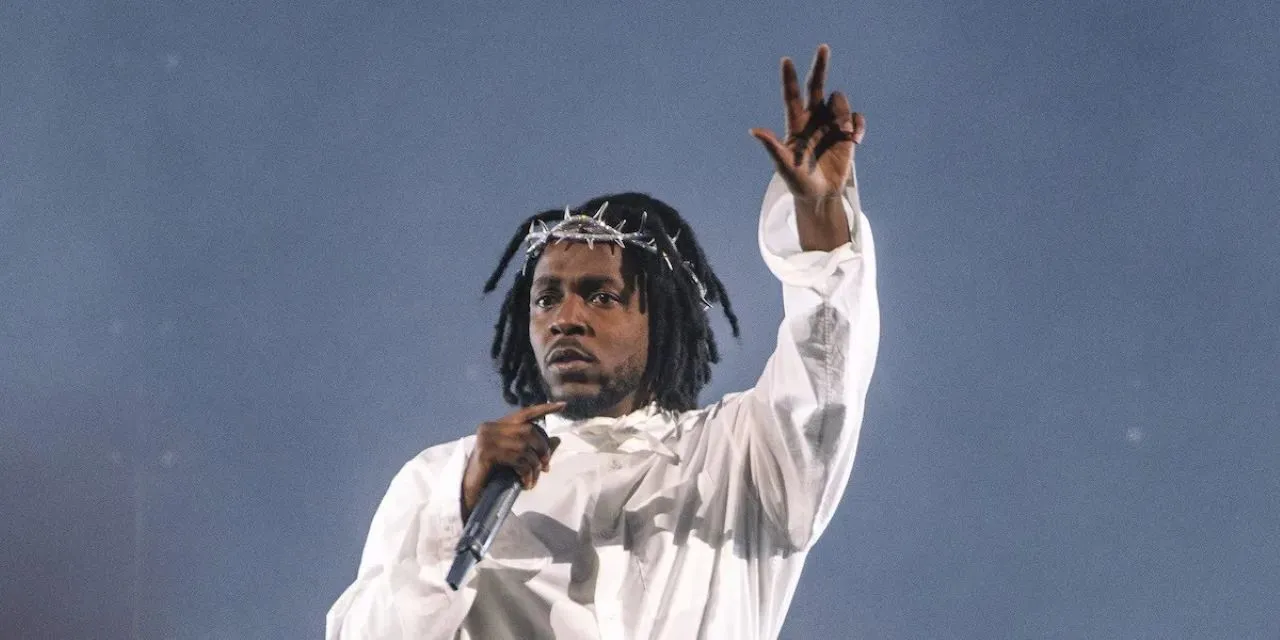
Kendrick Lamar is the only rapper who can make a crowd of 50,000 people scream about being "f***ed up" and then immediately pivot to the healing power of the Holy Ghost without skipping a beat. He occupies a strange, vibrating space in the culture. If you look at his forehead during a performance, you might see a diamond-encrusted crown of thorns. If you listen to his 2024 and 2025 output, including the "Pop Out" show and his Super Bowl LIX prep, the religious imagery is heavier than ever. But the question remains: is Kendrick Lamar a Christian in the way your auntie at the local Baptist church understands it?
Honestly, the answer is complicated.
Most people want a "yes" or "no" here. They want to know if he’s a pew-sitting, tithe-paying member of a specific denomination. But Kendrick doesn't really do "simple." He’s a man who began his major-label career with a literal sinner’s prayer on good kid, m.A.A.d city and later transitioned into calling himself an "Israelite" on DAMN. while quoting Deuteronomy. By the time he released Mr. Morale & The Big Steppers, he was referencing Eckhart Tolle and the "pain body" alongside the teachings of Jesus.
The Evolution of Kendrick's Faith
To understand Kendrick's relationship with Christianity, you have to look at the timeline. It’s not a straight line; it’s a jagged spiral.
Back in 2012, Kendrick was the "good kid" in a "mad city." That album literally ends with a grandmother figure leading him and his friends through a prayer of salvation after a tragic shooting. It was a classic "prodigal son" narrative. He was the young man coming out of the darkness of Compton, reaching for the light of Christ. At that point, the label "Christian" fit him like a glove. He was vocal about his baptism. He talked about God being his "vocation."
Then things got weird. Or, more accurately, they got deeper.
By 2017, with the release of DAMN., Kendrick wasn't just talking about a loving Savior. He was obsessed with the "God of the Old Testament." You know, the one who sends plagues and demands absolute obedience. This is where he famously rapped on the track "YAH.": "I'm not about a religion / I'm an Israelite, don't call me Black no mo'." This wasn't a rejection of God, but it was a pivot away from "mainstream" American Christianity. He was exploring Black Hebrew Israelite theology, which suggests that Black Americans are the true descendants of the biblical Israelites and are currently under a divine curse for their ancestors' disobedience.
Why the "Israelite" Phase Matters
Many fans were confused. Was he still a Christian?
If you define Christianity solely as "believing Jesus is the Son of God," then Kendrick probably still clears the bar. Even during his Israelite phase, his music remained fixated on the concepts of sin, judgment, and the need for a mediator. But he was clearly frustrated with the "cheap grace" he saw in modern churches. He told DJ Booth in an interview that he felt many churches only talk about "hope and forgiveness" while ignoring the "wrath and judgment" of God.
He wanted the fire and brimstone. He felt the world was too broken for a "soft" version of faith.
The Shift to "New Age" Spirituality?
If DAMN. was about judgment, Mr. Morale & The Big Steppers was about therapy. This is where the "Is Kendrick a Christian?" debate gets really spicy.
In this era, Kendrick started talking about:
- Ancestral trauma.
- Meditation and silence.
- Fasting for four days a week.
- Eckhart Tolle’s "The Power of Now."
In the song "Auntie Diaries," he explicitly says he "chose humanity over religion" when it came to supporting his transgender relatives. For some conservative Christian listeners, this was a breaking point. They saw it as him walking away from biblical authority.
But if you ask Kendrick? He likely sees it as the ultimate expression of the faith. He’s looking for a version of God that can actually heal a man who grew up seeing murders on his doorstep. He’s not interested in the "performance" of being pious. He’s interested in the "Real." As his father famously told him on a voicemail: "Real is God."
What We See in 2026
In his most recent moves—specifically the 2024 beef with Drake and his subsequent victory laps—Kendrick has leaned back into the "prophetic" archetype. He isn't just a rapper; he's a moral arbiter. When he says "I hate the way that you walk, the way that you talk," it sounds less like a playground insult and more like a biblical condemnation.
He still wears the crown of thorns. He still samples gospel. He still talks about the "Beast" and the "Enemy."
The truth is, Kendrick Lamar is a theologically idiosyncratic believer. He’s a guy who reads the Bible cover to cover but also isn't afraid to pray to the "trees and the flowers." He believes in the divinity of Jesus, but he’s also deeply influenced by Hebrew Israelite thought and modern psychological healing.
He’s a Christian who is "working out his salvation with fear and trembling," just like the book of Philippians says. It just looks a lot messier when you’re doing it in front of the whole world.
Direct Answers to Common Questions
People often get hung up on the labels. Let's break down what we actually know based on his lyrics and public statements:
- Is he Catholic? No. While he uses Catholic-adjacent imagery (like the thorns), he has never identified as Catholic.
- Is he a Black Hebrew Israelite? He has expressed strong affinity for their teachings, but he hasn't officially joined a specific group or abandoned the "Christian" label entirely.
- Does he believe in Jesus? Yes. From "His Pain" to "Mother I Sober," his belief in Christ as a source of healing and salvation is a recurring, though sometimes strained, anchor.
How to Listen to Kendrick Through a Faith Lens
If you're trying to figure out where he stands, don't look for a statement of faith on his website. You won't find one. Instead, look at how he handles the "Self."
In mainstream Christianity, the goal is to "die to self." In Kendrick’s recent work, the goal is to "kill the ego." Those two things sound very similar, but they come from different places. Kendrick is currently obsessed with the idea that our "ego" is what keeps us from God and from each other.
His music is basically a public confession booth. He admits to sex addiction, to pride, to wanting to "take a life" for his family. This isn't "Christian Rap" in the sense that it's safe for Sunday school. It’s "Christian" in the sense that it's a raw, bleeding account of a sinner trying to find his way back to the garden.
Actionable Insights for Fans and Critics
If you’re a fan trying to reconcile your own faith with Kendrick’s music, or just a curious observer, here’s how to approach it:
- Look for the tension, not the resolution. Kendrick rarely gives you a "happy ending" where everything is okay because of Jesus. He gives you the struggle. That is where his "Christianity" lives.
- Study the references. If he mentions "Deuteronomy 28," go read it. If he mentions "The Power of Now," look it up. He is inviting you into his library.
- Understand the "Prophetic" role. In the Black church tradition, a prophet doesn't just predict the future; they "speak truth to power" and "comfort the afflicted." Kendrick views himself as a modern-day prophet, which explains his intensity and his judgmental streak.
- Differentiate between "Religion" and "Faith." Kendrick clearly hates "religion" (the rules, the hierarchy, the hypocrisy) but he seems to love "faith" (the connection to the divine, the internal transformation).
Kendrick Lamar remains one of the most visible religious figures in the world, precisely because he refuses to be a "good" Christian. He’d rather be a "real" one. Whether that fits your definition of the word depends entirely on how much room you have for contradictions.
To truly understand Kendrick’s current spiritual state, the best thing you can do is listen to "The Heart Part 5" and "Mother I Sober" back-to-back. These tracks represent the bridge between his old-school Christian roots and his new-school spiritual healing. They show a man who hasn't lost his God, but has finally found his peace.
If you're looking for a label, you're going to be disappointed. If you're looking for a testimony, it's all over the records. He isn't a "Christian rapper," but he is a rapper who is deeply, painfully, and beautifully haunted by Christ.