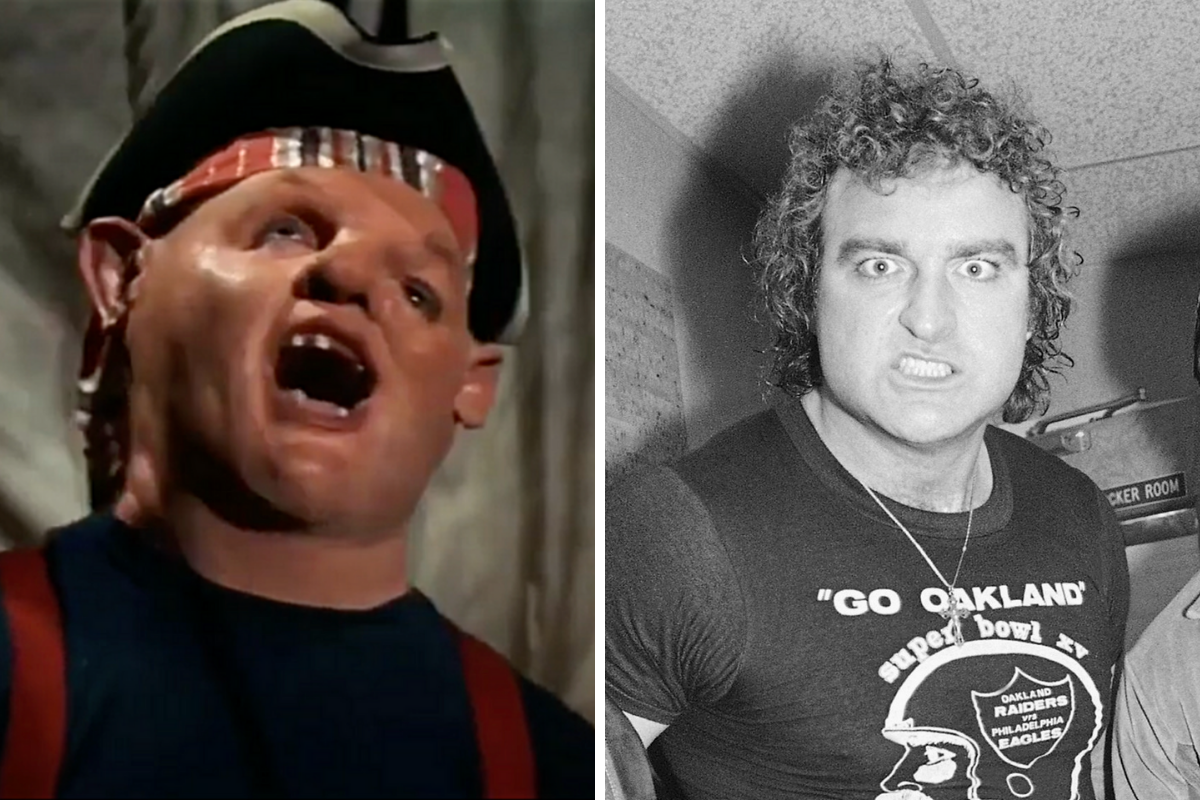
You know the face. That distorted, lovable, Baby Ruth-munching giant who ultimately saves the day in Astoria. For many of us who grew up in the eighties, Sloth wasn't just a character; he was the heart of the movie. But if you look past the heavy latex and the mechanical eye, the man who played Sloth in the movie Goonies was actually a world-class athlete with a life story that was way more intense than anything scripted by Chris Columbus.
His name was John Matuszak.
Most people just call him "Tooz." Before he was ever strapped into a makeup chair for five hours a day, he was the first overall pick in the 1973 NFL Draft. He wasn't some random character actor found in a casting call for "tall guys." He was a Super Bowl champion with the Oakland Raiders, a man known for being one of the most terrifying defensive ends to ever step onto a football field.
The Massive Transformation of John Matuszak
Basically, the physical toll of becoming Sloth was a nightmare. Imagine sitting in a chair at 4:00 AM while makeup artists apply layers of cold foam latex to your face. One of Sloth's eyes sat lower than the other. To make that work, the crew had to use a complex remote-controlled mechanism. One eye was Matuszak’s real eye, but the other was a prosthetic operated by a guy off-camera with a joystick.
It was awkward.
Matuszak had to blink his real eye in perfect sync with the mechanical one, or the illusion would shatter instantly. If he missed a beat, the take was ruined. This wasn't modern CGI where you just fix it in post-production. This was old-school practical effects magic.
The sweat was the worst part. Being a massive guy—he stood about 6'8"—Matuszak ran hot. Under those lights, the glue would start to fail. He’d be trapped inside a suit that weighed a ton, smelling like spirit gum and sweat, yet he had to maintain this gentle, childlike energy. It's a testament to his acting that you don't see the "Tooz" who used to crush quarterbacks; you only see a misunderstood soul who just wants a friend.
From the Gridiron to the Fratelli Hideout
Why did the producers pick a football player?
Directing kids is hard enough. Directing a giant who needs to be physically imposing but emotionally vulnerable is even harder. Richard Donner needed someone with immense physical presence who wouldn't accidentally hurt the child actors during the high-energy scenes on the pirate ship. Matuszak, despite his wild-man reputation in the NFL, was surprisingly patient with the kids.
Sean Astin and Corey Feldman have often talked about how Matuszak was a "gentle giant" on set. He’d hang out with them between takes, even when he was stuck in that grueling makeup. He had this weirdly specific task: he had to be the scariest thing in the room for the first half of the movie, then the most heroic in the second.
You’ve gotta realize that Matuszak was dealing with a lot of personal demons during filming. His NFL career had ended due to back injuries, and he was transitioning into a Hollywood career that was hit-or-miss. The Goonies was his big shot. He took it seriously. He wasn't just showing up for a paycheck; he wanted to prove he could act.
Why the Sloth Role Still Resonates
The "Baby Ruth" scene is iconic for a reason. It’s the moment the movie shifts from a treasure hunt to a story about empathy. When we ask who played Sloth in the movie Goonies, we aren't just looking for a name for a trivia night. We’re looking for the guy who gave that character a soul.
Matuszak’s performance relied heavily on his voice and his body language. Because his face was mostly immobile, he had to use his stature to convey emotion. Watch the way he protects Chunk. It’s protective, almost parental.
There’s a bit of trivia that often gets overlooked: the Raiders shirt. In the scene where Sloth rips his clothes off to reveal a Superman shirt, he was originally wearing an Oakland Raiders jersey. It was a nod to Matuszak’s real-life career. It’s those little layers of reality that make the movie feel so grounded, even when they’re sliding down giant water chutes into a cavern with a 17th-century galleon.
The Tragic Reality Behind the Mask
Honestly, it’s hard to talk about Matuszak without mentioning how his story ended. He died in 1989, just four years after The Goonies hit theaters. He was only 38.
An accidental overdose of prescription painkillers—compounded by an enlarged heart—took him way too soon. The back pain that ended his football career never really went away. He spent years trying to mask it. When you rewatch the movie now, knowing that the man behind the mask was in constant physical pain, his performance as the tortured but resilient Sloth becomes even more poignant.
He wasn't just playing a character who was cast aside by his family. In some ways, he was a man struggling to find his place in a world that only saw him as a "tough guy" or a "freak."
Key Takeaways for Goonies Fans
If you're looking to dive deeper into the history of the film or Matuszak's career, here are some things to keep in mind:
- Check out his other work: Before he was Sloth, he starred in North Dallas Forty, which is arguably one of the best football movies ever made. He plays a character much closer to his real-life persona.
- The Makeup Artists: Look up the work of Craig Reardon. He’s the genius who designed the Sloth prosthetic. Understanding the engineering behind the face makes the performance even more impressive.
- The "Sloth" Scream: That famous "Hey you guys!" line was actually a tribute to Rita Moreno's opening in The Electric Company. Matuszak nailed the delivery so well it became the defining catchphrase of the decade.
- The Ship Set: The pirate ship, the Inferno, was a full-sized vessel. Matuszak had to navigate those narrow decks in a costume that severely limited his peripheral vision. It was a safety nightmare that he handled like a pro.
To truly appreciate the legacy of who played Sloth in the movie Goonies, you should watch the 25th-anniversary cast reunions. Even decades later, the "Gooney kids" speak of Matuszak with a level of reverence that you don't often hear in Hollywood. He wasn't just a co-star; he was their protector on a chaotic set.
Next time you sit down to watch the Fratellis get outsmarted, keep an eye on Sloth’s expressions. Notice the subtle movements of the one eye he could actually control. That’s not just a monster in a cave; that’s John Matuszak, a man who went from the violent world of professional football to creating one of the most beloved characters in cinema history.
To honor his legacy, consider looking into the John Matuszak foundation or simply sharing the story of his career with someone who only knows him as the guy with the distorted face. His transition from the NFL's "Bad Boy" to a childhood icon is a story of range and resilience that deserves to be remembered as much as the movie itself.
Actionable Insights for Movie Buffs:
If you're a fan of practical effects, look for behind-the-scenes footage of the Sloth makeup application. It provides a masterclass in how 1980s cinema achieved "impossible" looks without a single pixel of digital help. Also, tracking down a copy of Matuszak's autobiography, Cruisin' with the Tooz, offers a raw, unfiltered look at the man behind the Sloth mask, providing context that makes his performance even more impressive.