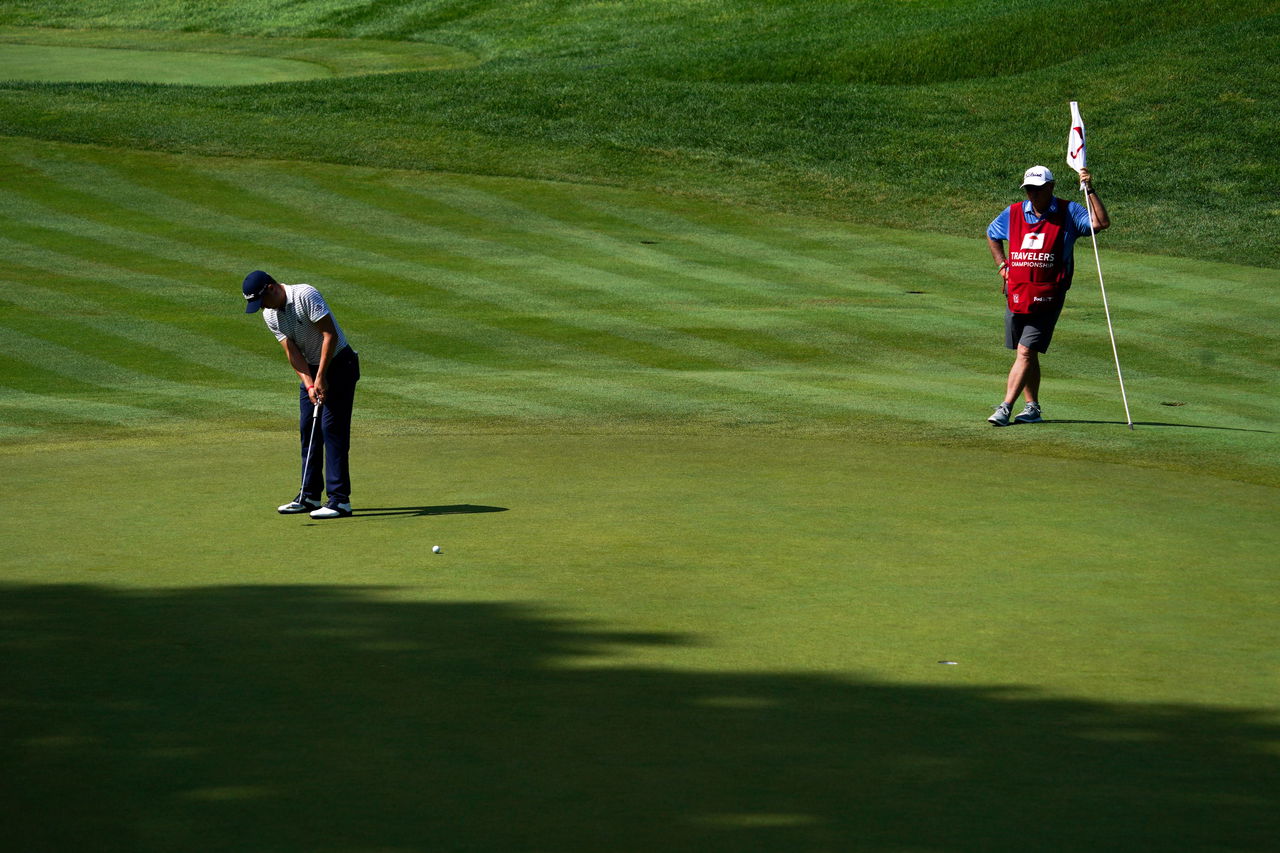
You’ve probably heard the old cliché "drive for show, putt for dough" about a thousand times. It's one of those things people just say because it sounds smart, right? Well, honestly, it’s kinda wrong. Or at least, it's not the whole story. If you really want to know who the best golfers in the world are, you have to look at PGA Tour strokes gained putting.
It’s the stat that finally killed the "total putts" metric. Total putts is a garbage stat. If you hit 18 greens in regulation but leave yourself 60-footers all day, you might have 36 putts. Does that mean you’re a bad putter? Not necessarily. Conversely, if you miss every green, chip it to three feet, and one-putt everything, you’ll have 18 putts. You look like a god on paper, but you basically just had a great chipping day.
How It Actually Works (The Nerd Stuff)
Columbia professor Mark Broadie is the guy we have to thank for this. He realized back in the early 2010s that we needed a way to measure putting that actually accounted for distance.
The math is actually pretty simple once you get the hang of it. Basically, every single spot on a green has an "expected number of strokes" to get the ball in the hole. This isn't just a guess; it's based on millions of putts tracked by the PGA Tour’s ShotLink system.
Let's say you're facing an 8-foot putt. The Tour average to hole out from there is roughly 1.5 strokes.
- If you drain it, you took 1 stroke. $1.5 - 1 = 0.5$. You just gained half a stroke on the field.
- If you two-putt, you took 2 strokes. $1.5 - 2 = -0.5$. You lost half a stroke.
At the end of the round, you add all those pluses and minuses up. If your total is +1.2, you were over a stroke better than the field that day. Simple.
Why 2026 is Different
The game has changed. We’re seeing guys like Sam Burns and Taylor Montgomery absolutely tear up the greens lately. In the current 2026 season, the baseline for what's considered "elite" keeps creeping up.
Take Sam Burns, for example. He’s been hovering around that +0.983 SG: Putting mark. To put that in perspective, in the entire history of this stat, only a handful of guys—like Jason Day in 2016 or Maverick McNealy a few years back—have ever averaged over +1.000 for a full season.
Being a full stroke better than the field every single time you step on a green is insane. It’s like starting every tournament with a four-shot lead before you even tee off.
The Myth of the "Hot Putter"
We often see a guy win a tournament and say, "Oh, he just got hot with the flatstick." While that's usually true—putting accounts for about 35% of the scoring advantage for tournament winners—it's rarely a fluke.
If you look at the long-term data, the guys at the top of the PGA Tour strokes gained putting rankings are consistent. Denny McCarthy? He’s basically a walking cheat code on the greens. Harry Hall is another one. These guys aren't just "getting lucky" for four days. They have a repeatable process that minimizes the damage on long putts and maximizes the "makes" from the 5-to-10 foot range.
Actually, that’s the real secret.
The "money" range is 5 to 15 feet. Tour pros make about 50% of their 8-footers. If you can bump that to 60%, you’re suddenly a top-10 player in the world. It’s not about the 40-foot bombs you see on Sunday highlights. It’s about not missing the boring 6-footer for par on a Thursday morning.
The Breakdown of Distance
- Inside 5 feet: Most pros are automatic (96%+). You don't gain much here; you only lose.
- 5-15 feet: This is where tournaments are won. This is the SG: Putting engine.
- 15-25 feet: You're only expected to make about 15-20% of these. Anything you make is a massive bonus.
- Over 25 feet: The goal here is "don't three-putt." If it goes in, scream.
The Limitations of the Stat
Is it perfect? No. Honestly, it doesn't account for green speed or slope perfectly for every single specific putt. If you’re putting on a triple-breaker at Augusta, it’s harder than a flat 10-footer at a standard resort course.
Also, it doesn't tell you why you're gaining strokes. Are you a great green reader? Do you have perfect tempo? Or are you just really good at lag putting? You have to look deeper into the sub-stats—like 3-putt avoidance and "putting from 4-8 feet"—to find the "why."
How You Can Use This
You don't need a ShotLink team following you to use these insights. Stop counting your total putts. Seriously. It’s lying to you.
Start tracking your distance for every first putt. If you’re 30 feet away and you 2-putt, that’s a win. You didn't "lose" anything. If you’re 3 feet away and you 2-putt, that’s where the "strokes lost" are killing your handicap.
Actionable Next Steps:
- Audit your "Makeable" Range: Spend 30 minutes on the practice green. Place 5 balls at 8 feet. If you aren't making at least 2 or 3 of them regularly, your stroke has a mechanical flaw that no "feel" will fix.
- Lag Putting over Line Reading: On long putts (20+ feet), 90% of three-putts come from poor speed, not a bad read. Focus on the weight of the hit, not whether it breaks 2 inches or 4.
- Track your Proximity: Next time you play, write down how far your first putt was. If you had 30 putts but your average first putt was 40 feet, you putted like a Tour pro. Give yourself some credit.
Putting is the ultimate equalizer in golf. You might not be able to swing it like Rory McIlroy, but there is absolutely nothing stopping you from having a +0.500 strokes gained putting day. It’s all about expectation management and owning that 8-foot circle.