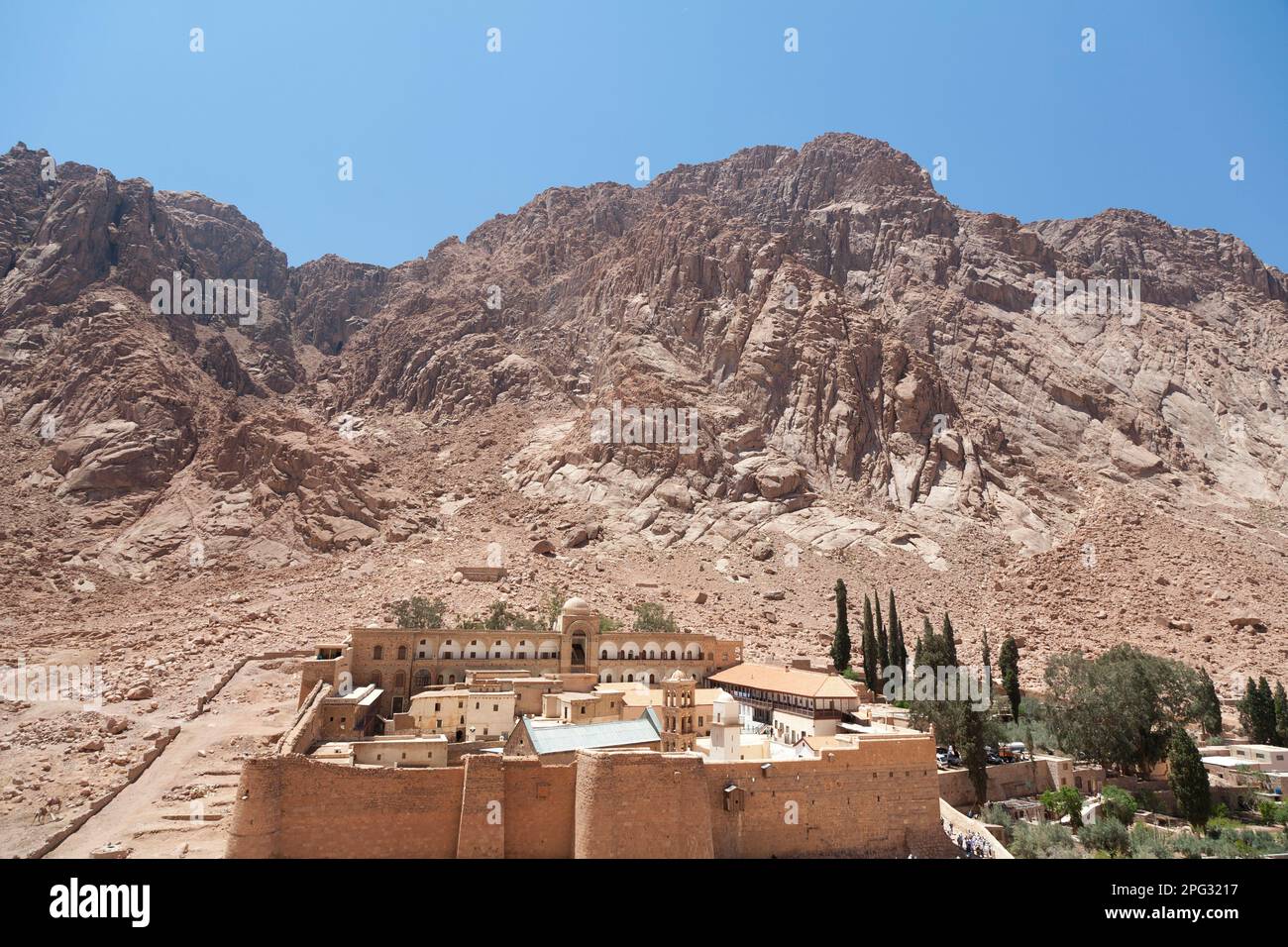
You’re standing at the base of a massive, jagged granite peak in the middle of the South Sinai wilderness. It’s quiet. Not just "no traffic" quiet, but a heavy, ancient silence that feels like it’s pressing against your eardrums. This is Saint Catherine's Monastery Mount Sinai Egypt, and honestly, it’s one of the few places left on the planet that actually lives up to the hype. Most people come here because they want to climb the mountain where Moses supposedly received the Ten Commandments, but they end up staring at the walls of the monastery instead. It’s a fortress. It’s a library. It’s a living time capsule that has survived the rise and fall of empires without ever closing its doors.
Actually, it’s the oldest continuously inhabited Christian monastery in the world. Think about that for a second. While the Roman Empire was collapsing and the Middle Ages were just getting warmed up, the monks here were already waking up at 4:00 AM to pray. They’re still doing it.
The Burning Bush and the Emperor’s Gamble
People get confused about the timeline. They think the monastery was built right after the events of Exodus, but it was actually commissioned by the Byzantine Emperor Justinian I between 548 and 565 AD. He didn't just pick a random spot in the desert. He built it around a much older chapel—the Chapel of the Burning Bush—which had been established by Empress Helena (mother of Constantine the Great) back in the 4th century.
The bush is still there.
Well, it’s a descendant of the original, a Rubus sanctus bramble that grows over a wall in the monastery courtyard. You’ve probably seen photos of it. It’s the only one of its kind in the entire Sinai Peninsula, and despite many attempts to transplant clippings elsewhere, they just don't take. It’s finicky. It wants to be exactly where it is.
But Justinian’s real genius wasn't the religious symbolism; it was the engineering. He sent a colony of two hundred families from Roman territories—mostly from Wallachia and Egypt—to guard the place. Their descendants, the Jebeliya Bedouin tribe, still live in the area today and serve as the monastery’s protectors. It’s a bizarre, beautiful example of cross-cultural survival. The monastery walls are massive, made of local granite, and they vary in thickness from two to three meters. They had to be. This was a lonely outpost in a lawless land.
Why the Library is Actually More Important Than the Mountain
If you talk to a historian about Saint Catherine's Monastery Mount Sinai Egypt, they won’t start with the views from the summit of Gebel Musa. They’ll start with the books.
Behind those granite walls sits the second largest collection of early codices and manuscripts in the world. The only place that beats it is the Vatican. We’re talking about thousands of items in Greek, Arabic, Syriac, Georgian, and Slavonic.
Ever heard of the Codex Sinaiticus? It’s a 4th-century handwritten copy of the Greek Bible. It is, for all intents and purposes, one of the most important books in human history. Most of it is in the British Library now (a long story involving a German scholar named Constantin von Tischendorf and some questionable paperwork), but the monastery still holds a few leaves.
But the library isn't just a museum of the past; it's a tech hub now. Researchers from the Early Manuscripts Electronic Library (EMEL) have been using multispectral imaging to read "palimpsests." These are parchments where the original text was scraped off and written over because vellum was expensive back in the day. By using different wavelengths of light, they’re finding lost medical texts from Hippocrates and previously unknown languages that have been hidden under religious chants for a thousand years. It’s basically Indiana Jones stuff, but with cameras and LED lights.
The Prophet's Protection: An Unlikely Survival
You might wonder how a Christian monastery survived 1,400 years of Islamic rule in the Middle East. It wasn't just luck.
There is a document called the Achtiname (the Covenant of the Prophet Muhammad). Tradition holds that a delegation from the monastery visited the Prophet in Medina in 626 AD to ask for protection. He granted it. The document, which bears the imprint of his hand, commands Muslims to protect the monks and their property until the end of time.
Whether the original parchment is authentic or a later medieval production is a debate for the academics, but the effect was real. Even during the Crusades and the Ottoman expansion, the monastery was largely left alone. To show their respect, the monks even built a small mosque inside the monastery walls during the Fatimid period. It sits right next to the church's bell tower. You don't see that everywhere.
Surviving the Climb (and the Crowds)
Most travelers visit Saint Catherine's Monastery Mount Sinai Egypt as part of a midnight trek. You wake up in Sharm El Sheikh or Dahab at 10:00 PM, drive through the desert, and start hiking at 2:00 AM.
There are two ways up:
- The Camel Path: This is the "Siket El Bashait." It’s a wide, winding trail that’s relatively easy on the knees. You can rent a camel for most of the way if you're feeling lazy or the altitude is hitting you.
- The Steps of Penitence: This is the "Siket Sayidna Musa." It consists of about 3,750 steps carved into the rock by a single monk as a form of penance. It’s brutal. Your quads will scream. But the views are arguably better.
Both paths meet at "Elijah’s Hollow," a small plateau where you wait for the final 750 steps to the summit.
Here’s a tip: it is freezing. You’re in Egypt, sure, but you’re at 2,285 meters (7,497 feet) above sea level. I’ve seen people show up in shorts and flip-flops because they forgot they weren't at the beach anymore. They ended up shivering in rented wool blankets that smelled like camel. Don't be that person. Bring a jacket.
The sunrise from the top is... well, it’s a lot. The sky turns this deep violet, then orange, and suddenly the entire Sinai range looks like a crumpled piece of reddish-brown paper. It’s spiritual even if you aren’t religious.
The Art You Won't See Anywhere Else
Down in the monastery’s Basilica of the Transfiguration, there is a mosaic that dates back to the 500s. It covers the apse and shows Christ surrounded by prophets and apostles. It’s made of glass, gold leaf, and semi-precious stones. Because of the dry desert air and the monastery’s isolation, it has never been destroyed or painted over.
Then there are the icons.
During the 8th and 9th centuries, the Byzantine Empire went through a phase called Iconoclasm. People went around smashing religious images because they thought they were idols. Because Saint Catherine’s was so remote and under the protection of the Caliphate at the time, the icon-smashers couldn't get to it.
The result? The monastery holds the world’s most significant collection of Encaustic icons. These are paintings made with hot, pigmented wax. They have a depth and a realism that later medieval art completely lost. The "Christ Pantocrator" icon here is world-famous. If you look closely at his face, the eyes are asymmetrical—one looking stern, one looking merciful. It’s a deliberate theological statement on the dual nature of Christ, and it's over 1,400 years old.
Practical Realities of Visiting Today
Sinai has had its share of security issues over the last decade, but the southern part of the peninsula, where the monastery is located, is heavily guarded. You’ll go through multiple checkpoints. It’s just part of the deal.
The monastery has very specific opening hours. It’s usually open from 9:00 AM to 11:30 AM, and it’s closed on Fridays, Sundays, and major Greek Orthodox holidays. If you time your hike wrong and get down from the mountain at noon, you’re out of luck. You’ll just be staring at a closed wooden door.
Also, dress decently. This isn't a resort. Cover your shoulders and knees. The monks are kind, but they take their sanctuary seriously.
Actionable Insights for Your Trip
If you're planning to head out to Saint Catherine's Monastery Mount Sinai Egypt, stop treating it like a checkbox on a tour itinerary. Do these things instead:
- Skip the Day Trip from Sharm: It’s a 3-hour drive each way. If you can, stay at the monastery’s guesthouse or a small hotel in the village of St. Catherine. You’ll get to see the stars without the light pollution of the tourist buses.
- Request the Icon Gallery: The main church is great, but the museum (the Sacred Sacristy) is where the real treasures are kept. It requires a separate ticket, but it’s worth every penny to see the Codex fragments and the Encaustic icons.
- Pack Layers: Even in summer, the mountain is cold at night. In winter, it can actually snow. Wear moisture-wicking base layers and a windproof shell.
- Talk to the Bedouin: The Jebeliya tribe aren't just guides; they are part of the monastery’s history. Hire a local guide through the Bedouin Support Program rather than just following a group leader from a big agency.
- Check the Calendar: Greek Orthodox holidays follow the Julian calendar, which is different from the Western one. Check the monastery’s official schedule before you book your transport.
This place isn't just a pile of old rocks. It’s one of the few threads left connecting the modern world to the ancient one. Whether you’re there for the history, the art, or the grueling hike, you’ll leave feeling like you’ve touched something that isn't supposed to exist anymore. It’s a miracle it’s still standing. Respect it.