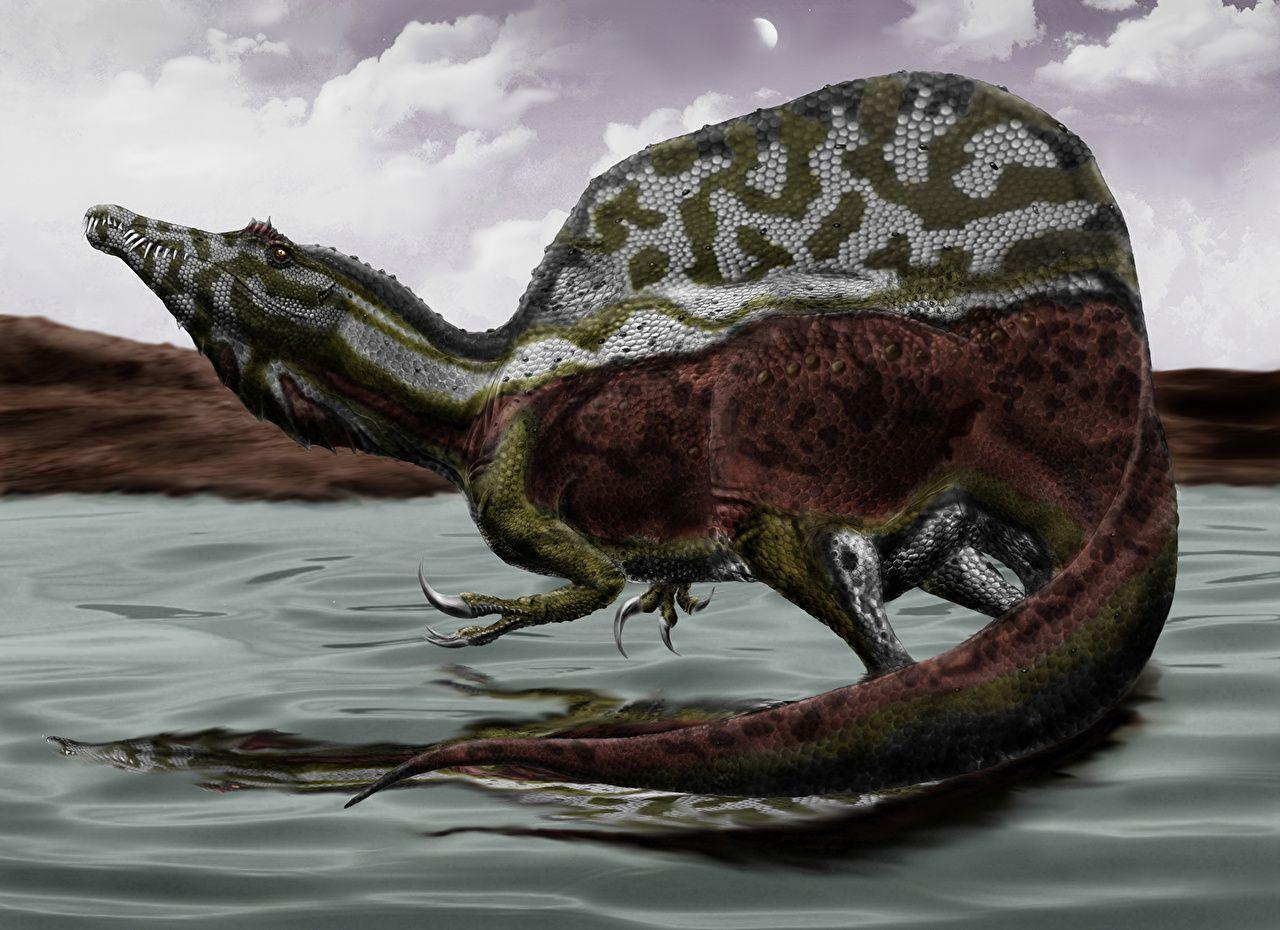
Forget the movie monster that snapped a T-Rex's neck in the early 2000s. Honestly, that version of spinosaurus in real life never existed. It’s a bit of a heartbreaker for fans of the franchise, but the actual animal was way weirder, way more specialized, and honestly, a lot more interesting than just a bigger version of a raptor.
For decades, we thought it was just a giant, sail-backed predator that walked on two legs. Then we thought it was a four-legged crawler. Then a river-dwelling swimmer. The science moves so fast it’s hard to keep up. But if you’re looking at the evidence unearthed by paleontologists like Nizar Ibrahim and Paul Sereno, the picture of this North African giant is finally coming into focus. It wasn't just a dinosaur; it was a biological experiment that pushed the limits of what a massive theropod could actually do.
The Identity Crisis of Spinosaurus in Real Life
Imagine finding a puzzle where half the pieces were melted in a fire and the other half were scattered across a desert. That's the Spinosaurus story. The original fossils, found by Ernst Stromer in Egypt around 1912, were famously destroyed during an Allied bombing raid on Munich in 1944. For over half a century, all we had were sketches.
We’re talking about a creature that could reach 45 to 50 feet in length. That’s longer than a T-Rex. But length doesn't mean it was a heavyweight champion in a land fight. The bone density tells a different story entirely. Recent studies of the femur and ribs show "pachyostosis," or bone thickening. This is something you see in hippos or penguins, not land-dwelling hunters. It helps with buoyancy control. Basically, spinosaurus in real life was likely weighted down so it could submerge itself in the massive river systems of the Cretaceous Kem Kem Beds.
It had these narrow, crocodile-like jaws. They weren't designed for crushing bone. Instead, they were lined with conical teeth perfect for gripping slippery, armored fish like the Onchopristis—a giant prehistoric sawfish. If you saw one today, it wouldn't be sprinting across a field. It would be lurking in the reeds of a delta, its nostrils high up on its snout so it could breathe while most of its head stayed underwater.
The Tail That Changed Everything
In 2020, a discovery in Morocco flipped the script again. Ibrahim’s team found a nearly complete tail. It wasn't the thin, tapering tail of a typical meat-eater. It was a giant, flexible paddle.
This was huge.
It provided the first real evidence of a dinosaur using aquatic propulsion. By lateral undulation—waving that tail side-to-side—the Spinosaurus could actually move through the water with some degree of efficiency. It wasn't just a wader like a heron; it was a swimmer. However, don't picture it out-swimming a dolphin. Some biomechanical models suggest it was still a bit clunky due to the massive sail on its back, which might have acted more like a billboard or a stabilizer than a sail for catching wind.
Why the "River Monster" Theory Still Has Critics
Paleontology is never settled. You've got guys like David Hone and Tom Holtz who have argued that while Spinosaurus definitely hung out by the water, it might have been more of a shoreline specialist. Their research suggests that its anatomy wouldn't have allowed it to be a high-speed pursuit predator in open water.
- The center of gravity was weird.
- The sail would create massive drag.
- The neck wasn't particularly "S-curved" for striking like a heron, yet it wasn't shaped like a shark's either.
It’s a middle-ground animal. It’s a chimera. Looking at spinosaurus in real life means accepting that nature doesn't always fit into neat categories like "land animal" or "sea animal." It lived in the "Lost World" of Cretaceous Africa, a place where the predators were so numerous they had to specialize just to survive without killing each other off.
Living With the Sail
That giant structure on its back? It’s the elephant in the room. Some of those neural spines were over five feet tall. If you’re a hunter trying to be stealthy in the water, a five-foot-tall orange or red fin sticking out isn't doing you any favors.
So why have it?
Most experts now lean toward display. Sex. Intimidation. Species recognition. In a crowded ecosystem filled with other massive predators like Carcharodontosaurus and Bahariasaurus, you needed a way to say "This is my river" without having to fight every five minutes. It was a billboard. It might have been brightly colored or even capable of flushing with blood to change hue.
The idea that it helped with heat regulation is mostly falling out of favor. The surface area to volume ratio doesn't make as much sense as social signaling. It’s the same reason a peacock has a tail—it’s a massive handicap that proves you’re healthy enough to survive despite it.
The Bone Structure Breakdown
If you look at the density of a Spinosaurus bone under a microscope, it’s nearly solid. Most theropods have hollower, "pneumatized" bones to keep them light and fast. Spinosaurus traded speed for stability.
- Heavy bones act as a diving belt.
- The flat feet might have been webbed (though we need more soft tissue evidence to be 100% sure).
- The pelvic girdle was reduced, meaning its legs were shorter than you'd expect for a dinosaur of its size.
This supports the idea that on land, it was probably pretty awkward. It wasn't chasing down Jeeps. It was likely moving between water sources, perhaps occasionally scavenging, but primarily focused on the bounty of the prehistoric river.
What This Means for Your Next Museum Visit
Most museums still have the old "tripod" or "bipedal" mounts. They’re outdated. When you’re looking at spinosaurus in real life reconstructions today, look for the horizontal posture, the low-slung body, and that unmistakable paddle tail.
The Kem Kem Group, where these fossils are found, is a tough place to work. It’s a series of plateaus on the border of Morocco and Algeria. The fossils are often sold by local miners before scientists can get to them, which makes "in-situ" (in the original spot) research incredibly difficult. Every new tooth or vertebrae found in these red sands adds a tiny bit of data to a picture that is still being painted.
We also have to talk about the "other" Spinosaurs. Baryonyx from England and Suchomimus from Niger. They are the cousins. They give us clues. But Spinosaurus was the extreme version—the one that took the aquatic lifestyle to the absolute limit.
Actionable Insights for Paleo-Enthusiasts
If you want to keep up with the actual science of Spinosaurus without getting bogged down in movie myths, there are a few things you can do to stay informed.
- Check the Year of the Paper: If you're reading a study or an article about Spinosaurus from before 2014, it’s basically ancient history. The 2014 Ibrahim paper and the 2020 tail discovery changed the game entirely.
- Follow the Lead Researchers: Keep an eye on the University of Portsmouth or the University of Chicago's paleontology departments. Nizar Ibrahim and Paul Sereno are the primary figures currently reshaping this species.
- Look at Bone Histology: Don't just look at the shape of the bones; look at the density. Modern paleontology is moving away from just "looking" at fossils and toward CT scans and chemical analysis.
- Visit Updated Exhibits: If you're in Chicago, the Field Museum often updates its information, even if the physical mounts take longer to change. The National Geographic Museum has also hosted specific "Spinosaurus: Lost Giant of the Cretaceous" exhibits that use the most recent 3D scans.
The reality of this animal is far more bizarre than any movie monster. It was a 15-meter-long semi-aquatic predator with a paddle tail and a billboard on its back. It reminds us that evolution doesn't always move toward a "perfect" predator like the T-Rex; sometimes, it takes a weird turn into the water and creates something completely unique. Don't get stuck on the old versions. The real Spinosaurus was a master of a world that no longer exists, a river king that redefined what it meant to be a dinosaur.