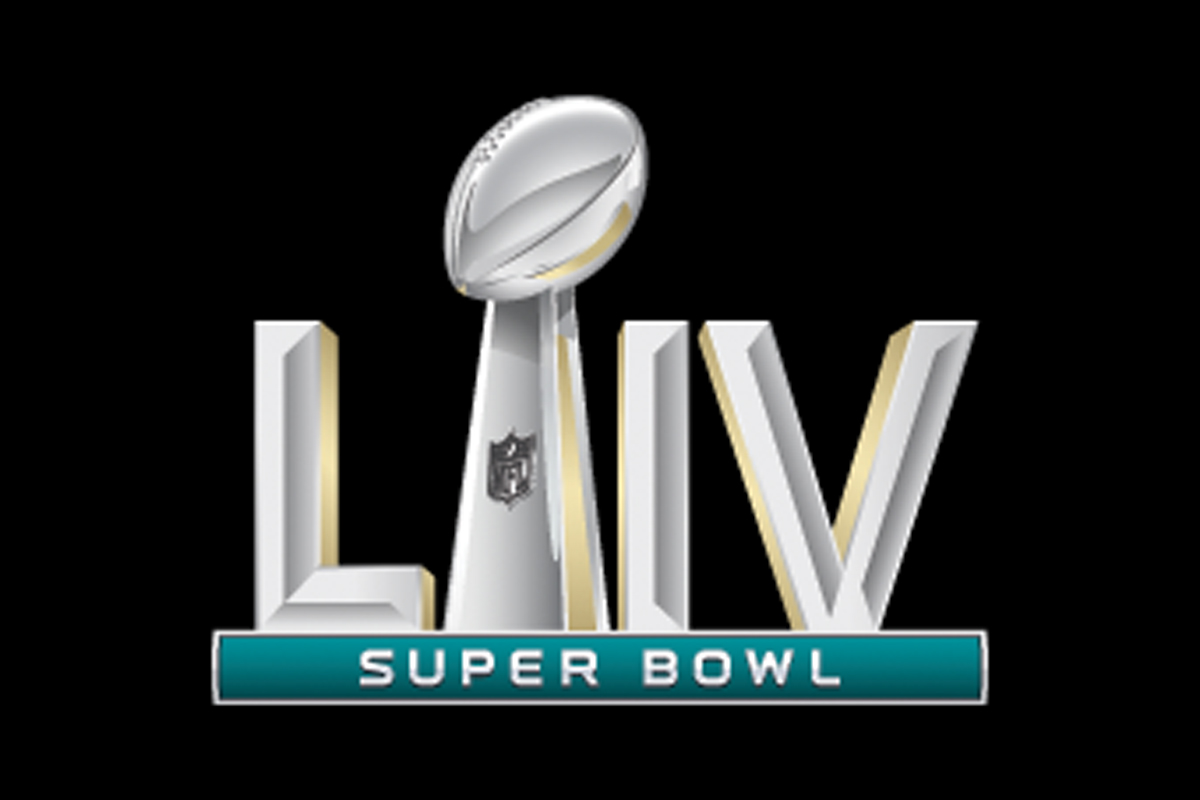
Hardcore NFL fans remember exactly where they were when the Kansas City Chiefs finally ended their fifty-year drought in Miami. But if you ask a graphic designer or a branding nerd about that night, they won’t talk about Patrick Mahomes’ fourth-quarter heroics or Damien Williams hitting the pylon. They’ll talk about the Super Bowl 54 logo. Specifically, they’ll talk about how it felt like the league was finally—mercifully—starting to loosen its grip on a decade of visual monotony.
It was a weird time for NFL branding.
For years, the league had been stuck in what fans called the "Sliver Era." Starting with Super Bowl XLV, every single logo looked the same. You had the Vince Lombardi Trophy front and center, some sterile silver numbers, and a stadium backdrop that looked like it was rendered in a cold, windowless basement. It was boring. Honestly, it was soulless. But the Super Bowl 54 logo changed the vibe, even if it didn't totally break the mold. It gave us color. It gave us palm trees. It gave us a hint that maybe, just maybe, the NFL remembered that football is supposed to be fun.
The Miami Heat: Breaking the "Regional" Curse
The Super Bowl 54 logo was unveiled in early 2019, and the reaction was immediate: "Wait, is that pink?"
Actually, it was a vibrant shade of Coral, paired with a deep Sky Blue. This wasn't just a random choice by a committee in a boardroom. It was a direct nod to the Art Deco architecture of South Beach and the neon-soaked nights of Miami. The design team at the NFL, which usually plays things incredibly safe, decided to lean into the host city's identity.
They kept the standard template—the trophy still stands tall in the middle—but they infused the numbers "LIV" with a gradient that felt tropical.
You've got to understand how much of a departure this was. For nearly ten years, the logos were monochromatic. If you look at the logos for Super Bowls 50 through 53, they are virtually indistinguishable if you strip away the Roman numerals. By the time we got to Miami, the fatigue was real. The Super Bowl 54 logo used its colors to tell a story about the location. The palm trees silhouetted inside the numerals were a subtle touch, but they acted as a lighthouse for fans who were tired of the "corporate" look. It was a signal that the NFL was listening to the critics who missed the old days of the 90s, where every logo felt like a unique postcard.
Why the "Template" Logo Exists in the First Place
People love to complain about the "standardized" logo system. I get it. I miss the Super Bowl XXX logo with the Southwest vibes or the Super Bowl XXXIII logo that looked like a jet engine. But there's a business reason the Super Bowl 54 logo followed a template, even if it tried to spice things up.
It’s all about the "Vince."
The Lombardi Trophy is the most recognizable icon in American sports. Back in the day, the NFL noticed that the Super Bowl brand was becoming fragmented. Every year, the logo changed so drastically that the "shield" and the "trophy" were getting lost in a sea of local illustrations. Around 2010, the league decided to create a "Global Brand Identity." The goal was to make the Super Bowl as instantly recognizable as the World Cup or the Olympics.
Basically, they wanted a "master brand."
This meant the trophy had to be the hero. Always. The Super Bowl 54 logo represents the peak of this philosophy trying to coexist with fan demand for creativity. It was the "Goldilocks" of logos—not too boring, not too wild. It kept the corporate structure the NFL demanded while finally allowing a bit of Miami's soul to peek through the silver.
The "LIV" Factor: Typography and Visual Weight
The Roman numerals for 54 are "LIV."
Design-wise, this is a gift. Unlike Super Bowl LVIII or LXXXVIII (which we’ll get to eventually, God help the designers), "LIV" is compact. It’s symmetrical. It’s punchy.
In the Super Bowl 54 logo, the designers used this brevity to their advantage. They didn't have to cram seven different characters into a small space. This allowed the "Coral" and "Blue" gradients to really pop. If you look closely at the bottom of the numbers, there’s a slight reflection, meant to mimic the sun hitting the Atlantic Ocean. It’s these tiny details that separate the 54 logo from its predecessors. It wasn't just a stamp; it was a composition.
Some critics, like those at SportsLogos.net, pointed out that while the colors were a step forward, the "containment" was still an issue. The logo was still trapped inside a rigid system. You couldn't just take the "LIV" and put it on a hat without the trophy; the NFL’s licensing agreements are incredibly strict about how these elements are separated. This is why you rarely see "variant" logos that look significantly different from the primary mark.
Comparing 54 to the "New Era" of Logos
If we look at what happened after Super Bowl 54, it’s clear that Miami was a turning point.
The following year in Tampa (LV), the league went with a red and pewter scheme. Then came LVI in Los Angeles, which featured sunset oranges and palm trees that were even more integrated into the design. We’ve now entered an era where the "regional" elements are the star of the show.
The Super Bowl 54 logo was the bridge.
- Pre-54: Silver, metallic, cold, stadium-focused.
- Super Bowl 54: The introduction of dual-tone gradients and city-specific flora.
- Post-54: High-concept illustrations, like the desert landscapes for Arizona or the neon "Vegas" lights for LVIII.
It’s funny to think that a little bit of pink and a couple of palm tree silhouettes could be "revolutionary," but in the context of the NFL's rigid branding history, it was like a lightning bolt. It broke the "Silver Era" and proved that you could have a global brand identity without being incredibly dull.
The Controversy: Was it "Too Much" Like a Travel Brochure?
Not everyone was a fan. A segment of the fanbase thought the Super Bowl 54 logo looked a bit too much like a logo for a luxury hotel or a tourism board.
"Where's the football?" was a common refrain on Twitter (now X) when the logo dropped.
There's some truth to that. If you took the "LIV" and the trophy out, you could easily see that color palette on a bottle of sunblock or a Miami Heat "Vice" jersey. But honestly? That's what made it work. The Super Bowl isn't just a football game anymore. It’s a week-long festival. It’s a cultural moment. The logo needs to sell the "experience" of being in the host city, not just the sport itself.
The 54 logo succeeded because it felt like Miami. It felt warm. It felt like a party. When you saw that logo on the broadcast, you could almost hear the Will Smith song playing in the background. That’s effective branding.
Technical Specs and Brand Usage
For the real nerds out there, the Super Bowl 54 logo wasn't just a single file. It was a massive suite of assets.
The NFL provides broadcasters like FOX (who had the game that year) with "Style Guides." These guides dictate exactly how the logo can be animated. For Super Bowl 54, the animations featured "light sweeps" that mimicked the neon lights of Ocean Drive.
The font used for the "Super Bowl" text is a custom serif that the league has used since 2010, designed to look "timeless and authoritative." It’s a heavy, high-contrast font that balances out the more fluid, colorful elements of the Miami-themed numerals. This contrast is key. If everything was "Miami style," it would look amateur. By keeping the typography "Official," the NFL maintains its status as a premier global entity.
The Legacy of the LIV Mark
When the Chiefs won, the logo became immortalized on millions of pieces of merchandise. From "LIV Champions" hats to the commemorative coins, the Super Bowl 54 logo held up remarkably well in print.
One of the biggest tests for any logo is "reducibility." Can you see it on a tiny Instagram icon? Can you see it on a massive billboard? Because the LIV numerals were so thick and the trophy was so distinct, the 54 logo was one of the most legible designs the league has ever produced.
It also marked the last "normal" Super Bowl before the world changed in March 2020. There’s a bit of nostalgia attached to it now. It represents the last big party we all had before the lockdowns. Whenever I see that coral-and-blue gradient, I don't just think of Mahomes’ comeback; I think of the end of an era in more ways than one.
How to Value Super Bowl 54 Memorabilia Today
If you’re a collector looking at items featuring the Super Bowl 54 logo, there are a few things to keep in mind.
First, look for the "Official Licensed Product" hologram. Because the colors of the 54 logo are so specific, bootleg merchandise often gets the "Coral" wrong—it’ll look too red or too orange. The authentic logo has a very specific pinkish-orange hue that is hard to replicate without the exact Pantone codes.
Second, the "Program" is usually the best place to see the logo in its high-res glory. The official game program for Super Bowl 54 featured a holographic version of the logo that shifted colors as you moved it. It’s a beautiful piece of sports history.
Moving Forward: What Fans Should Look For
The Super Bowl 54 logo taught the NFL that fans crave local flavor. Since then, we've seen a massive shift in how the league approaches its big-game branding.
If you're interested in the evolution of sports design, take a look at the logos for the next few years. You’ll see that the "DNA" of the Super Bowl 54 logo is present in all of them. The use of gradients, the inclusion of local landmarks, and the departure from "just silver" all started right there in Miami.
To really appreciate the design, you should:
- Compare it to Super Bowl XLV: Look at the first "standard" logo and see how far we've come.
- Check the "Style Guides": Search for leaked NFL branding guides to see the "Clear Space" rules for the 54 logo.
- Watch the Intro: Go back and watch the FOX broadcast intro from 2020. See how they used the logo’s colors to set the tone for the entire show.
The Super Bowl 54 logo wasn't just a graphic; it was a vibe shift. It proved that even the biggest, most corporate sports league in the world can find room for a little bit of color and a little bit of soul. It remains a high-water mark for the "Template Era" and a fan favorite for anyone who prefers palm trees over parking lots.