You just landed at O'Hare. Your ears are popping, the cabin pressure was a nightmare, and now you’re staring at a rideshare app telling you a car to the Loop is eighty bucks. Welcome to Chicago. Honestly, skip the Uber. The Chicago airport Blue Line is the only way to get downtown without losing your mind in the I-90 crawl.
It's loud. It’s a bit gritty. But it’s reliable.
For about five bucks, you can bypass the legendary gridlock of the Kennedy Expressway. The "L" (Chicago's shorthand for the elevated and subway trains) is basically the heartbeat of the city. If you haven't taken it before, finding the station inside O'Hare feels a bit like a scavenger hunt, but once you're on that platform, you're officially a Chicagoan for the next forty-five minutes.
Finding the Train Without Getting Lost
O'Hare is massive. It’s a labyrinth of terminals and moving walkways. If you’re coming from a domestic flight in Terminals 1, 2, or 3, just follow the "Trains to City" signs. They’re everywhere. You’ll head downstairs to the lower level. Keep walking. Then walk some more. It’s a trek, but you’re under a roof the whole time.
Coming from Terminal 5? That’s where things get slightly annoying. Terminal 5 is the international hub and it’s physically separated from the others. You have to hop on the Airport Transit System (ATS)—that’s the automated tram—and ride it over to the main terminal area or the Multi-Modal Facility (MMF). From there, look for the Blue Line signs.
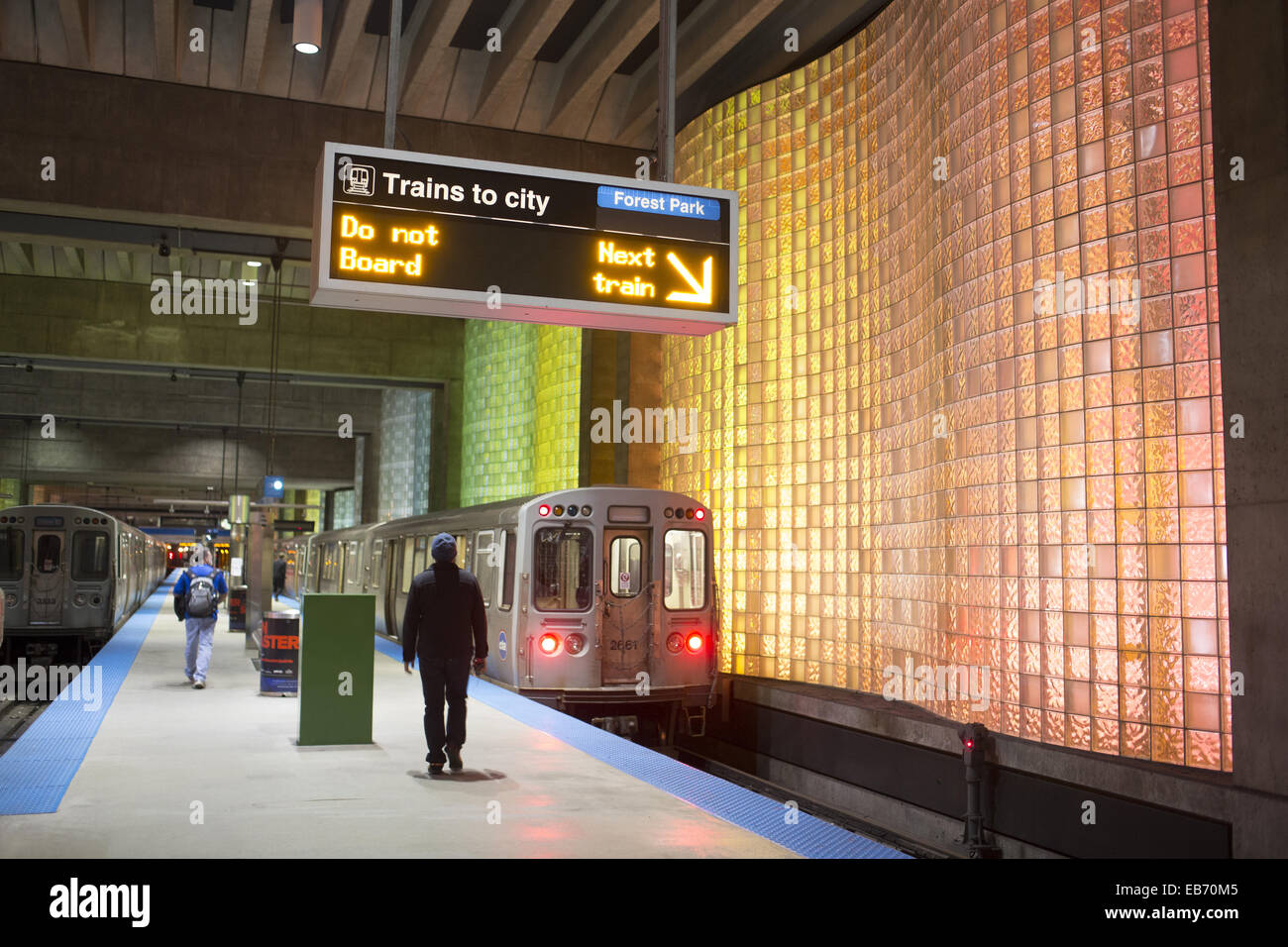
The station itself is a trip. It was designed in the early 1980s by the architect Helmut Jahn and features these glowing, wavy glass walls that look like something out of a retro sci-fi movie. It’s arguably the coolest station in the entire CTA system.
Paying Your Way
Don't stand there fumbling with a paper ticket like a tourist. The CTA (Chicago Transit Authority) uses Ventra. You can buy a physical card at the vending machines, but honestly, just use your phone. If you have Apple Pay, Google Pay, or a contactless credit card, you can tap it directly on the turnstile reader.
A ride from O'Hare costs $5.00. That’s a special "airport premium" rate. Anywhere else in the city, a ride is $2.50. It’s still the best bargain in town. If you’re staying for a few days, maybe grab a 3-day or 7-day pass. It’ll save you a fortune if you plan on hitting up neighborhoods like Logan Square or Wicker Park.
The Reality of the Ride
The Chicago airport Blue Line runs 24/7. That is a rarity. Most cities shut their trains down at midnight, but Chicago keeps the Blue and Red lines humming all night long. If your flight lands at 3:00 AM, the train is still there for you.
Expect a forty-to-fifty-minute ride to reach the Loop.
The train is loud. It’s a heavy-rail system, and the screech of metal on metal is part of the "charm." It starts out above ground in the median of the highway, so you get to look at all the poor souls stuck in traffic while you zip past them at fifty-five miles per hour. Around the Belmont stop, the train dives underground and stays there through the downtown core.
Safety and Etiquette
Is it safe? Generally, yes. It's a public transit system in a major American city, so use common sense. During morning and evening rush hours, the cars are packed with commuters, flight attendants, and students. If you’re traveling late at night, try to sit in the front car—that’s where the operator is.
Keep your bags close. Don't be the person blocking the doors with a giant hardshell suitcase. If the train is crowded, pull your backpack off and put it between your feet. People here are friendly but they have places to be, and nothing annoys a Chicagoan more than someone blocking the aisle during a Tuesday morning commute.
Major Stops You Should Know
The Blue Line doesn't just go to the Loop. It cuts through some of the most vibrant neighborhoods in the city.
- Rosemont: This is the first stop after the airport. It's for the convention center, the outlet malls, and a bunch of airport hotels.
- Jefferson Park: A big transit hub. If you need to catch a Metra train to the suburbs or a bus to the far Northwest side, this is your spot.
- Logan Square: This is where the cool kids live. Incredible coffee, dive bars, and some of the best food in the city.
- Damen: This is the heart of Wicker Park. If you want to see the "Six Corners" intersection and grab a drink at a rooftop bar, get off here.
- Clark/Lake: This is the main transfer point in the Loop. You can switch to almost any other train line here—Green, Pink, Orange, Brown, or Purple.
Navigating the "L" Ghost Trains
One thing you should know: the CTA tracker isn't always perfect. You might see a sign saying the next train is in two minutes, and then ten minutes pass with nothing. We call these "ghost trains."
Since the pandemic, the CTA has struggled with some staffing shortages, though things are getting better in 2026. Still, it’s smart to download an app like "Transit" or use Google Maps. They tend to be a little more accurate than the official boards when things get wonky. If you see a train pull in that is completely empty while others are packed, maybe think twice before jumping in—there might be a reason it's empty (like a broken AC or a "smell" situation).
Why the Blue Line is Better Than a Ride Share
Let's talk about the Kennedy Expressway. It is a parking lot.
Construction on I-90/94 is a permanent fixture of Chicago life. A drive that should take twenty-five minutes can easily take ninety minutes if there's a fender bender or a light drizzle. The Chicago airport Blue Line doesn't care about traffic. It has its own dedicated tracks.
Also, surge pricing is real. I’ve seen Uber rides from O'Hare hit $110 during a snowstorm. The Blue Line stays $5.00.
Accessibility Notes
The O'Hare station is fully accessible with elevators. However, not every stop on the Blue Line is. If you have heavy luggage or mobility issues, check the CTA website before you pick your destination stop. Many of the older neighborhood stations like Belmont or Damen only have stairs. The downtown stops like Clark/Lake, Washington, and Jackson are equipped with elevators, but they can be... temperamental. Always have a backup plan or check the CTA’s elevator status alerts.
The Forest Park vs. UIC-Halsted Branch
When you’re heading back to the airport, make sure the train sign says "O'Hare."
The Blue Line is a bit like a giant "V." One end is O'Hare. The other end splits. Some trains go to Forest Park, others used to end at UIC-Halsted. Just look at the front of the train or the flickering signs on the platform. If it says "O'Hare," you're good. If it says "Forest Park," you're going the wrong way.
Actionable Steps for Your Arrival
Don't overthink it. Once you land, follow these steps to make your transition from the tarmac to the city as smooth as possible:
- Check the ATS Status: If you’re in Terminal 5, verify the tram is running. If not, look for the shuttle buses to the main terminals.
- Prep Your Wallet: Open your digital wallet on your phone while you're walking. It saves you from digging for your physical card at the turnstile.
- Find the "L" Entrance: At O'Hare, it's located on the lowest level of the main terminal core.
- Pick the Right Car: If you have huge bags, try to find a car that isn't already jammed. The middle of the train usually has more breathing room than the cars right by the platform entrance.
- Download the Map: The "L" map is simple, but having a PDF on your phone helps when you lose cell service in the downtown tunnels.
The Blue Line is a raw, authentic introduction to Chicago. You'll see the skyline rise up as you come over the hill near Montrose, and for a second, the screeching wheels and the cramped seating won't matter. You're in the Windy City, and you just saved sixty bucks. Use that money for a deep-dish pizza instead.