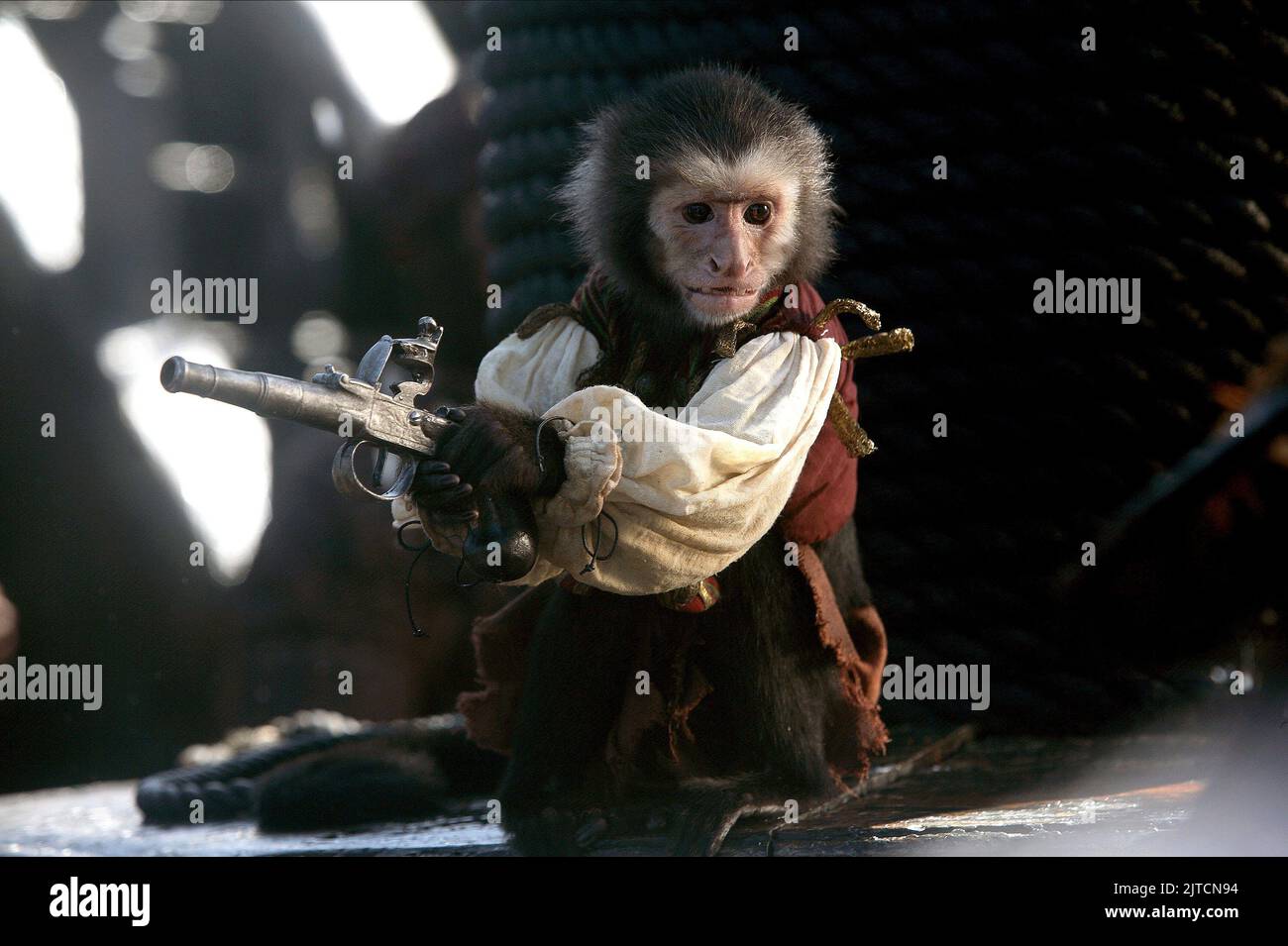
You remember the first time you saw Jack. Not Captain Jack Sparrow—the other Jack. The one with the tiny waistcoat and the screech that could pierce through a Caribbean gale. Honestly, that little capuchin monkey became such a fixture of the Pirates of the Caribbean series that it's hard to imagine the Black Pearl without him perched on a rigging line.
Jack the monkey wasn't just a prop. He was a plot device, a comedic foil, and, for a good chunk of the first movie, an undead nightmare.
Most people think of him as just "the monkey," but there is a weirdly complex history behind how those animals were trained, the multiple monkeys that played the role, and the sheer chaos they caused on set. It wasn't just one monkey. It was a rotating cast of primates, a lot of peanut butter, and some very patient trainers who had to make sure a capuchin didn't actually bite Johnny Depp’s ear off.
The Real Actors Behind the Pirates of the Caribbean Monkey
When we talk about the Pirates of the Caribbean monkey, we’re actually talking about a few different animals. In The Curse of the Black Pearl, the heavy lifting was done by Tara and Levi. They were the originals. By the time the sequels rolled around, specifically Dead Man's Chest and At World's End, two other capuchins named Chiquita and Pablo took over the mantle.
It’s kinda fascinating how Hollywood handles this. You can’t just have one monkey. What if one gets cranky? What if one isn't feeling the "vibe" of a night shoot in the middle of a swamp? You need backups.
Chiquita and Pablo were the mainstays for years. These monkeys are incredibly intelligent, which is why they’re used in movies, but they are also notoriously unpredictable. Capuchins are known as the "organ grinder" monkeys, but in the context of a Disney blockbuster, they had to learn complex cues that involved interacting with cursed gold, firing tiny props, and reacting to explosions.
Training them isn't like training a dog. You don't just say "sit" and expect a result. Trainers like Mark Harden from Animal Actors Worldwide spent months prepping these animals. They use positive reinforcement—mostly treats like fruit or nuts—to get the monkeys to hit their marks. But even then, if a monkey decides it doesn't want to scream at Geoffrey Rush on a Tuesday, the whole production waits.
Why Jack the Monkey Matters to the Lore
Jack the monkey is named after Jack Sparrow, mostly as an insult from Hector Barbossa. That’s the joke. But his role in the story is actually pretty dark if you think about it.
In the first film, he’s cursed just like the rest of the crew. He’s immortal. He’s a skeleton in the moonlight. Most people forget that at the very end of The Curse of the Black Pearl, after the credits roll, there’s a stinger. The monkey swims back to the chest, steals a coin, and becomes cursed all over again.
This wasn't just a throwaway gag. It explained why the Pirates of the Caribbean monkey could survive being fired out of a cannon in later movies. He literally can't die.
- He represents Barbossa’s only real companion.
- He serves as a bridge between the supernatural elements and the comedy.
- He is one of the few characters to appear in all five films.
Think about that. Jack the monkey has more screen time and longevity than most of the human pirates. He outlasted the Kraken. He outlasted Davy Jones. He even outlasted Will Turner and Elizabeth Swann for a while there.
The Chaos on Set: Working with Primates
Working with animals in a high-budget environment is a nightmare. Ask any director. Gore Verbinski reportedly had a "love-hate" relationship with the monkey's presence because of how much time it added to the schedule.
There’s a famous story from the set of Dead Men Tell No Tales where the monkey (played by a capuchin named Chiquita at that point) actually bit a makeup artist. It wasn't a malicious attack—monkeys get stressed. You have thousands of people, bright lights, loud noises, and a guy dressed like a ghost pirate. It’s a lot for a small animal to process.
The "screaming" you hear Jack do in the movies? That’s almost always added in post-production. In reality, capuchins make chirping noises or low whistles. The cinematic "monkey scream" is a sound design staple because the real noises wouldn't sound "piratey" enough.
Also, the costumes. Imagine trying to get a monkey to stay in a tiny velvet vest while filming in the humid heat of St. Vincent or the Dominican Republic. The trainers had to make dozens of identical outfits because the monkeys would inevitably rip them or get them covered in salt water.
The Controversy and Animal Welfare
We have to talk about the ethics. Back in the early 2000s, when the first three movies were filmed, the conversation around using live primates in film was different than it is today.
Groups like PETA have been very vocal about the Pirates franchise. During the filming of the fifth movie in Australia, there were protests. The argument is that capuchins are social, highly intelligent animals that shouldn't be subjected to the stress of a film set.
Disney eventually leaned more on CGI for certain stunts, but for the most part, the Pirates of the Caribbean monkey remained a physical, living actor. This is a point of contention in the industry now. Many productions, like Planet of the Apes, have moved entirely to motion capture. But there’s a certain "realness" that the Pirates movies have because those monkeys were actually there, sitting on Geoffrey Rush's shoulder and stealing his hat.
Specific Moments You Probably Missed
The monkey has some subtle character beats. In At World's End, when the crew is in the locker and everything is hopeless, the monkey is the one who provides the most consistent physical comedy to break the tension.
- The "Cannonball" Scene: In Dead Man's Chest, when Jack is fired out of a cannon, that was a mix of a stuffed prop and a very brief shot of the real animal.
- The Peanut Scene: Barbossa feeding the monkey is a recurring motif. It shows a softer side of a murderous pirate captain.
- The Undead Reveal: The CGI used to make the monkey look like a skeleton in 2003 was actually quite ground-breaking for its time.
Honestly, the chemistry between Geoffrey Rush and the monkeys was better than some of the human pairings in the later sequels. Rush apparently grew quite fond of his primate co-stars, despite the occasional nipped finger or stolen prop.
What Happened to the Monkeys After the Movies?
This is the part that usually worries people. Where do they go?
The monkeys used in the films are professional animal actors owned by specialized companies. They aren't "pets." When they aren't filming, they live on compounds with other animals, receiving constant veterinary care and enrichment.
Tara and Levi, the originals, retired years ago. Capuchins can live for 35 to 45 years in captivity, so they have long lives after their Hollywood careers end. They basically live out their days in "actor retirement homes" for animals.
The Legacy of the Capuchin
When people look back at the legacy of the Pirates of the Caribbean monkey, they see a symbol of the franchise's peak. The monkey represents the era of big-budget, practical-effects-heavy filmmaking that felt tangible.
The monkey wasn't just a mascot. He was a survivor. In a world of cursed gold, sea goddesses, and trident-wielding gods, the small, immortal capuchin was the most relatable thing on screen. He just wanted a peanut and to stay out of trouble, but he kept getting dragged into the mess.
If there is ever a sixth movie—with or without Johnny Depp—the fans will almost certainly demand the return of the monkey. You can swap out the leads, you can change the ship, but you can’t really have a Pirates movie without that iconic screech.
Actionable Insights for Fans and Aspiring Trainers
If you're fascinated by the role of animals in cinema or just want to appreciate the work that went into these films, here is how you can look at it through a professional lens:
- Observe the "Eye Line": Watch the scenes where the monkey is on a shoulder. Notice how the human actors (like Geoffrey Rush) never look directly at the monkey unless the scene calls for it. This is to avoid "challenging" the animal, as direct eye contact can be seen as a threat in primate language.
- Identify the "Mark": Look for the subtle ways trainers hide treats on the actors' clothing to get the monkey to stay in place. Often, a piece of fruit or a smear of something sweet is hidden just out of camera range.
- Appreciate the Sound Design: Next time you watch, mute the TV when the monkey appears. You’ll realize how much of the "character" is created by the Foley artists and sound editors, rather than the animal itself.
- Support Ethical Standards: If you're interested in animal welfare, look into the AHA (American Humane Association) "No Animals Were Harmed" certification and understand the specific guidelines they have for primates on sets, which have become much stricter since the first Pirates movie was released in 2003.
The Pirates of the Caribbean monkey remains one of the most successful uses of a live animal in a modern blockbuster. It’s a testament to the trainers and the actors who had to share their spotlight with a three-pound primate who consistently stole every scene he was in.
Source References:
- Harden, M. (Animal Actors Worldwide) - Production interviews for "The Curse of the Black Pearl".
- Disney Behind-the-Scenes Featurettes: "Diary of a Movie Monkey".
- American Humane Association Film & TV Unit reports (2003-2017).
- Interviews with Geoffrey Rush regarding on-set interactions with Pablo and Chiquita.