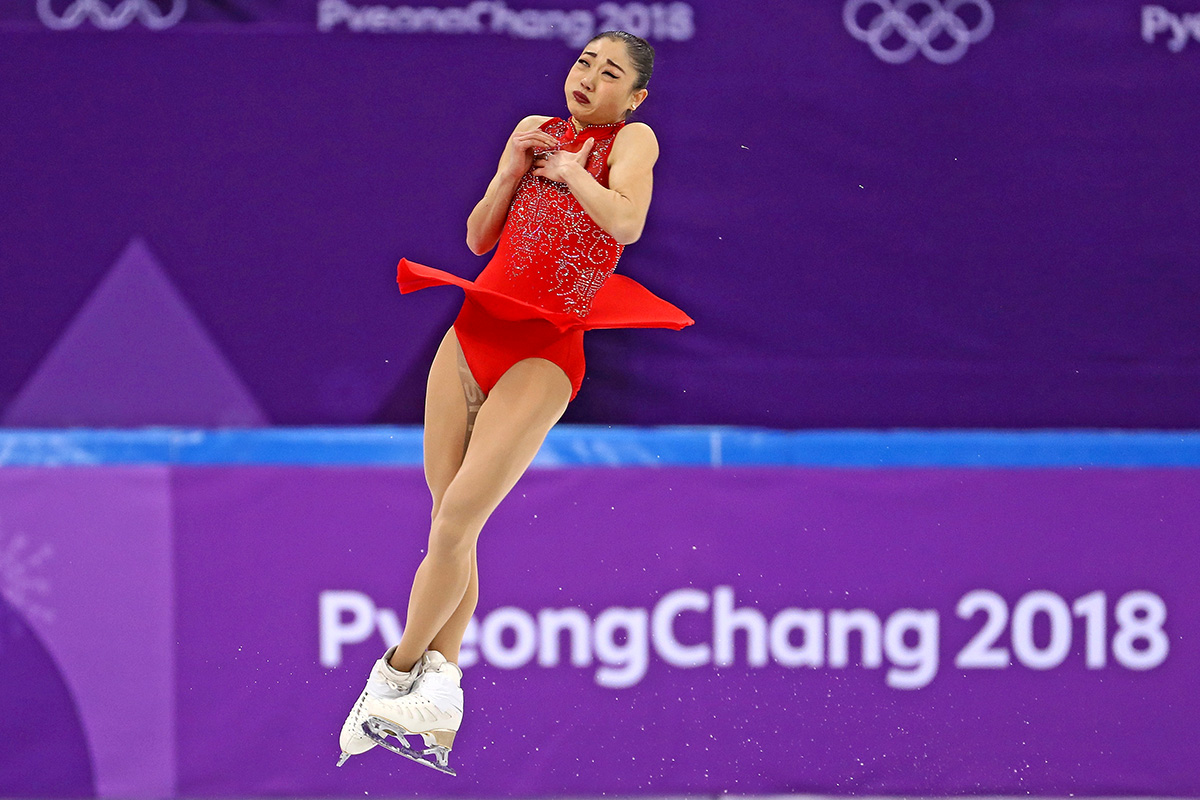
It looks so simple when you're watching it on a TV screen during the Olympics. A skater glides backward, turns forward, and launches into the air like they’ve been shot from a cannon. They spin, they land, they move on. But honestly? The axel jump is a mechanical anomaly that defies the basic logic of every other jump in figure skating. If you’ve ever tried to step off a moving sidewalk while turning in a circle, you have a tiny, clumsy fraction of an idea of what’s happening here.
The Axel is the only jump in the competitive repertoire that takes off from a forward edge. That sounds like a small technicality. It’s not. It changes everything about the physics, the timing, and the sheer terror involved in the takeoff. Because you’re facing the direction of travel, you don’t have the luxury of using your momentum to "roll" into the rotation. You have to create it out of thin air while moving at high speeds on a thin strip of metal.
What makes the axel jump so different?
Every other jump—the Lutz, the Flip, the Loop, the Salchow, and the Toe Loop—starts with the skater moving backward. This allows the skater to use the natural curve of their entry to whip themselves into a spin. The axel jump forces you to face your fears. You are heading forward on an outside edge, usually the left foot for a counter-clockwise spinner, and you have to vault yourself upward.
Think about the math. A "single" Axel isn’t actually one rotation. It’s one and a half. Since you start forward and land backward, you’re always doing an extra half-turn. A double is two and a half. A triple? Three and a half. This is why the triple Axel remained a "white whale" for female skaters for decades. Midori Ito finally conquered it in 1988, but even today, in 2026, it remains the ultimate separator between the elite and the rest of the pack.
The terrifying physics of the takeoff
You’ve got to get the "vault" right. Most beginners make the mistake of trying to spin too early. If you spin while your blade is still on the ice, you lose all your vertical power. You basically "skid" into the air.
To do it right, you have to drive your free knee (the right one, usually) up and forward. It’s like you’re trying to knee an invisible giant in the chin. At the same exact moment, your arms have to swing from behind your body to a tight "hitch" position across your chest. If your timing is off by a millisecond, your center of gravity shifts. You’ll either fly out of the circle or, worse, "pop" the jump and come down straight on your hip.
It hurts. Ask any skater. The "Axel hip" is a real thing—a permanent bruise that comes from learning how to transfer weight in mid-air.
The Triple Axel: A barrier of biology and nerves
For a long time, the triple Axel was the ceiling. It’s 1,260 degrees of rotation. To pull this off, a skater needs a combination of explosive leg power and a "snap" so fast it’s almost invisible to the naked eye.
Take Mao Asada or Tonya Harding. Both were famous for their Axels, but their techniques were night and day. Harding used sheer raw power, launching herself high and wide. Asada was more about the "quickness" of the wrap—getting her legs crossed and her arms tight the instant she left the ice.
- Height: You need enough airtime to complete the turns.
- Rotational Velocity: How fast can you pull your limbs into your core?
- The Landing: You're landing with roughly five to eight times your body weight in force on one leg.
The margin for error is zero. If you under-rotate by even 1/4 of a turn, the judges will "downgrade" the score, and you’ll likely catch an edge and face-plant. It’s a high-risk, high-reward gamble that defines modern short programs.
The Quadruple Axel: Breaking the 2026 standard
We have to talk about Ilia Malinin. For years, experts thought the quad Axel was physically impossible for a human being. The sheer amount of height required to fit four and a half rotations into a single leap seemed to exceed what human muscles could produce.
Then came 2022. Malinin landed it.
He didn't just land it; he made it look routine. By 2024 and into 2026, the quad Axel has become the "Final Boss" of men's figure skating. To achieve this, Malinin utilizes a technique that minimizes air resistance. His "air position" is so tight that he looks like a pencil spinning on its tip.
But even with modern training, the toll is immense. The impact of landing a quad Axel is comparable to jumping off a second-story balcony and trying to land on one foot while wearing a rollerblade. Skaters today are using specialized off-ice harnesses and plyometric routines just to prep their joints for that kind of violence.
Common misconceptions about the "Forward Jump"
People often think the Axel is easier because you can "see where you're going."
Actually, that's exactly what makes it harder. In a backward-entry jump, you can't see the "drop," so you rely on muscle memory. In an axel jump, your eyes are telling your brain that you are about to launch yourself into a void at 20 miles per hour. The "mental block" on Axels is legendary in rinks across the world. You’ll see skaters circle the rink fifty times, setting up for the jump, only to "chicken out" at the last second because the forward takeoff feels so exposed.
Another myth? That it’s all in the legs.
Nope. The Axel is won or lost in the shoulders. If your shoulders "open up" too early, you'll never get the rotation. You have to keep your upper body "checked" or square to the direction of travel until the very last moment. It’s a game of patience played in a heartbeat.
Why the landing is the hardest part
The landing of an axel jump is always on the back outside edge of the opposite foot from the takeoff.
If you take off on your left, you land on your right. You’re coming down from a significant height, spinning at a terrifying speed, and you have to find a 1/4-inch piece of steel to catch you. You have to "check" the rotation instantly by throwing your arms out wide and extending your free leg behind you. If you don't stop the spin immediately upon landing, you'll just keep twirling until you fall over. It requires incredible core strength and ankle stability.
Actionable steps for mastering the Axel
If you’re a skater—or just a fan trying to understand the mechanics—here is how the progression actually works in a real training environment. It’s not just "try it and see."
- The Waltz Jump: This is the "baby Axel." It’s a half-turn. You learn the forward takeoff and the back-edge landing without the stress of multiple rotations. If your Waltz Jump isn't perfect, your Axel will be a disaster.
- Back Spin Proficiency: You cannot land a double or triple Axel if you can’t hold a tight, fast back spin on the ice for 10+ revolutions. The air position is literally just a back spin in flight.
- Off-Ice Rotation: Most skaters spend hours on "spinner" plates or just jumping in sneakers on a gym mat. You have to train your brain to handle the dizziness.
- The "Hitch Kick" Drill: Practice driving the knee up without jumping. This builds the muscle memory for the "vault" phase.
- Harness Work: Using an overhead pulley system (the harness) allows a skater to feel the sensation of three rotations without the fear of breaking a bone on the landing.
The axel jump remains the gold standard for a reason. It is the perfect marriage of athletic power and graceful timing. Whether it’s a single Axel in a local competition or a quad Axel on the world stage, that forward takeoff will always be the ultimate test of a skater’s nerves.
To really understand it, next time you're at a rink, try just stepping from a forward glide to a backward glide while hopping an inch off the ice. Even that little "bunny hop" will show you how unnatural—and how impressive—the Axel truly is.
Next Steps for Deepening Your Knowledge
- Analyze slow-motion footage of Ilia Malinin’s 2024 World Championship quad Axel to see the "snap" timing.
- Research the impact of carbon-fiber boots on landing stability for high-rotation jumps.
- Study the ISU (International Skating Union) Judging System (IJS) to see how "under-rotation" calls on Axels can swing a podium result by 10+ points.