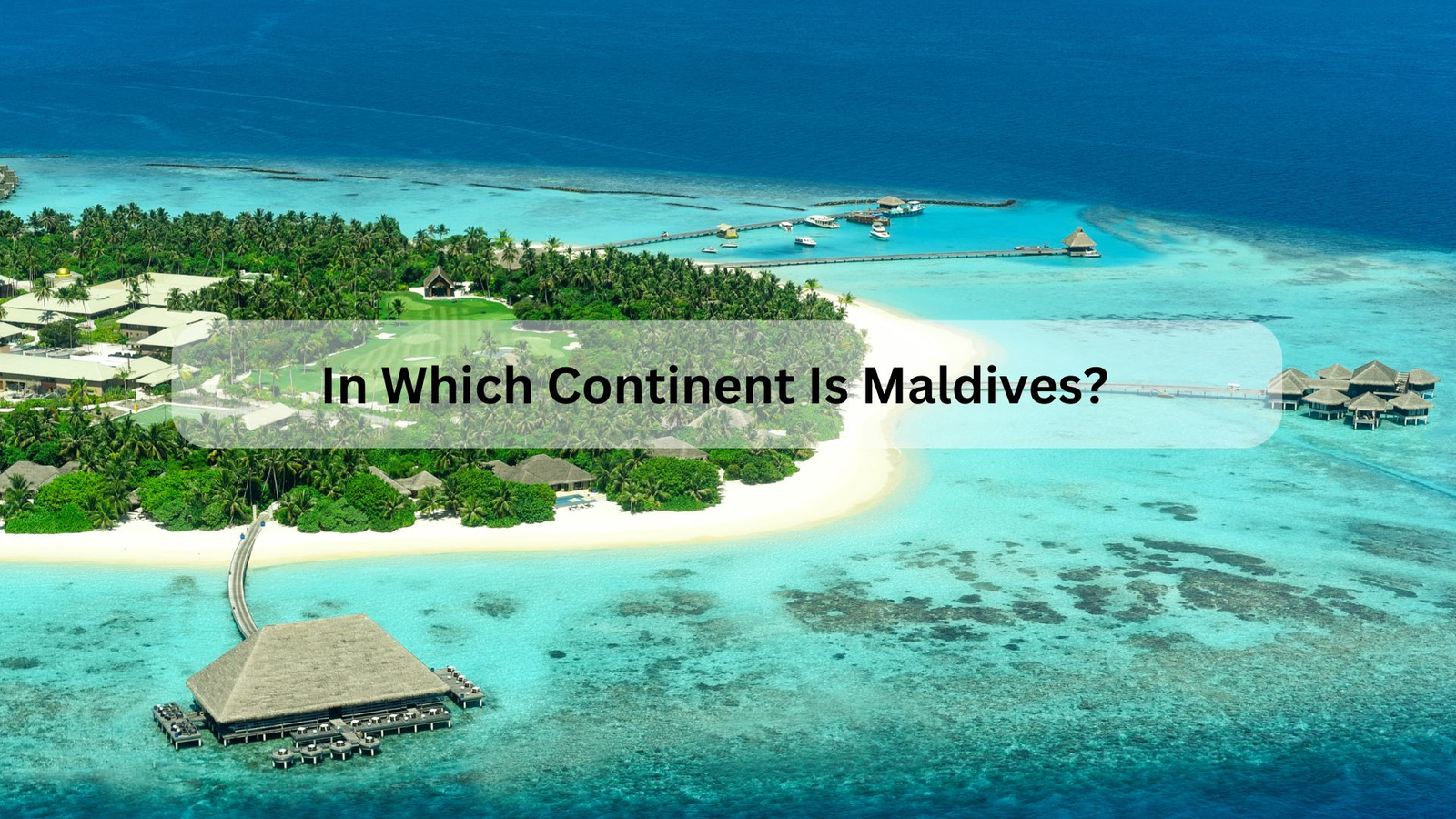
You’re looking at a map, scrolling through those tiny specks in the middle of the Indian Ocean, and the question hits you: what is the continent of Maldives? It’s a fair thing to ask. Honestly, when you see a country that is 99% water and 1% sand, the concept of a "continent" feels a little weird.
The short answer is Asia. Specifically, South Asia.
But saying the Maldives is in Asia is like saying a single strawberry is part of a giant fruit salad. It’s true, but it doesn't really explain how it got there or why it feels so different from its neighbors like India or Sri Lanka. The Maldives is actually the smallest country in all of Asia, both by land area and population. It’s a tiny, scattered kingdom of coral that somehow managed to become one of the most famous places on the planet.
Why Everyone Asks About the Continent of Maldives
Geography is messy. Most of us think of continents as huge, solid chunks of land—the kind you can walk across for days. The Maldives defies that. It is an archipelago of 1,192 coral islands grouped into 26 atolls. If you took all the actual land in the Maldives and squished it together, it would barely cover 298 square kilometers. To put that in perspective, the city of London is five times bigger than the entire country of Maldives.
Because it sits so far out in the Indian Ocean—about 750 kilometers from the Asian mainland—people often wonder if it belongs to Africa or maybe even Oceania.
It’s not in Africa. Though the Seychelles and Mauritius are over toward the African side of the ocean, the Maldives remains firmly tethered to the Asian tectonic plate. Culturally and historically, it’s also deeply linked to the Indian subcontinent. The first settlers likely came from southern India and Sri Lanka over 2,500 years ago.
The Geological Weirdness of an Island Nation
The Maldives isn't just a bunch of random islands. It’s actually the top of a massive, submerged mountain range called the Laccadive-Chagos Ridge.
Think of it like this: there’s a giant underwater mountain range stretching across the ocean floor. Most of it is deep underwater. But the peaks of these mountains reach just high enough for coral to grow on them. Over thousands of years, that coral grew, died, and piled up, eventually forming the ring-shaped "atolls" we see today.
Is it really a "continent" thing?
In a strictly geological sense, the Maldives sits on the Indian Plate. This is the same piece of the Earth's crust that crashed into the Eurasian plate millions of years ago to create the Himalayas. So, while you're standing on a beach in the Maldives that’s only 1.5 meters above sea level, you’re technically standing on the far edge of the same structural foundation that holds up Mount Everest.
It's a wild thought. The lowest country on Earth is connected to the highest mountains on Earth.
Living on the Edge (Literally)
Knowing what is the continent of Maldives is one thing, but understanding what life is like there is another. Being an Asian nation located smack in the middle of the ocean creates some unique challenges.
- The Water Crisis: Even though they are surrounded by the ocean, getting fresh water is a nightmare. In 2026, many islands still struggle with saline intrusion. This happens when rising sea levels push saltwater into the underground freshwater "lens" that people use for drinking and farming.
- The 2.4-Meter Problem: The highest point in the entire country is just about 2.4 meters (roughly 8 feet) above sea level. On some islands, it's even lower. If the ocean rises even a little bit, the land disappears. This makes the Maldives one of the most vocal countries in the world when it comes to climate change.
- The One-Island-One-Resort Rule: This is a uniquely Maldivian quirk. To keep tourism from overwhelming local culture, the government mostly keeps tourists on separate "resort islands." If you go to a resort, you’re essentially on a private island where the only residents are guests and staff.
Cultural Roots: More Than Just Beaches
While it’s officially part of the Asian continent, the Maldives has a flavor all its own. It’s a 100% Muslim nation, and the culture is a blend of Indian, Sri Lankan, Arab, and even African influences.
You can hear this in the language, Dhivehi. It sounds a bit like Sinhala (from Sri Lanka) but has its own unique script called Thaana, which is written from right to left, similar to Arabic.
You see the African influence in "Boduberu" music. It’s traditional drum music that started with sailors and traders coming across the Indian Ocean centuries ago. It’s loud, rhythmic, and honestly, way more high-energy than the "relaxed island vibe" you see in travel brochures.
The Economy of a Water-Based Nation
Since they don't have much land, Maldivians can't really do large-scale farming or mining. They have two main things: fish and tourists.
For a long time, tuna was the entire economy. Maldivian fishermen still use the "pole and line" method, which is super sustainable because they catch the fish one by one rather than using giant nets that kill everything in their path.
Then, in 1972, the first resort opened. Everything changed. Today, tourism makes up about 28% of their GDP. They've become the gold standard for luxury travel. If you've seen a photo of an overwater bungalow with a glass floor, it was probably taken here.
What Most People Get Wrong
People often assume the Maldives is "near" Bali or "near" the Caribbean. It’s not.
If you fly from Male (the capital) to Bangkok, it’s about a 4-hour flight. If you fly to Dubai, it’s 4 hours. It is isolated. This isolation is what kept the islands relatively independent throughout history, even when the Portuguese, Dutch, and British tried to exert control. They became a British protectorate in 1887 but finally gained full independence in 1965.
Actionable Insights for Your Next Step
If you're planning to visit this tiny slice of the Asian continent, don't just stay at a resort. The "real" Maldives is found on the inhabited islands.
- Check out a Guesthouse: Since 2009, tourists have been allowed to stay in local guesthouses on islands like Maafushi or Dhiffushi. It’s way cheaper and you actually get to see how people live.
- Respect the Local Laws: Remember, it’s a conservative country. Alcohol is only allowed on resort islands and safari boats. If you’re on a local island, keep the bikinis for the designated "bikini beaches" and dress modestly elsewhere.
- Support Sustainable Tourism: Look for resorts that use solar power or have their own coral regeneration programs. The Maldives is fighting for its life against rising seas, so every bit of eco-conscious travel helps.
Essentially, the Maldives is a miracle of geography. It’s an Asian nation that shouldn't exist according to the rules of "normal" landmasses, yet it’s thrived for millennia. Whether you're there for the diving or just to figure out where it sits on a map, it’s a place that stays with you long after you leave its tiny, sandy shores.
To understand the Maldives better, start by looking into the "Great Barrier Reef of the North"—the Ari Atoll—to see how these coral structures actually function as living organisms that protect the land.