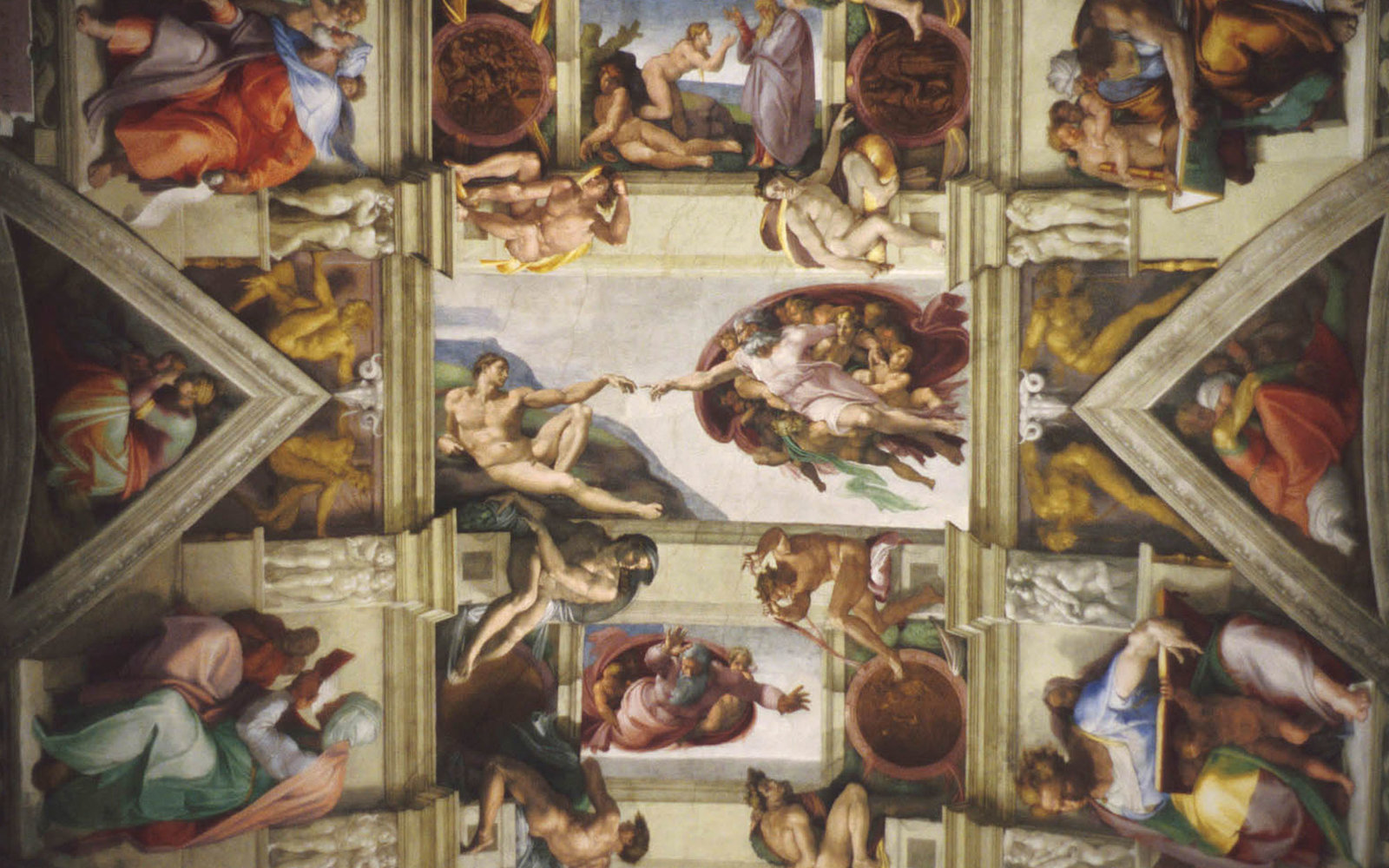
Everyone thinks they know it. You’ve seen it on coffee mugs, iPhone cases, and those weird parody memes where ET or a cat replaces God. But honestly, looking at the actual painting of the creation on the ceiling of the Sistine Chapel is a whole different beast. It’s huge. It’s overwhelming. And if we’re being real, most people are looking at the wrong things when they crane their necks up in that crowded room in the Vatican.
Michelangelo didn't even want the job. He was a sculptor, not a painter. He basically told Pope Julius II to shove it, but you don't really say "no" to the Pope in the early 1500s. So, he spent four years on a scaffold, ruining his eyesight and his back, to create something that changed how humans visualize the divine forever.
It’s not just art. It’s a statement about what it means to be alive.
The Gap That Changed Everything
The most famous part of this painting of the creation isn't the contact. It’s the lack of it. Look at the fingers. They aren't touching. There’s this tiny, electric sliver of space between Adam’s limp hand and God’s surging, muscular reach.
That gap is everything.
If they were touching, the story would be over. The spark would be transferred. By keeping them apart, Michelangelo captures the exact moment before the miracle. It’s the "almost." It represents the human longing for the divine and the idea that we are always just a fraction of an inch away from something greater. Adam looks kinda lazy, honestly. He’s lounging on the earth, looking a bit "newborn" despite his shredded physique. God, on the other hand, is flying through the air with a massive amount of momentum. The contrast is jarring.
Is That a Brain? The Neuroanatomy Conspiracy
Here is where things get genuinely weird. In 1990, a doctor named Frank Meshberger published a paper in the Journal of the American Medical Association. He pointed out that the red cloak surrounding God and the angels isn't just a random shape. It’s a structurally accurate cross-section of the human brain.
I’m serious.
You can see the sulci of the cerebrum, the brainstem, the frontal lobe, and even the pituitary gland. Michelangelo was a bit of a rebel—he used to dissect cadavers in secret to learn how the body worked. Did he hide a brain on the ceiling of the Vatican? Some art historians think it’s a stretch. Others think it’s a subtle "f-you" or a deep philosophical point: that the "gift" God is giving Adam isn't just life, but intelligence and consciousness.
It makes sense. If you look at the composition, God is literally encased in the mind. It suggests that the divine spark is actually our capacity for thought and reason. Pretty heavy for a ceiling painting from 1512.
Who Is the Woman Under God's Arm?
If you zoom in on the figure of God, he’s got his left arm wrapped around a woman. For a long time, people just assumed it was an angel. But she looks different. She’s observant. She’s staring right at Adam with a look that’s hard to pin down.
- Eve: The most common theory is that it’s Eve, waiting in the wings before she’s officially "created."
- Sophia: Some scholars argue it represents Wisdom (Sophia in Greek), suggesting that wisdom was there since the beginning of the cosmos.
- The Virgin Mary: A more religious take is that it’s Mary, with the Christ child at her feet, showing that the plan for humanity’s redemption was already in place the moment Adam breathed his first breath.
There’s no right answer. Michelangelo didn't leave a cheat sheet. That’s the beauty of it.
The Technical Nightmare of Fresco
We need to talk about how hard this actually was to make. This isn't a canvas. It’s fresco. You apply pigment to wet plaster. You have a very small window of time before the plaster dries and locks the color in forever. If you mess up, you can’t just paint over it. You have to chip the whole section off with a hammer and start over.
Michelangelo was working 60 feet in the air. He didn't lie on his back like the movies show; he stood up, leaning back at an agonizing angle, with paint dripping into his eyes. He wrote a poem about how much he hated it, complaining that his "belly was pushed under his chin" and his "face was a rich floor for droppings."
The painting of the creation survived because he was a perfectionist. He developed his own scaffolding system that didn't touch the walls. He mixed his own plaster to prevent mold (a problem that ruined his first few weeks of work). The sheer physical grit required to finish the Sistine Chapel is honestly more impressive than the art itself.
Why the "Creation" Still Matters in 2026
We live in a world of AI-generated images and instant gratification. You can prompt a computer to make a "painting of the creation in the style of Cyberpunk" in four seconds. But it lacks the "terribilità"—the emotional intensity and soul—that Michelangelo poured into the ceiling.
This painting remains the definitive image of the beginning of the world for the Western mind. It’s been referenced in The Simpsons, E.T., and countless advertisements because it captures a universal truth: the moment of transition. We are all Adam at some point—waiting for a spark, looking for purpose, feeling a bit sluggish while something powerful tries to reach us.
How to See It Without Losing Your Mind
If you’re actually planning to visit the Vatican to see it, don't just walk in and look up. You’ll get a neck cramp and be annoyed by the "No Photo" guards shouting every five minutes.
- Bring binoculars. No, seriously. The ceiling is high. You can't see the brushstrokes or the tiny details of the brain theory without them.
- Book the earliest slot. The Sistine Chapel becomes a sardine can by 11:00 AM. If you can get the 7:30 AM "Early Entry" tour, do it. It’s expensive, but silence is the only way to actually feel the weight of the art.
- Look at the Ignudi. These are the naked muscular men sitting on the corners of the central panels. They don't really have a "biblical" purpose, but they show off Michelangelo's obsession with the human form.
- Notice the hands. Compare Adam’s hands to the hands in the Last Judgment on the far wall. The style changed as Michelangelo aged. He got darker, more cynical, and more focused on the soul than the skin.
Actionable Insights for Art Lovers
Don't just stare at the painting of the creation and think "that’s nice." Engage with it.
Start by looking at the lighting. Michelangelo used a technique called cangiante. Instead of just adding black to make a color darker, he would use a completely different, contrasting color to show shadows. It’s why the robes look so vibrant and almost neon in the restored version.
Study the anatomy. If you’re an artist or just a fan of biology, look at the muscle attachments on Adam’s torso. They are almost perfectly accurate, which is insane considering Michelangelo didn't have X-rays or anatomy textbooks. He just knew bodies.
Finally, recognize the scale. The "Creation of Adam" is just one small part of a much larger narrative. It sits right in the middle because it is the pivot point of the entire human story in the eyes of the Renaissance. Everything before it is the cosmos; everything after it is the fall and the struggle. It is the literal center of his universe.
When you look at it, you aren't just looking at a religious scene. You're looking at a man who was obsessed with the human body trying to explain where life comes from using nothing but minerals, water, and wet lime. That's the real miracle.