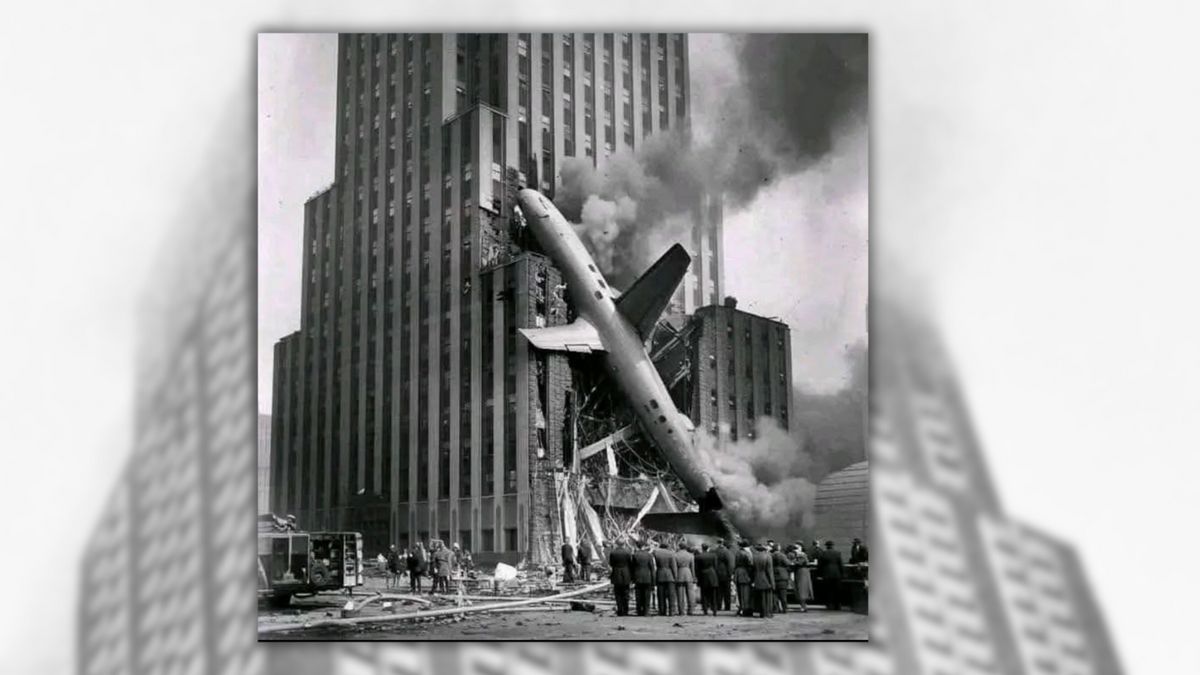
It was thick. The kind of fog that swallows skyscrapers whole, turning the Manhattan skyline into a gray, ghostly void. On July 28, 1945, Lieutenant Colonel William F. Smith Jr. was piloting a B-25 Mitchell bomber, trying to make it to Newark Airport. He was a combat veteran, a man who had flown harrowing missions over Europe. But that Saturday morning, the soup-thick mist over New York City proved more treacherous than a flak field.
He missed a turn.
Instead of banking left past the Chrysler Building, he veered right. Suddenly, the towering silhouette of the world’s tallest building loomed out of the white nothingness. Smith tried to climb, tried to bank, but it was too late. At nearly 200 miles per hour, the plane hit the Empire State Building, tearing a hole 18 feet wide and 20 feet high directly into the 78th and 79th floors.
Most people today hear "plane hits skyscraper" and their minds immediately jump to the horrors of 2001. But 1945 was different. This wasn't an act of terror; it was a tragic, surreal accident that occurred at the tail end of World War II. It’s a story of structural resilience, a record-breaking elevator plunge, and a city that somehow went back to work the very next Monday.
The Impact and the Chaos on the 79th Floor
When the plane hit the Empire State Building, it didn't just crumple. The B-25 was a 15-ton medium bomber. It struck with such force that one of its engines literally shot through the entire building. It exited the opposite side, crashed through the roof of a penthouse on 33rd Street, and started a fire that destroyed a sculptor’s studio. The other engine and part of the landing gear tumbled down an elevator shaft.
Inside the building, the 79th floor was occupied by the National Catholic Welfare Conference.
Imagine sitting at your desk, checking paperwork, and suddenly the wall vanishes in a fireball of high-octane aviation fuel. Eleven people in the building died almost instantly. Smith and the two others on the plane were killed on impact. The fuel surged down the hallways and into the stairwells, turning the upper reaches of the Art Deco icon into a furnace.
Honestly, it’s a miracle the death toll wasn't in the hundreds. Because it was a Saturday, many of the offices were half-empty. Had this happened on a Tuesday at 2:00 PM, we’d be talking about a much darker chapter in New York history.
Betty Lou Oliver: The Woman Who Survived a 75-Story Plunge
If you want to talk about the "stranger than fiction" aspect of when the plane hit the Empire State Building, you have to talk about Betty Lou Oliver. She was a 20-year-old elevator operator.
She was already injured from the initial impact. Rescuers, thinking they were helping her, placed her in an elevator to evacuate her to the ground floor for medical treatment. They didn't realize the cables had been severely weakened by the crash and the fire.
The cables snapped.
Betty Lou fell 75 stories. That’s over 1,000 feet. It is still the Guinness World Record for the longest survived elevator fall. How did she live? Basically, the frayed cables coiled at the bottom of the shaft, creating a sort of springy cushion. Additionally, the rapid descent of the elevator car compressed the air at the bottom of the shaft, creating a pocket of pressure that slowed the impact just enough.
She walked away—well, she survived with a broken back and legs—and eventually returned to the building months later. It’s the kind of story that sounds like an urban legend, but the physics of that air pocket actually checked out.
Why the Building Didn't Collapse
You’ve probably wondered why the Empire State Building stood tall while the Twin Towers fell decades later. It comes down to old-school engineering vs. modern efficiency.
The Empire State Building is essentially a "heavy" building. It’s a massive steel grid encased in stone and brick. It was over-engineered because, in the 1930s, they weren't quite sure how much wind load a building that size would take. When the plane hit the Empire State Building, the structure absorbed the energy locally. The fire was intense, but it wasn't hot enough or widespread enough to compromise the heavy masonry-protected steel columns.
- Structure: The Empire State uses a traditional cage frame.
- Fuel Load: A B-25 Mitchell is tiny compared to a Boeing 767. The B-25 carried about 800 gallons of fuel; the 767s on 9/11 carried closer to 10,000 gallons.
- Materials: The 1945 fire was largely confined to two floors.
The damage was estimated at $1 million (in 1945 dollars). Remarkably, the building was open for business on many floors by the following Monday. They just boarded up the hole and kept going. That's a level of New York grit that’s hard to wrap your head around today.
Navigating the Myths
A lot of people get the details wrong when they talk about the day a plane hit the Empire State Building. Some think it was a fighter jet. Nope, it was a propeller-driven bomber. Others think it happened at night. It was actually around 9:40 AM.
There’s also a common misconception that the pilot was suicidal. There is absolutely no evidence for that. Smith was a decorated pilot who simply made a catastrophic navigational error in "zero-zero" visibility. He had been warned by the tower at LaGuardia to land, but he pushed on toward Newark, likely confident in his ability to navigate the corridor he knew well.
The crash actually led to the passage of the Federal Tort Claims Act of 1946. Before this, you couldn't easily sue the federal government for damages caused by its employees (like a military pilot). This accident changed the legal landscape of the United States, allowing citizens to seek compensation for government negligence.
What You Should Do Next
If you’re a history buff or just someone fascinated by the resilience of New York City, there are a few ways to see the "scars" of this event for yourself.
First, visit the Empire State Building Observatory. While you won't see a giant hole anymore, the 80th-floor exhibit often features historical photographs of the repair process. It puts the scale of the building in a whole new perspective.
Second, if you're into aviation history, look up the B-25 Mitchell. There are several flight-ready models in museums across the U.S., like the Smithsonian or the Lone Star Flight Museum. Seeing one in person makes you realize just how "small" that plane was compared to the limestone giant it struck.
Finally, read the official accident report from the Civil Aeronautics Board if you can find archives. It’s a clinical, chilling look at how a series of small mistakes—fog, a missed turn, a bit of overconfidence—can lead to a disaster that defines a city's history.
The 1945 crash remains a testament to the era's architecture and the incredible stories of survival that emerge from chaos. It’s a reminder that even the most solid foundations can be tested in an instant.
Next Steps for Deep Diving into NYC History:
- Research the "Skyboy" photos to see how the Empire State Building was built without modern safety harnesses.
- Compare the B-25 crash with the 1946 crash of a C-45 into the 40 Wall Street building to see how the city handled a string of post-war aviation mishaps.
- Check out the NYC Fire Museum for exhibits on high-rise firefighting techniques that evolved directly from these early 20th-century disasters.