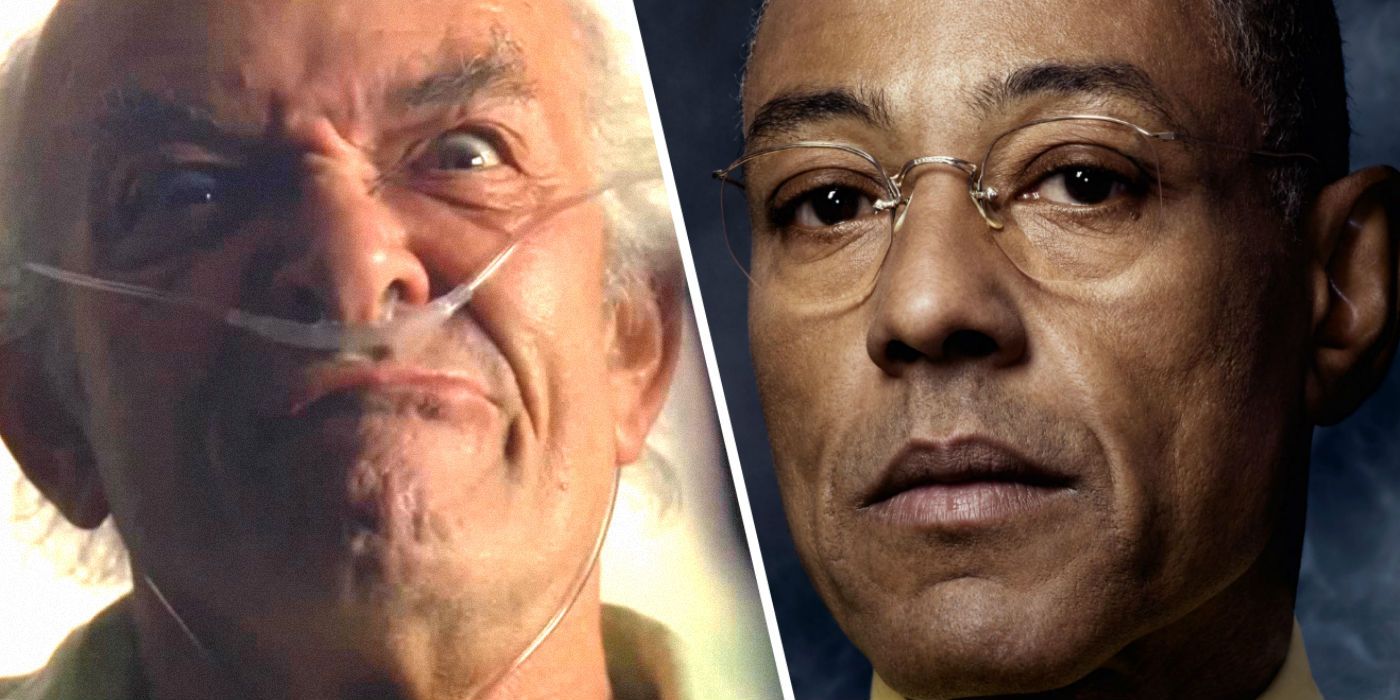
He adjusted his tie. That’s the image burned into the collective consciousness of anyone who watched Breaking Bad back in 2011. Even now, over a decade later, the death of Gus Fring remains a masterclass in tension, subversion, and the sheer unpredictability of Vince Gilligan’s writing.
It was a explosion. Literal and figurative.
Gus Fring wasn’t just a villain; he was the shadow of who Walter White wanted to be. He was the "Chicken Man." A philanthropist. A cold-blooded kingpin. When he walked into that nursing home room to face Hector Salamanca, most of us expected a clean kill or a narrow escape. We didn't expect a two-faced reveal that would redefine the limits of cable television.
The Clockwork Precision of Face Off
The Season 4 finale, titled "Face Off," is widely considered one of the greatest hours of television ever produced. Honestly, the build-up was agonizing. For weeks, Walt had been trying to get close to Gus, but the man was a ghost. He was too smart. Too careful.
He didn't use a cell phone when it mattered. He didn't take risks.
But Gus had one weakness: pride. Specifically, his deep-seated, decades-long grudge against the Juárez Cartel and the last surviving member of the Salamanca family, the bell-ringing Hector. Walt realized that the only way to lure the dragon out of its lair was to use the one person Gus hated more than Walt himself.
It’s kinda brilliant when you think about it. Walt didn't outsmart Gus with chemistry; he outsmarted him with psychology.
How the Bombing Actually Worked
The mechanics of the death of Gus Fring were relatively simple in theory but terrifying in execution. Walt rigged a pipe bomb to Hector’s wheelchair. The trigger? Hector’s own call bell. That "ding" wasn't just a communication tool anymore. It was a detonator.
When Gus entered the room at Casa Tranquila, he expected a final moment of triumph over his enemy. He leaned in, ready to deliver a lethal injection. Instead, he saw the look in Hector’s eyes. It wasn't fear. It was pure, unadulterated rage.
The bell rang. Multiple times.
Then, silence. Then, fire.
The Visual Shock That Fooled Everyone
What happened next is the stuff of TV legend. The door to the room is blown off its hinges. Smoke pours into the hallway. And then, Gus Fring walks out.
He looks fine.
For about three seconds, the audience collectively gasped. We thought he’d survived. We thought he was immortal. He stands there, straightens his suit jacket, and adjusts his tie with that signature, methodical calm. Then the camera pans.
The right side of his face is gone.
The makeup work by Greg Nicotero and the VFX team was gruesome. You could see the skull, the empty socket, the raw muscle. It was a "Two-Face" moment brought to life in a way that felt grounded—or at least as grounded as a man walking with half a head can be. He collapses. He dies. The reign of the Los Pollos Hermanos empire ends right there on the carpet of a retirement home.
The Real-World Science: Could You Walk Away?
Let’s be real for a second. Could a human being actually stand up and walk after an explosion that clears half their face?
Medical experts have debated this for years. While Breaking Bad is fiction, the show usually tried to stay within the realm of "plausible but extreme." The phenomenon is known as "cadaveric spasm" or simply a massive surge of adrenaline. There have been recorded instances in war zones where soldiers, suffering from catastrophic head wounds, perform a final, reflexive action before the brain realizes the body is dead.
Gus Fring’s tie adjustment wasn't a conscious choice. It was muscle memory. It was the final twitch of a man who had spent his entire life obsessed with order and appearance.
Honestly, if he had just fallen over, it wouldn't have been Gus. That final act of grooming was the most honest moment the character ever had.
Why the Death of Gus Fring Had to Happen
Narratively, Gus had to go so Walt could become the monster.
As long as Gus was alive, Walt was a secondary player. He was an employee. A disgruntled chemist. By orchestrating the death of Gus Fring, Walt officially moved from being a protagonist we rooted for to an antagonist we feared. Remember the phone call to Skyler right after?
"I won."
Three words. That’s all it took to realize that the hero of the story was gone, and "Heisenberg" had fully taken the wheel. The power vacuum left by Gus led directly to the chaos of Season 5, the introduction of Lydia Rodarte-Quayle, and the eventual rise of Todd and the Neo-Nazis. Gus was the "professional" criminal. What followed was amateur hour, and it was significantly bloodier because of it.
The Aftermath and the Legacy
The Los Pollos Hermanos brand became a symbol of hidden evil. In the wake of the explosion, the DEA finally connected the dots. Hank Schrader, who had been obsessed with Gus for months, was finally vindicated. But it was a hollow victory.
The death of Gus Fring didn't end the drug trade in Albuquerque. It just made it more volatile.
In Better Call Saul, the prequel series, we got to see the years of labor Gus put into building his underground laboratory. Seeing the decades of planning that went into his empire makes his sudden, violent end in Breaking Bad even more impactful. You realize he wasn't just a drug dealer; he was an architect. And Walt knocked his building down with a bell and some homemade explosives.
Fact-Checking the Fring Finale
There are some common misconceptions about this episode that still float around fan forums.
- Was it a suicide mission? Yes, for Hector. He knew he was dying. He chose to go out taking his greatest rival with him.
- Did Tyrus die instantly? Yes. Tyrus Kitt, Gus’s loyal henchman, was in the room and was caught directly in the blast radius.
- Was the nursing home real? The exterior shots were filmed at a real assisted living facility in Albuquerque, though the explosion was handled through a mix of practical sets and CGI.
The technical execution of the scene involved a "split-plate" shot. Giancarlo Esposito (the actor who played Gus) performed the scene twice—once with his face intact and once with green tracking dots. The VFX team then layered a digital sculpt of the wound over his performance. It’s why the movement feels so fluid and terrifyingly real.
Actionable Takeaways for Fans and Creators
If you’re a storyteller or a student of film, the death of Gus Fring offers several concrete lessons on how to handle a "big bad" exit.
- Exploit the Character's Trait: Gus died because of his need for personal revenge and his obsession with neatness. Use a character's greatest strength as their fatal flaw.
- Subvert the "Immediate Death": The three-second delay where Gus appears unharmed is what makes the scene iconic. It toys with the audience's expectations.
- The "I Won" Moment: Ensure the death of a major antagonist serves the character development of the protagonist. Walt’s reaction to the kill was more important than the kill itself.
To truly appreciate the depth of this moment, it’s worth re-watching the Season 4 finale alongside the Better Call Saul episode "Fun and Games." The contrast between Gus at the height of his power and his final moments in the nursing home is staggering.
The story of Gustavo Fring is a tragedy of discipline. He was the man who could never be caught, right up until the moment he let his humanity—his hatred—get the better of him. When the smoke cleared in that hallway, it wasn't just a man who died. It was the last bit of "order" in the New Mexico underworld.
Next time you see a blue bucket of fried chicken, remember the man who adjusted his tie while staring into the abyss. It’s a level of "cool" that television will likely never see again. Even if he was a monster, he was a monster with standards.
Practical Research Steps:
- Watch the "Making of Face Off" featurette on the Breaking Bad Blu-ray for a deep dive into the prosthetic work.
- Compare the cinematography of the nursing home scene with the Season 3 finale, "Full Measure," to see how the show uses lighting to signal a power shift.
- Read Giancarlo Esposito's interviews regarding his "zen" approach to playing Gus, which informed that final, chilling walk out of the room.