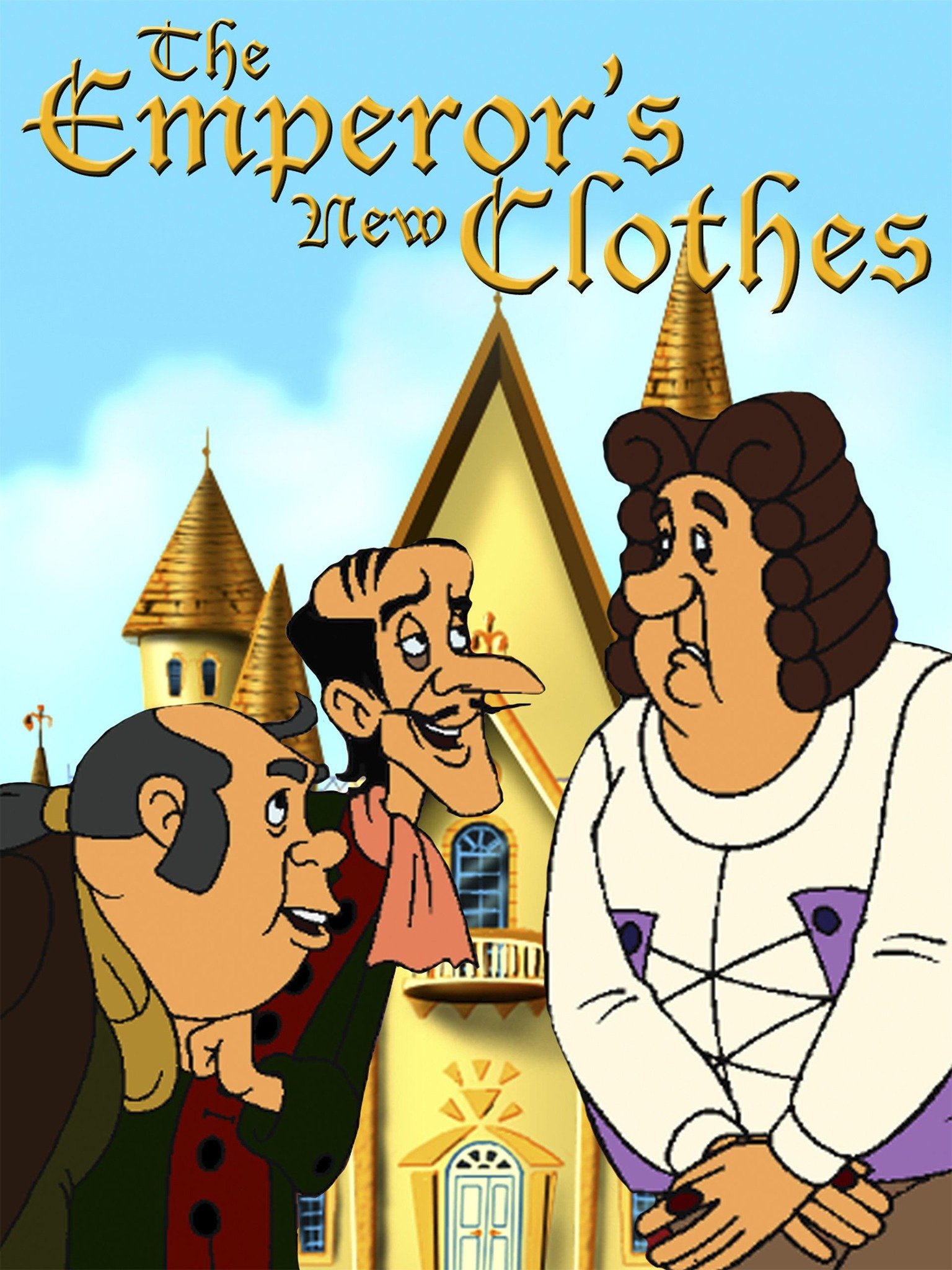
You know the story. Some guy in a crown walks down the street stark naked because two con artists convinced him that only "stupid" people couldn't see his magical suit. We laugh at the king. We roll our eyes at the courtiers. But honestly? We’re doing the exact same thing every single day in boardrooms, fashion galleries, and social media feeds.
Hans Christian Andersen published The Emperor's New Clothes in 1837, yet it feels more like a 2026 documentary than a fairy tale. It isn’t just a cute story for kids about a naked guy. It’s a brutal psychological breakdown of pluralistic ignorance—that weird human glitch where everyone privately disagrees with something but publicly goes along with it because they think they’re the only ones who don't "get it."
Where the Story Actually Came From (It Wasn't Denmark)
Most people think Andersen just whipped this up out of thin air. He didn't. He actually adapted it from a Spanish collection of stories called El Conde Lucanor, written by Juan Manuel in 1335. In the original Spanish version, the "invisible" thing wasn't for stupid people—it was for people who weren't their father's true sons. It was a test of legitimacy and inheritance.
Andersen made a brilliant pivot.
By changing the "test" to one of intelligence and professional fitness, he tapped into a much deeper insecurity. Nobody wants to be the "dumb" person in the room. This shift turned a local Spanish moral tale into a universal masterclass in social pressure. He knew that the fear of being seen as incompetent is way more powerful than the fear of being seen as illegitimate.
He almost gave it a different ending, too. In his original draft, the Emperor just continues the procession and everyone stays quiet. It wasn't until the very last minute, right before the 1837 publication of Fairy Tales Told for Children, that he added the child who shouts, "But he hasn't got anything on!"
That tiny change changed history.
The Psychology of the Naked Emperor
Why didn't the advisors speak up? Are they just idiots?
Probably not.
Social psychologists call this "informational social influence." When we’re unsure about something, we look to others to see how to react. If everyone else is nodding and smiling at a pile of empty air, our brains literally start to rewrite our own sensory input. We tell ourselves, "I must be missing something. Maybe it’s a very fine weave. Maybe the light is hitting it wrong."
We see this in the Asch Conformity Experiments from the 1950s. Solomon Asch showed people lines of obviously different lengths. When a group of actors (confederates) all pointed to the wrong line, about one-third of the real subjects went along with the group's incorrect answer. They chose to be wrong rather than be different.
The Emperor’s New Clothes is a 19th-century version of that lab experiment.
The "weavers" in the story are classic gaslighters. They don't just sell a product; they sell a consequence for not liking the product. If you don't see the gold thread, you’re unfit for your job. That’s a high-stakes threat. It’s the same vibe as a high-end art critic telling you that a blank white canvas represents "the hollowness of post-industrial capitalism." You nod because you don't want to look like a Philistine who doesn't "get" modern art.
Modern Day "Invisible" Suits
Look around. We see this in the tech world constantly. Remember the hype cycles where people are told that a specific "revolutionary" tool is the future, and if you don't see the value, you're just a "luddite" or "behind the curve"?
- Corporate "Synergy": How many hours have you spent in meetings where a manager uses words like "holistic pivot" or "ecosystem optimization," and everyone just nods? No one knows what it means. It’s invisible fabric.
- The "Hustle" Culture: We’re told that working 18 hours a day is "weaving" a life of success, even when we can clearly see the person is burning out and miserable.
- Fads and Trends: High fashion often plays this game. A designer sends a literal trash bag down a runway for $2,000. People buy it because they want to belong to the "in-group" that understands the irony.
The scary part isn't the scammers (the weavers). Scammers always exist. The scary part is the collective silence of the crowd.
The Child’s Perspective: Radical Honesty
The child in the story succeeds where the "experts" fail because the child has no status to lose. He doesn't have a government job. He isn't worried about his reputation at the local tavern. He just sees skin and says, "That's skin."
Intellectual honesty is expensive.
If you're the first person in a corporate meeting to say, "I actually don't understand how this project makes money," you are taking a massive social risk. You are the child in the street. You might be right, but you’re also the one making everyone else feel uncomfortable for their own silence.
In a way, the story is a warning about the "Expert Fallacy." We assume that because someone has a title or a fancy loom, they must be producing something of value. Andersen shows us that the higher up the social ladder you go, the more clothes you’re forced to pretend you see.
How to Spot the "Invisible Fabric" in Your Own Life
It’s easy to judge the Emperor, but it’s harder to realize when we’re the ones parading around in our underwear. Identifying these moments requires a bit of a "sanity check" routine.
- Check for "The Threat": Is the value of this thing tied to your intelligence or status? If someone says, "Only smart people like this," your internal alarm should go off. Real value doesn't need a barrier to entry based on ego.
- The "Explain it to a Five-Year-Old" Test: If you can't explain why a strategy, a product, or a trend is good without using buzzwords, you’re probably looking at empty air.
- Find Your "Truth-Teller": Everyone needs that one friend who isn't impressed by your titles or your "designer" gear. The one who will tell you that you're being ridiculous.
The Emperor actually realized he was naked halfway through the parade. Andersen writes that the Emperor "shivered, for he suspected they were right." But he didn't stop. He held himself even more stiffly and continued the march.
That’s the most human part of the whole story. The "sunk cost fallacy" kicks in. You've already committed to the lie, so you double down rather than admit you were a fool.
Final Thoughts on the Naked Truth
The Emperor's New Clothes isn't a story about a lack of clothes. It's a story about a lack of courage.
We live in a world of "weavers" who are very good at selling us things that don't exist—whether that’s a perfect lifestyle on Instagram or a "guaranteed" investment. The only defense we have is the willingness to be the "stupid" person in the room who asks the simple question.
Stop looking for the gold thread. Start looking at the person behind the loom.
Next Steps for Staying Grounded:
- Practice Low-Stakes Dissent: Next time you're in a group and everyone agrees on a movie or a restaurant you actually hated, say so. Get used to the feeling of being the lone voice.
- Audit Your Influences: Look at the "experts" you follow. Are they providing concrete value, or are they just telling you that you’re "special" for following them?
- Value Clarity Over Complexity: In your own work and communication, aim to be the person who makes things simple. Complexity is often just a fancy cloak for a lack of substance.