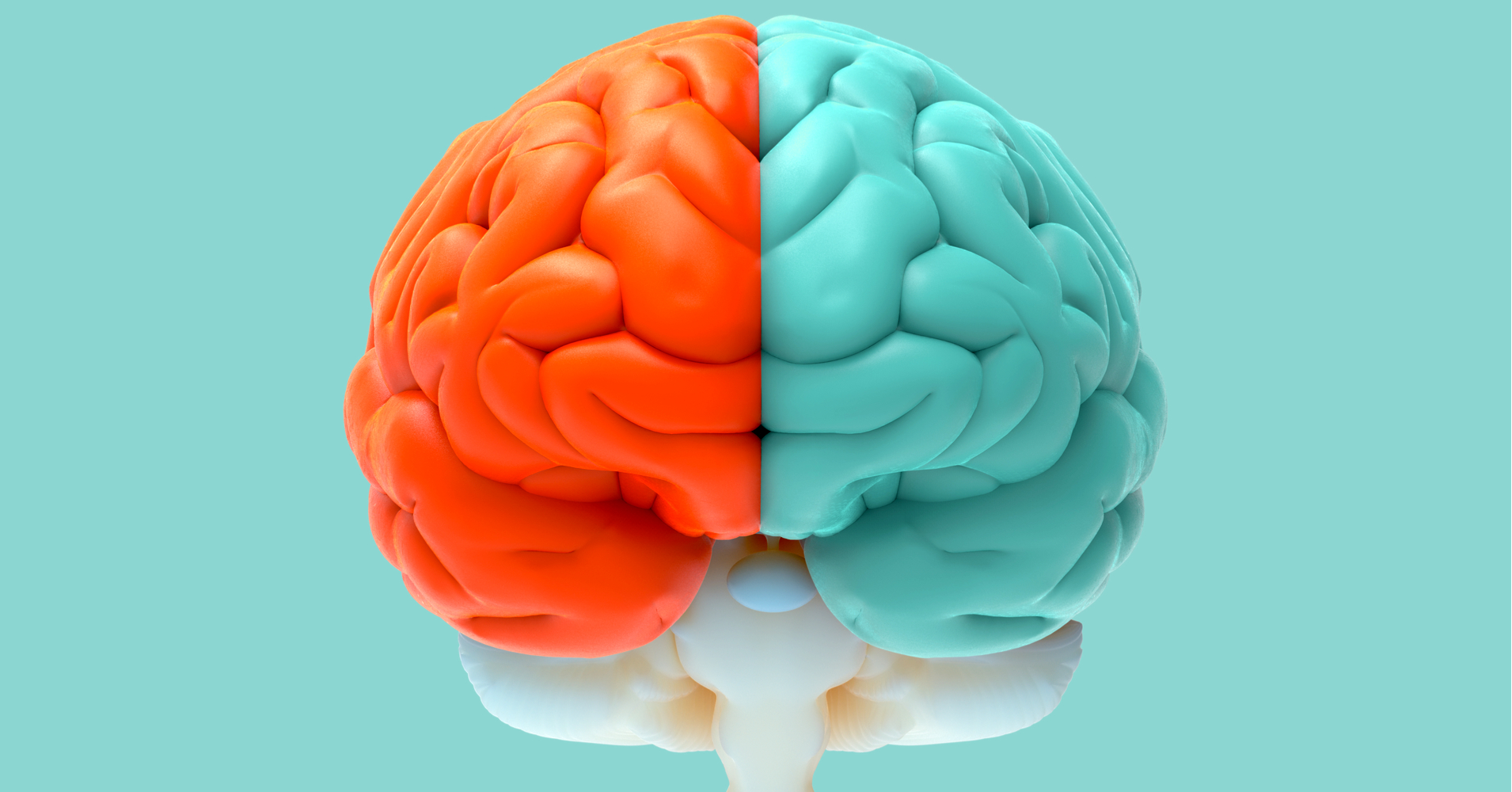
You’ve seen the meme. It’s usually a spinning ballerina or a colorful graphic of an explosion of paint next to a rigid grid of equations. The caption asks if you see the dancer turning clockwise or counter-clockwise. Then, it hits you with the "verdict." If she’s spinning right, you’re a creative, soulful, "right-brained" visionary. If she’s spinning left, you’re a logical, math-loving, "left-brained" strategist.
People love taking a left brain or right brain test because it feels like a shortcut to understanding who we are. It’s like a horoscope but with the shiny veneer of neuroscience.
The problem? It’s basically all wrong.
That doesn't mean the tests are useless, though. They tell us a lot about our preferences, even if the "science" behind the hemisphere split is about fifty years out of date. To really understand why we’re obsessed with this, we have to look at where the idea started and how the human brain actually handles a heavy workload.
The Nobel Prize That Started the Mess
In the 1960s, a neurobiologist named Roger W. Sperry conducted experiments that would eventually win him a Nobel Prize. He worked with "split-brain" patients—people who had their corpus callosum (the bridge between the two halves of the brain) severed to treat severe epilepsy. By isolating the hemispheres, Sperry discovered that the left and right sides did indeed specialize in certain tasks.
He found the left side generally handled language and logic. The right side was better at spatial recognition and face processing.
It was groundbreaking. It was also immediately oversimplified by the public.
Suddenly, every self-help guru and pop-psychology magazine was peddling the idea that you were "dominant" in one side. We started categorizing people like Pokémon types. You’re an accountant? Left-brained. You’re a painter? Right-brained. It’s a clean, binary way to view the world, which is why it stuck. But the brain isn't a collection of siloed departments. It’s more like a massive, chaotic, high-speed conference call.
Why Your Left Brain or Right Brain Test Results Are Misleading
In 2013, researchers at the University of Utah decided to settle this. They looked at brain scans of more than 1,000 people. They analyzed thousands of regions of interest to see if individuals had stronger networks on one side versus the other.
The results were a bit of a buzzkill for the "personality test" industry.
The study found no evidence that people have a dominant side. While certain functions are lateralized (language really does live mostly in the left hemisphere for most right-handed people), the connections across the entire brain are what define our abilities. You don't "use" your right brain to paint while the left brain sleeps. You use your left brain to handle the fine motor control of the brush and the right brain to judge the perspective and color. They’re a team.
Honestly, the idea that a creative person isn't logical or a logical person isn't creative is kind of insulting to how complex we are.
Think about a professional programmer. Coding is often seen as the ultimate "left-brain" activity. It's logic, syntax, and math. But any high-level dev will tell you that writing elegant code is a deeply creative process. It requires visualizing abstract structures that don't exist yet. That’s "right-brain" territory. The labels just don't hold up under pressure.
The Power of the Placebo: Why We Still Take the Tests
If the science is bunk, why do we care?
It's because a left brain or right brain test serves as a mirror. When you answer questions about whether you prefer schedules (left) or spontaneity (right), you aren't discovering your brain's physical architecture. You’re identifying your cognitive style.
Psychologists often talk about "Big Five" personality traits or "Need for Cognition." The left-right myth is just a more digestible way to talk about these things. If you score as "right-brained," it usually just means you value intuition and open-endedness. That’s a valid thing to know about yourself! It just has nothing to do with which hemisphere is "stronger."
We like categories. They make the world feel less random. If I can say, "Oh, I'm just right-brained, that's why I'm messy," it gives me a sense of identity. It’s a story we tell ourselves.
The Real "Side" Story: Lateralization is Real (But Different)
To be fair to the test-makers, lateralization isn't a total myth. It’s just nuanced.
- Language: For about 95% of right-handed people, the left hemisphere is the heavy lifter for speech and writing. For left-handed people, that number drops to about 70%.
- Attention: The right hemisphere is generally more involved in "broad" attention—being aware of your surroundings—while the left hemisphere focuses on "narrow" attention—concentrating on a specific task.
- Emotion: Some studies suggest the left side is more involved in "approach" emotions (like joy or anger), while the right side handles "avoidance" emotions (like fear or disgust).
Notice that none of these mean you're a "math person" or an "art person." They’re just functional specializations that help the brain run more efficiently. If both sides tried to do everything at once, it would be a massive waste of metabolic energy.
How to Actually Use Your "Results"
So, you took a left brain or right brain test and it said you're a "Right-Brain Creative." What now?
Don't use it as an excuse. Don't say, "I'm right-brained, so I can't do my taxes." That’s a trap. Instead, use it to understand your learning preferences. If you know you lean toward "right-brain" traits, you might learn a new language better through immersion and conversation (big picture) rather than drilling grammar rules (fine details).
If you score as "left-brained," you might find that you work best when you break a large project into a checklist.
The goal isn't to figure out which side of your head is "winning." The goal is to figure out how to get the two sides to talk to each other more effectively. Neuroplasticity—the brain's ability to change—means you aren't stuck in one "mode" forever. You can build the "logical" muscles or the "creative" ones through practice.
The Danger of the Binary
The most annoying part of this myth is how it limits kids.
Imagine a ten-year-old taking a goofy online quiz and being told they are "left-brained." They might stop trying in art class. Or a "right-brained" kid might decide they are "bad at math" before they even give it a real shot. We’re essentially using fake science to build boxes for ourselves.
The most successful people in history were "whole-brained." Leonardo da Vinci was an anatomist and an artist. Albert Einstein played the violin to help him think through physics problems. They didn't see a wall between logic and intuition. They saw them as two ends of the same string.
Actionable Steps: Moving Beyond the Quiz
If you’ve been relying on these tests to define your career or personality, it’s time to pivot. Stop looking for which side you belong to and start looking at how to integrate both.
Challenge your "weak" side. If you think you're "left-brained" (logical), spend twenty minutes a day doing something with no "correct" answer. Doodling, improv, or even just taking a different route home. This forces your brain to step out of its "optimization" mode and into "exploration" mode.
Structure your "strong" side.
If you identify as "right-brained" (creative), try applying a rigid system to your chaos. Use a "Time Blocking" method for your creative work. It sounds counterintuitive, but having a strict container for your creativity often makes the output better.
Ignore the "spinny girl" tests.
Optical illusions like the spinning dancer aren't tests of your personality. They are tests of your visual system's "bistable perception." Your brain is just making a 50/50 guess on 2D data that lacks depth cues. It doesn't mean you're a genius or a poet. It just means your brain is trying to make sense of a confusing image.
Focus on "Flow."
Instead of worrying about hemispheres, focus on "flow state." This is the mental state where you're so involved in an activity that nothing else seems to matter. Research shows that during flow, the brain's "executive" functions (usually left-side heavy) and "associative" functions (usually right-side heavy) work in a highly synchronized way.
Ultimately, the left brain or right brain test is a fun diversion, but it’s a terrible map for your life. You have a whole brain. You might as well use all of it.
Start by picking one task this week that scares you because it's "not your style." If you're a numbers person, write a poem. If you're a writer, spend an hour learning the basics of a spreadsheet. You'll probably find that your "other" brain is a lot more capable than a 10-question internet quiz led you to believe.
Don't let a myth dictate your potential. The most interesting version of you is the one that refuses to be categorized by a hemisphere.