You think you know the Florida Panhandle. Most people do. They see the white sand and think they've unlocked the whole map. But honestly? The 15-mile stretch from Perdido Key to Pensacola is a weird, beautiful, and sometimes confusing transition from "Lost Key" isolation to historic city grit.
It’s not just a drive. It's a vibe shift.
You start in Perdido, where the buildings are shorter and the pace feels like it’s stuck in 1994. Then you cross that bridge. Suddenly, you’re hitting the back gate of NAS Pensacola, dodging Navy flight students, and smelling the smoked mulch of the bayou before you even see the downtown skyline. If you just stick to the main highway, you're doing it wrong. You're missing the pockets of the Gulf Islands National Seashore that most tourists drive right past because they're too busy looking for a Five Guys.
The Reality of the Perdido Key to Pensacola Route
Let’s talk logistics. If you take Gulf Beach Highway (SR 292), you’re looking at about 30 minutes. That’s if the traffic at the intersection of Blue Angel Parkway isn't backed up because of a shift change at the base.
Perdido Key is a barrier island. It’s narrow. On one side, you have the Gulf of Mexico; on the other, the Big Lagoon. This geographical sandwich means there is only one way out if you’re heading east toward the city. You have to cross the Theo Baars Bridge.
Once you’re over that bridge, you aren't in Pensacola yet. Not really. You’re in a sort of "no man's land" of residential neighborhoods and bait shops. This is where the local knowledge comes in handy. Most GPS apps will try to shove you onto Navy Boulevard. It’s efficient, sure. But it’s ugly. It’s all strip malls and pawn shops.
If you want the real experience, you stay south.
Why the National Seashore is the Actual Star
Most people hear "National Park" and they think of Yellowstone. Out here, the Gulf Islands National Seashore is basically just our backyard. But it's massive. Between Perdido Key to Pensacola, you have the Johnson Beach area.
Listen. Do not just go to the first parking lot.
Drive. Keep driving until the road literally ends. The road out to the tip of Johnson Beach is frequently covered in sand because the dunes are alive. They move. The National Park Service (NPS) spends half their life sweeping that road. When you get to the end, you can hike out toward the ruins of Fort McRee. There are no roads there. No condos. Just the sound of the boat wakes hitting the shore and maybe a stray heron wondering why you're in its space.
It’s quiet. Ghostly, even.
The contrast when you finally hit the Pensacola city limits is jarring. You go from that primal, salty silence to the roaring engines of the Blue Angels practicing overhead. If it's a Tuesday or Wednesday morning, look up. You’ll see the C-130 "Fat Albert" or the F/A-18s banking so hard over the bayou that you can see the vapor trails. It’s loud. It’s visceral. It’s Pensacola.
Mapping the Transition: From Sand to Sidewalks
The drive from Perdido Key to Pensacola takes you through several distinct mini-ecosystems.
- The Key: High-end condos mixed with "Old Florida" beach shacks. The Florabama is technically just over the line in Alabama, but it dominates the culture here.
- Innerarity Point: This is a peninsula just off the key. Go here if you want food that isn't fried shrimp in a basket. Hub Stacey’s at the Point is a local staple. Get a sandwich. Sit outside. Watch the boats.
- Warrington: This is the area surrounding the Naval Air Station. It’s rugged. It’s where the locals live. It has the best hole-in-the-wall taco joints and dive bars that have been there since the 1950s.
- Downtown Pensacola: Palafox Street. This is where the money is. It’s been voted one of the "Great Streets in America," and honestly, it earns it. Crepe myrtles, wrought-iron balconies, and more breweries than you have liver capacity for.
People often ask if they should stay in Perdido or Pensacola. It’s a trick question.
Perdido is for when you want to disappear. It’s for reading a book and realizing you haven't put on shoes in three days. Pensacola is for when you want a $15 cocktail and a ghost tour in a building that’s older than the United States.
The Blue Angel Factor
You cannot talk about this region without talking about the Navy. The flight path from the base often follows the coastline. When you’re lounging on the sand in Perdido, you’ll occasionally feel the ground shake. It’s not an earthquake. It’s just the sound of freedom, or so the bumper stickers say.
The National Naval Aviation Museum is right on the route. It’s free. Or, it used to be perfectly open until security tightened up—now you need to check the current base access status because it changes based on "threat levels" or whatever the Pentagon decides that week. If the gate is open to civilians, go. They have a Sunken Forest of planes that were pulled from the bottom of Lake Michigan. It’s haunting.
Where Everyone Gets it Wrong
The biggest mistake? Treating the Perdido Key to Pensacola corridor as a destination rather than a journey.
People rush. They want to get to the "main" beach at Pensacola Beach (which is actually a different island entirely, via a different bridge). By doing that, they skip Big Lagoon State Park.
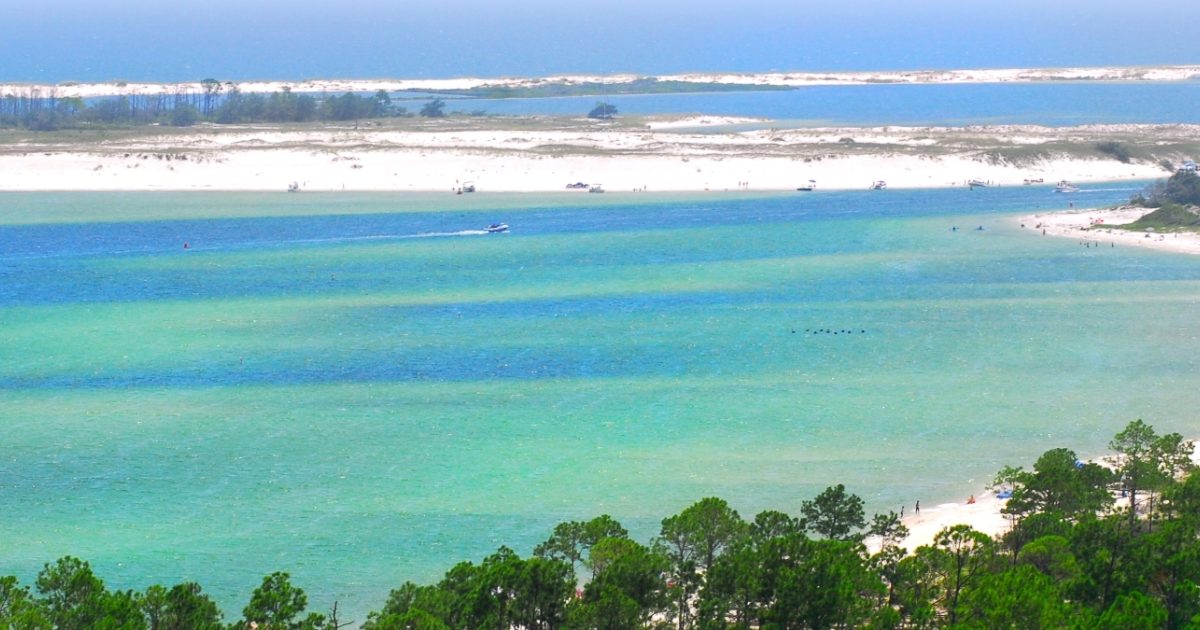
Big Lagoon is sort of the underdog of the Florida State Park system. It’s not a "beach" park in the traditional sense. It’s a marshy, salty, pine-covered labyrinth. There’s a wooden observation tower there. Climb it. You can see the entire barrier island system laid out like a geography textbook. You see how fragile this strip of land actually is. One good hurricane—like Sally or Ivan—and the whole map gets rewritten.
That’s the thing about this area. It feels permanent, but it’s shifting. The sand moves. The inlets open and close. Even the sand is different; it's nearly 100% quartz, washed down from the Appalachian Mountains over millions of years. It literally squeaks when you walk on it. If your sand doesn't squeak, you aren't on the Emerald Coast.
Feeding the Beast: The Food Gap
Food on the Key is... okay. It’s fine. It’s touristy.
Food in Pensacola is a whole different animal.
As you move from Perdido Key to Pensacola, the culinary landscape shifts from "Shrimp Po'boy #4" to James Beard-nominated chefs. George Latzko's "George Bistro + Bar" or the high-end fusion at Iron. You wouldn't expect a city this size to have a food scene that rivals larger metros, but the military influence brings in people from all over the world. You can find authentic Vietnamese pho five minutes away from a place serving artisanal Southern grits.
Don't ignore the Joe Patti’s factor. It’s a seafood market on the edge of downtown Pensacola. It’s chaotic. It’s loud. There’s a guy on a microphone calling out numbers like it’s a high-stakes bingo game. You buy your shrimp by the pound, take it back to your rental in Perdido, and steam it yourself. That is the peak "Perdido-to-Pensacola" lifestyle.
Actionable Advice for Your Coastal Trek
If you're planning to navigate this stretch, stop thinking like a tourist and start moving like a local.
- Check the Tide Tables: If you're planning on hitting the National Seashore at Johnson Beach, low tide is when the tidal pools form. These are perfect for kids or for spotting small rays and crabs without the surf knocking you over.
- Avoid "The 98" at Rush Hour: Highway 98 is the main artery. From 7:30 AM to 9:00 AM and 4:00 PM to 5:30 PM, it is a parking lot. Use Sorrento Road or Gulf Beach Highway as your alternates.
- The Bridge Toll: There isn't one between Perdido and Pensacola. However, if you decide to ventur over to Pensacola Beach (Santa Rosa Island), there is a $1 electronic toll. Don't look for a person to hand a dollar to; they don't exist anymore. It’s all SunPass or "toll-by-plate."
- Pack for Two Climates: It can be 85 degrees and sunny on the sand in Perdido, but by the time you reach the shaded, oak-lined streets of North Hill in Pensacola, the humidity traps the heat differently.
- Respect the Flags: The Gulf has a mean undertow. If you see a red flag at Perdido, stay out of the water. People drown here every year because they think "it doesn't look that rough." The Pensacola pass—the opening between the islands—has currents that will drag a grown man out to sea before he can yell for help.
The Actionable Bottom Line
To truly experience the Perdido Key to Pensacola corridor, you need to split your time 60/40. Give 60% of your energy to the raw, undeveloped nature of the Key and the National Seashore. Spend the other 40% getting lost in the history of Pensacola.
Start your morning at the sunrise on Johnson Beach. Hike the Discovery Trail. Then, hop in the car, roll the windows down, and take the slow road past the Bayou Grande. Grab a coffee at Fosko Coffee Barre downtown, walk the T-Pier to watch the fishing boats come in, and end your day at a brewery like Gulf Coast or Odd Colony.
This isn't a "pick one" situation. The beauty of this specific corner of Florida is that you can be a beach bum in the morning and a history buff by lunch. Just watch your speed through Warrington—the cops there don't care that you're on vacation.
Take the detour through the Naval Air Station if the gates are open. Visit the lighthouse. Climb the 177 steps. Look west toward Perdido and east toward the city. You’ll see the white line of the coast connecting them, a thin ribbon of sand that holds more history and hidden gems than any travel brochure will ever tell you.