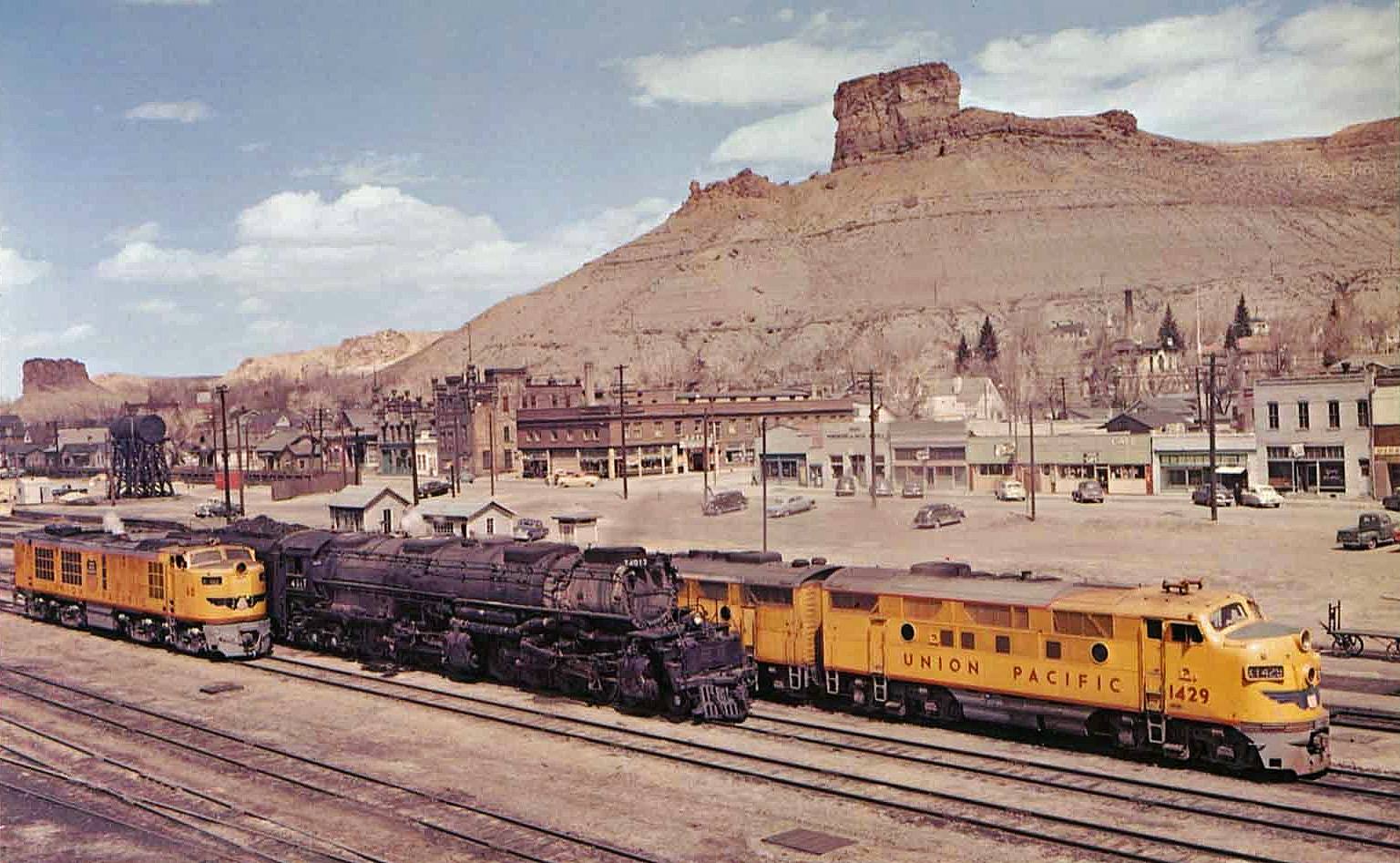
Honestly, we talk about the Union Pacific transcontinental railroad like it was just a big construction project. It wasn't. It was basically the 19th-century version of the Moon landing, but with more dirt, dynamite, and corruption. People today look at an old iron spike and think "cool history," but they don't realize that before this thing existed, getting from New York to San Francisco took six months. You either risked your life in a wagon across the Plains or spent a fortune on a ship that might sink off the coast of South America. Then, suddenly, it was six days. Everything changed.
The Union Pacific wasn't just building a path; they were literally inventing a new world.
The Messy Reality of the Union Pacific Transcontinental Railroad
When Abraham Lincoln signed the Pacific Railway Act in 1862, the country was literally tearing itself apart in the Civil War. It seems kind of insane to start a massive infrastructure project while the North and South were killing each other. But Lincoln knew that without a physical connection, the West Coast might just drift away. The Union Pacific started in Omaha, Nebraska, and headed west. They weren't exactly the "good guys" in a clean-cut story. It was a business. A messy, greedy, incredibly ambitious business.
The work was brutal.
Most people don't know that the Union Pacific relied heavily on Civil War veterans—Irish immigrants who had just finished fighting and now found themselves swinging sledgehammers. These guys lived in "Hell on Wheels" towns. These were basically mobile tent cities that followed the tracks, filled with saloons, gambling dens, and a lot of violence. It was chaotic. You've got thousands of men pushed to their limits, working in blistering heat and freezing winters, all while the company leaders were back in the East trying to figure out how to squeeze more money out of the government.
The Credit Mobilier Scandal
We have to talk about the money because it was a disaster. The Union Pacific wasn't just funded by the government; it was subsidized by the mile. This led to one of the biggest financial scandals in American history: Credit Mobilier. Basically, the guys running the Union Pacific created their own construction company, Credit Mobilier, and then hired themselves at massive markups. They were essentially overcharging the government and pocketing the difference.
It was bold. It was illegal. It almost ruined everything.
When the truth came out in 1872, it smeared the reputations of powerful politicians, including Vice President Schuyler Colfax. It shows that the Union Pacific transcontinental railroad wasn't just a feat of engineering; it was a masterclass in corporate greed. But even with all that corruption, the tracks kept moving. The sheer momentum of the project was unstoppable.
Iron, Sweat, and the Central Pacific Rivalry
While the Union Pacific was pushing west from Omaha, the Central Pacific was pushing east from Sacramento. It was a race. Literally. The government paid per mile of track laid, so both companies were incentivized to work as fast as humanly possible, even if the tracks were sometimes shoddy.
The Union Pacific had it "easy" compared to the Central Pacific, which had to blast through the Sierra Nevada mountains. But the Union Pacific had its own nightmares. They were crossing the Great Plains, which sounds flat and simple until you realize there was almost no timber for ties and no stone for bridges. They had to haul every single piece of wood and iron from the East.
- They laid as much as 10 miles of track in a single day at their peak.
- The workforce grew to over 10,000 men.
- They dealt with constant raids and conflicts with Indigenous tribes like the Sioux and Cheyenne, who—rightly—saw the railroad as a direct threat to their way of life and the buffalo herds they relied on.
The environmental impact was staggering. It wasn't just about the tracks. It was about the buffalo. The railroad brought hunters who slaughtered the herds by the millions, effectively starving the Plains tribes into submission. It’s a dark part of the story that often gets glossed over in the "triumph of progress" narrative.
Promontory Summit: The Moment Everything Changed
By May 1869, the two lines were closing in on each other in Utah. The Union Pacific and Central Pacific had actually graded parallel paths past each other for miles because they didn't want to stop collecting those government subsidies. The government finally had to step in and say, "Pick a spot, guys." That spot was Promontory Summit.
On May 10, the "Golden Spike" was driven.
Actually, there were several spikes, and they weren't all gold. The famous one was, but it was immediately pulled out and replaced with regular iron because, obviously, you can't leave gold sitting in the middle of the desert. The telegraph operator sent out one word: "DONE." It was the first mass-media event in American history. People in New York and San Francisco celebrated simultaneously. The continent was finally, physically, one nation.
Why It Still Matters in 2026
You might think the Union Pacific transcontinental railroad is just a dusty chapter in a textbook. It's not. The route the Union Pacific laid out is still largely the backbone of American freight today. When you see a long train blocking a crossing in Nebraska or Wyoming, there’s a good chance it’s sitting on the same right-of-way established in the 1860s.
The engineering was incredible for the time. They didn't have computers. They didn't have GPS. They had transits, chains, and a lot of math done by hand. The fact that the tracks actually met up within inches of each other is a miracle of 19th-century science.
The Human Cost and Legacy
We can't talk about this without acknowledging the people who were erased or exploited. While the Union Pacific used mostly Irish labor, the Central Pacific used thousands of Chinese workers who were paid less and given the most dangerous jobs. When the project was finished, the Chinese workers were largely ignored in the celebrations.
The railroad also spelled the end of the "Old West." The romanticized era of the long-distance wagon train was over. The frontier was officially "closed" by 1890, largely because of the accessibility the train provided. It turned the West into a series of stops for a corporation.
Visiting the History
If you actually want to see this for yourself, don't just go to a museum. Drive the "Transcontinental Railroad Backcountry Byway" in Utah. It’s a 90-mile stretch of the original grade where the tracks were pulled up in 1942 for the war effort. You can see the original cuts through the rock and the trestles that haven't moved in over 150 years.
It's quiet out there. You get a sense of the scale.
- Golden Spike National Historical Park: This is where the engines met. They have working replicas of the "Jupiter" and "No. 119" locomotives. They actually run them. The smell of the coal smoke and the hiss of the steam gives you a visceral sense of what it was like.
- Union Pacific Railroad Museum: Located in Council Bluffs, Iowa. It houses the really deep-dive stuff—personal letters, the actual tools used, and the maps that changed the country.
- The Sierra Nevada Tunnels: Though this was the Central Pacific side, you can still hike through the old Donner Pass tunnels. It’s haunting.
The Union Pacific transcontinental railroad was a beautiful, terrible, brilliant mess. It was built on a foundation of greed, immigrant sweat, and a desperate need for national unity. It proved that the American landscape could be conquered, but it also showed the high price of that conquest.
Next time you’re flying over the mid-section of the country, look down. You can still see those straight lines cutting through the plains. That's not just dirt. That's the ghost of a machine that built the modern world.
Actionable Steps for Exploring Railroad History
If you’re interested in the legacy of the transcontinental era, don't just read about it. Experience the logistics and the geography that defined the 1860s.
Map the Original Route
Use tools like Google Earth to trace the original 1869 line from Omaha to Promontory. Look for the "bow-tie" patterns in the landscape where the tracks were straightened over the years. This helps you understand how the geography of the Great Plains dictated the movement of goods for the last 150 years.
Analyze the Business Legacy
The Union Pacific is one of the few companies from that era that still exists today under its original name. If you're into business history, look into their current operations. They still control vast amounts of land granted to them by the 1862 Act. Understanding how land grants created corporate empires is key to understanding modern American wealth.
Support Preservation
Visit local railway museums in the towns that only exist because the Union Pacific stopped there. Towns like North Platte, Nebraska, or Laramie, Wyoming, have deep ties to the rail. Visiting their local historical societies provides a more "ground-level" view of how the railroad affected individual families, rather than just the "Big History" version.
Follow the Freight
Watch a modern Union Pacific "double-stack" train go by. Those containers are filled with goods from all over the world. The "Transcontinental" dream didn't end in 1869; it just evolved into a global supply chain that still relies on those same mountain passes and river crossings.