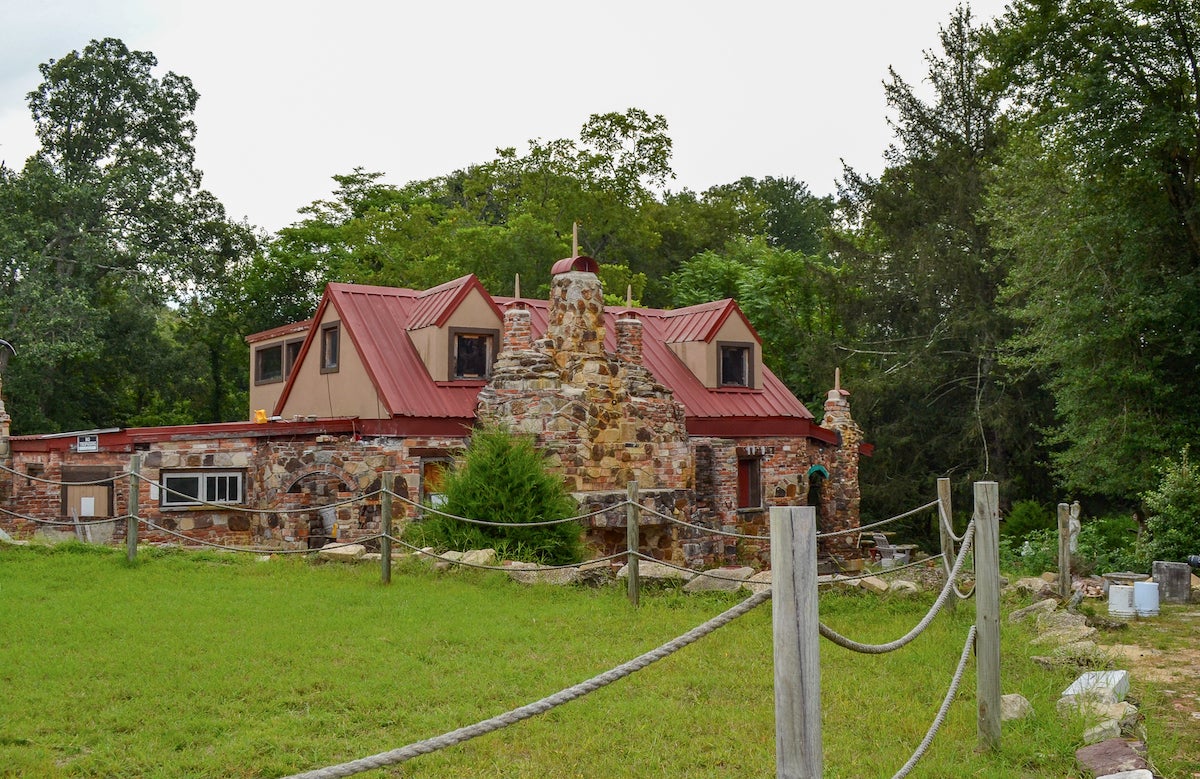
George Daynor was a man who lost everything. Then he built a palace.
Actually, calling it a palace is kinda underselling it. It was a sprawling, subterranean, bizarre, and beautiful monument to the human spirit—or maybe just to one man's obsession with trash. You’ve probably heard of "outsider art," but the Vineland Palace of Depression is the absolute gold standard of the genre. It wasn't just a house; it was a middle finger to the Great Depression.
Imagine it’s 1929. The stock market just ate everyone's lunch. Daynor, a former gold miner who claimed to have struck it rich in Alaska only to lose it all, walks into a swampy thicket in Vineland, New Jersey. He buys the land for a pittance because, honestly, who wanted a mosquito-infested mud hole in the middle of a national financial collapse? Nobody. Except George. He told people a "celestial messenger" guided him there.
He didn't have money for bricks or lumber. So he used what the world threw away. Old car parts. Discarded bottles. Jagged rocks. Mud. It took him years, but by the time he was done, he had created the "Strangeest House in the World." People didn't just visit; they were mesmerized. It became a roadside sensation, a beacon of weird hope during a time when most people were just trying to find their next meal.
What George Daynor Actually Built
Daynor was a character. He dressed in flashy clothes and spun yarns that would make a fisherman blush. But the physical structure of the Vineland Palace of Depression was undeniably real. It featured a network of spires, tunnels, and rooms that felt like they belonged in a dark fairy tale rather than a Jersey suburb.
The centerpiece was the "Washer-Dryer" tower, which sounds like a laundry room but was actually a complex chimney and ventilation system made of scrap metal. He built an underground "Shrine to the Depression" where he encouraged visitors to leave their worries behind. The walls were thick—sometimes several feet of mud and stone—which kept the place cool in the humid New Jersey summers.
He used logic that only an artist (or a madman) could follow.
- Auto Parts as Architecture: Grilles from Model Ts became window vents.
- The Bottle Walls: Thousands of colorful glass bottles were embedded in the walls, creating a stained-glass effect when the sun hit just right.
- The Mud-Cast Spired: He literally hand-molded the exterior to look like a melting castle.
It was chaotic. It was messy. It was brilliant.
Why People Think It's Just a Legend
If you drive down Mill Road today, you won't see the original sprawling complex that Daynor reigned over for decades. That's the tragedy. After Daynor died in 1964—penniless and living in the very structure he built—the "Palace" fell into a state of absolute ruin. Vandals, fires, and the relentless New Jersey elements did what the Great Depression couldn't. They tore it down.
By the late 1960s, the city of Vineland had a problem. The site was dangerous. Kids were sneaking in. It was a liability. So, they bulldozed it. They literally pushed the "Palace" into its own basement and covered it with dirt. For thirty years, the Vineland Palace of Depression was nothing but a memory and a few grainy photographs in the local library's archives. It became a ghost story. A legend of a "crazy old man" who lived in the mud.
But you can't kill an idea that stubborn.
The Resurrection: Rebuilding a Nightmare (in a Good Way)
In the late 90s, a group of locals decided that the Palace was too important to stay buried. They didn't just want a plaque; they wanted the castle back. Led by Kevin Kirchner and a dedicated band of volunteers, they started digging. They actually found the original footprint. They found the discarded bottles and the rusted car frames George had used as rebar.
They’ve been rebuilding it piece by piece for years. It’s a slow process because they’re trying to use Daynor’s original "junk-tech" methods. You can visit the site today and see the progress. It’s one of those rare instances where a community decided their local "weirdness" was their greatest asset.
The Man Behind the Mud
George Daynor wasn't just a builder; he was a promoter. He understood "the hustle" before that was even a term. He’d charge a few cents for a tour and sell postcards of himself standing in front of his creation. He claimed he was a multi-millionaire, but the reality was he lived a very humble, almost ascetic life dedicated to the upkeep of the Palace.
There’s a common misconception that he was just a hoarder. That’s wrong.
Hoarding is about accumulation without purpose. Daynor had a vision. Every piece of scrap had a home. He was an architect of the discarded. He proved that even when the economy is in the toilet, you can still create something that makes people stop their cars and stare in wonder.
What You See When You Visit Today
If you go to Vineland now, don't expect a polished Disney-fied version of history. It’s still a work in progress. It’s gritty. You’ll see volunteers hauling stones and mixing mortar. You’ll see the "New" Palace rising from the ruins of the old one.
- The Main Spire: They've managed to recreate the iconic silhouette that once graced postcards.
- The Underground Rooms: Walking into the restored subterranean sections gives you a chill—not from ghosts, but from the sheer ingenuity of the cooling system.
- The Jersey Devil Connection: Daynor used to claim he had "tamed" the Jersey Devil and kept it in the basement. The volunteers have leaned into the folklore, keeping that quirky, slightly spooky vibe alive.
The Real Legacy of the Palace
We live in a world of "disposable everything." We buy a phone and throw it away two years later. We tear down old buildings to put up glass boxes. The Vineland Palace of Depression stands as a total contradiction to that mindset. It says that nothing is truly "trash" if you have enough imagination.
It’s a reminder that resilience isn't just about surviving; it’s about decorating your survival. George Daynor didn't just survive the 1930s; he built a palace out of them. He took the very symbol of his failure—the dirt and the scrap—and turned it into a landmark.
How to Experience the History Yourself
Don't just read about it. The site is located at 2250 S Mill Rd, Vineland, NJ. Because it's a volunteer-run restoration, the hours can be a bit "eccentric."
- Check the Facebook page: The "Palace of Depression Restoration" group is the most active place for updates.
- Bring cash: They usually ask for a small donation to keep the lights on (and the mortar mixing).
- Wear sturdy shoes: This isn't a marble museum. It’s a construction site and a mud palace.
- Talk to the volunteers: Most of the people working there have been obsessed with the Palace for decades. They know stories you won't find in any textbook.
Stop by the Vineland Historical and Antiquarian Society while you're in town. They hold some of the original artifacts and photos from Daynor’s era that couldn't be left out in the rain. It gives you the "before and after" context that makes the restoration feel even more miraculous. Supporting these local efforts is the only way weird, wonderful places like this survive into the next century.