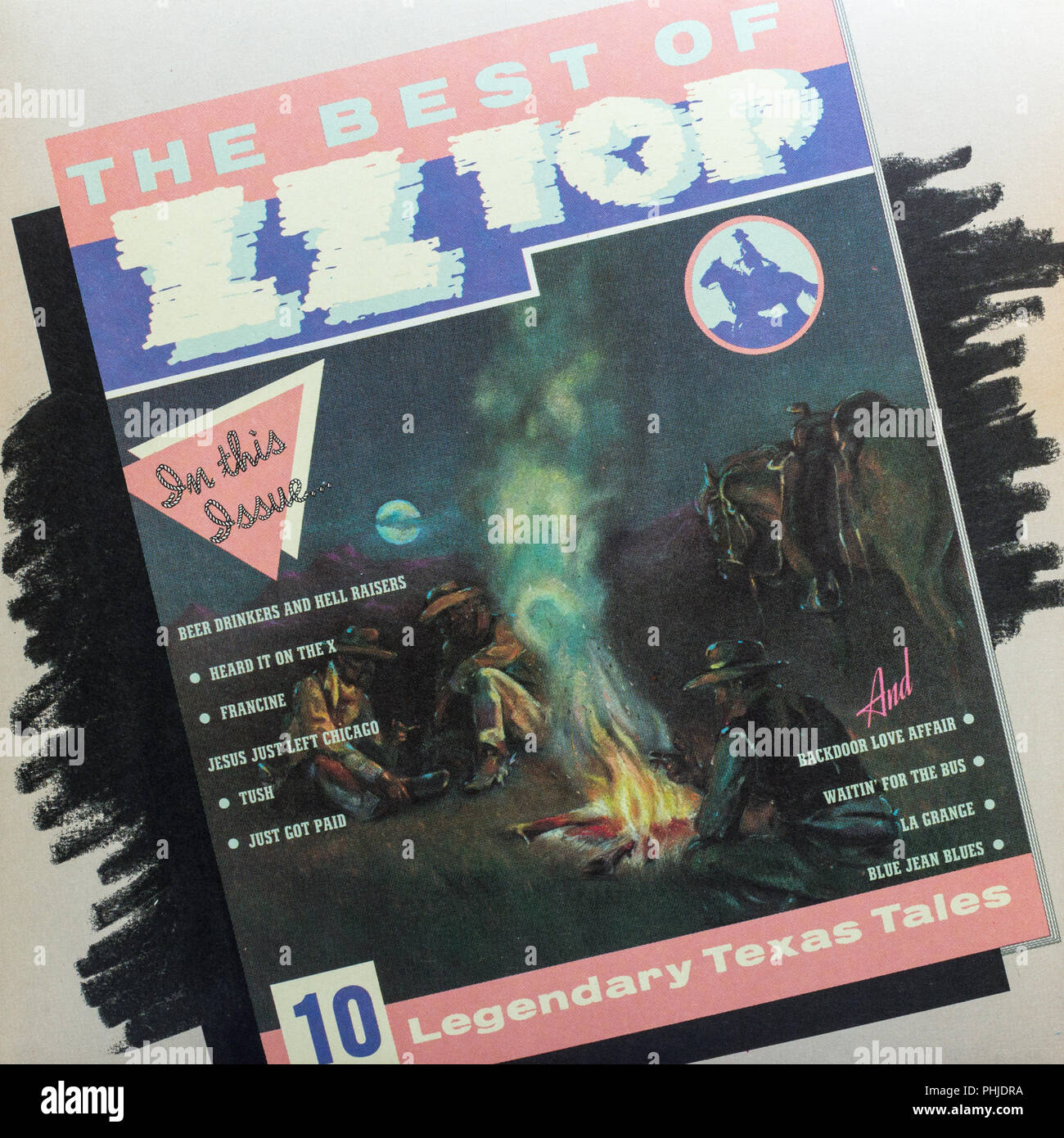
You’ve seen the red car. Even if you aren't a gearhead or a blues-rock fanatic, that 1933 Ford Coupe is burned into your brain. It’s the zz top album cover that redefined the band's career, turning three Texas bluesmen into global MTV icons. But honestly? The story behind their artwork is way weirder than just a cool car.
Most people think ZZ Top just showed up with beards and hot rods one day. Not even close. Before the synthesizers and the flashy videos, their covers were love letters to a very specific, gritty version of Texas. If you look at the progression from their 1971 debut to the chrome-plated 80s, you aren't just looking at marketing. You’re looking at a band that figured out how to turn a regional vibe into a universal visual language.
The Tex-Mex Feast That Nobody Actually Ate
Let's talk about the Tres Hombres gatefold.
If you own the vinyl, you know the photo. It’s a massive, glistening spread of Tex-Mex food—enchiladas, tacos, beans, the works. It’s basically "food porn" before that was even a phrase. Fans in the 70s would sit in their rooms, staring at that photo while listening to "La Grange," feeling like they could almost smell the cumin.
That meal was prepared at Leo's Mexican Kitchen in Houston. The band used to hang out there constantly. For the shoot, they had the restaurant whip up the ultimate platter. It looked perfect. The lighting was right. The vibe was immaculate.
Then things went sideways.
The photographer, Galen Scott, took a fifteen-minute break. When the crew walked back into the room, the food was gone. Every single bit of it.
A German Shepherd belonging to the restaurant owner had jumped onto the table and inhaled the entire feast. Billy Gibbons once recalled finding the dog lying on its side, literally gasping for breath because it had eaten so much. That iconic photo we all see? That was the very last frame they managed to snap before the dog struck.
Why the Eliminator Car Changed Everything
By 1983, the band was at a crossroads. They had the beards—which, fun fact, Gibbons and Dusty Hill grew independently during a hiatus without telling each other—but they needed a hook.
Enter the Eliminator.
Billy Gibbons is a legitimate hot rod obsessive. He didn't just rent a car for a photo shoot; he commissioned Don Thelen’s Buffalo Motor Cars to build a custom '33 Ford 3-window coupe. It took years. When it was finished, it wasn't just a vehicle; it was the centerpiece of the zz top album cover for Eliminator.
That car did more for the band than any PR firm ever could. It appeared in the videos for "Gimme All Your Lovin’" and "Sharp Dressed Man," usually piloted by three mysterious, beautiful women. It gave the band a "prop" that felt like an extension of their music—sleek, powerful, and distinctly American.
People often forget that the car on the cover is actually a painting by Tom Hunnicutt, not a photograph. The artwork has this hyper-real, almost glowing quality that fit the new, polished sound of the 80s perfectly.
The Weird Space-Age Shift of Afterburner
After Eliminator sold ten million copies, the band had to go bigger.
For the 1985 follow-up, Afterburner, they didn't just stick with the car. They turned the car into a spaceship.
The artist behind this one was Barry E. Jackson. He was a big-deal illustrator who had worked with Neil Young and Ronnie James Dio. The band’s manager, Bill Ham, basically told Jackson he wanted the red hot rod orbiting the globe. He wanted to show that ZZ Top wasn't just a Texas band anymore; they were "international."
Jackson took it to the extreme. He created a painting nearly six feet long. He used an airbrush to get those smooth, futuristic gradients that defined the mid-80s aesthetic.
Interestingly, Jackson hadn't heard a single note of the music when he painted the cover. The band was still in the studio mixing. He was working entirely off the "vibe" and the title, which drummer Frank Beard supposedly came up with because an afterburner is the hottest part of a rocket’s exhaust.
Small Details You Probably Missed
If you go back to the early stuff, the covers feel almost handmade.
- ZZ Top's First Album (1971): The design was handled by Bill Narum. It’s simple, brown, and looks like an old leather pouch or a piece of luggage. It was a "here we are" statement.
- Rio Grande Mud (1972): The title was inspired by the river separating Texas and Mexico, and the cover reflects that dusty, border-town grit.
- Tejas (1976): This one features a beautiful, wraparound painting of longhorns and bison under a starry sky. It feels like a Western mirage.
Bill Narum was the secret weapon for their early visual identity. He understood that ZZ Top wasn't just a rock band; they were a cultural export from the South. He used a lot of "found" imagery and hand-painted textures that made the records feel like artifacts you’d find in a dusty roadside bar.
The Logo: A Masterclass in Branding
Take a close look at the logo that debuted on Eliminator.
It’s metallic, 3D, and looks like it was ripped off the hood of a luxury car. Those stacked "Zs" with the word "Top" perched on the horizontal line of the second Z became one of the most recognizable logos in music history.
In the 90s, for the Recycler album, they updated it to a silver, more "industrial" look. It was a subtle shift that mirrored the band’s attempt to move back toward a rawer, more mechanical blues sound.
Actionable Insights for Collectors and Fans
If you're looking to dive deeper into the world of ZZ Top's visual history, here is how to actually spot the "real" stuff:
- Check the Mixes: If you're buying the early 70s albums on CD, look for the 2013 The Complete Studio Albums box set. For years, the digital versions of these albums used "modernized" 80s drum sounds that ruined the original vibe. The box set restored the original artwork and, more importantly, the original "muddy" Texas blues mixes.
- Verify the Car: There are dozens of "Eliminator" clones out there at car shows. The real one—the actual steel Ford used in the videos—now lives at the Rock & Roll Hall of Fame in Cleveland. If you see one with a fiberglass body, it’s a tribute, not the legend.
- The Gatefold Experience: You cannot truly appreciate the Tres Hombres food platter on a streaming thumbnail. Buy the vinyl. Open it up. Seeing it in its full 12-inch glory is the only way to understand why it drove people crazy in 1973.
The evolution of the zz top album cover is really the story of three guys from Houston who knew exactly who they were. They started with the mud and the tacos, and they ended up in a chrome spaceship. But through it all, they kept the same three chords and the same sense of humor. That consistency is exactly why we're still talking about a picture of a car forty years later.