You’ve probably heard the rumors that college costs are spiraling out of control everywhere. While that’s mostly true, the story at the University of Mary Washington tuition office is a bit more nuanced than a scary headline. Honestly, if you're looking at Virginia schools, UMW sits in this weirdly specific sweet spot. It’s got that private-school, "I-know-my-professor’s-dog’s-name" vibe, but with a public school price tag.
But here's the thing: the "sticker price" is basically a lie for most people.
If you just look at the raw numbers on the website, you might freak out. For the 2025-2026 academic year, the Board of Visitors approved a 2.5% tuition increase. That sounds like a lot, but in the world of higher education inflation, it’s actually relatively conservative. Let's break down what you're actually signing up for when those bills hit your EaglePay account.
The Raw Numbers: What You'll Actually See on the Bill
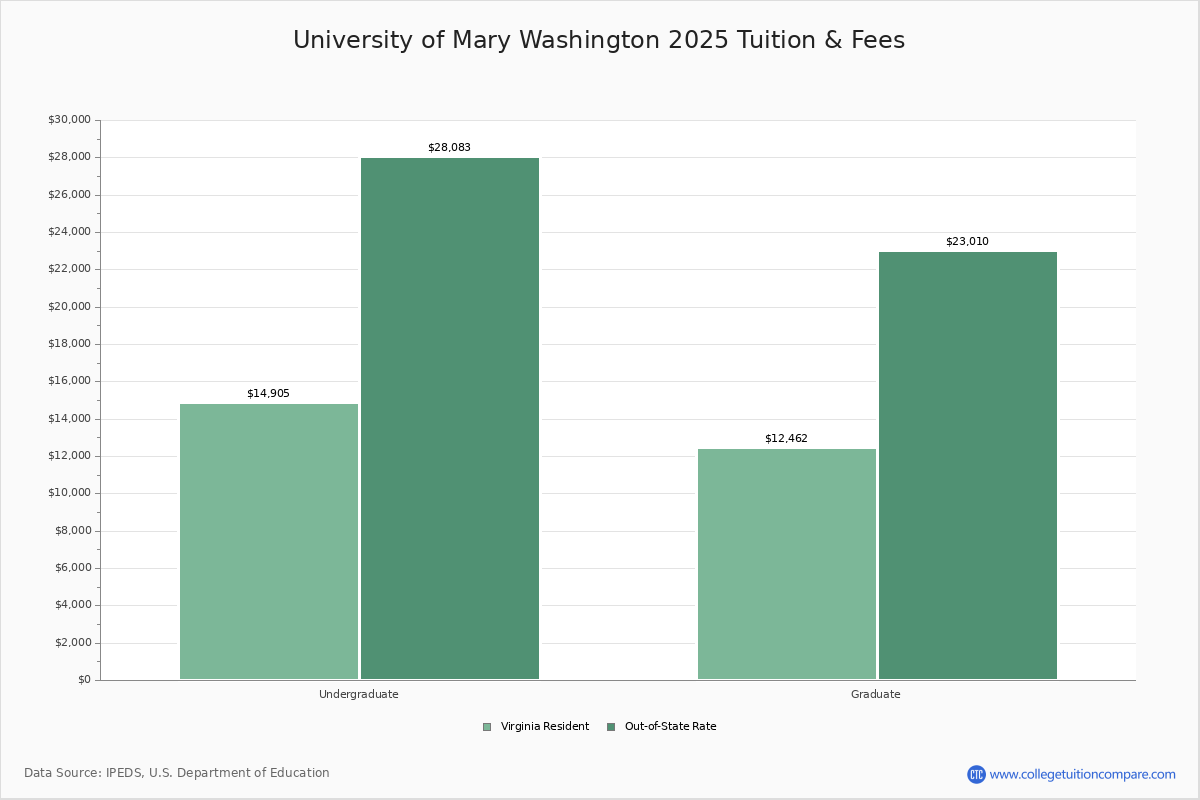
If you are a Virginia resident, the University of Mary Washington is a steal. Total tuition and mandatory fees for an in-state undergraduate for the 2025-26 year land around $15,882.
Out-of-state? Yeah, it's steeper. You’re looking at roughly $29,794 for the year.
It's expensive. I get it.
But those are just the academic costs. Most students aren't commuting from their parents' basements in Fredericksburg. They're living on campus. When you factor in the "Comprehensive Fee" (which covers all the fun stuff like the gym, student activities, and technology) plus room and board, the total cost of attendance for 2025-26 jumps to about $29,595 for Virginians and $43,101 for out-of-staters.
The "Hidden" Fee Trap
One thing that catches people off guard is the mandatory non-E&G fees. These are the "auxiliary" charges that pay for things the state of Virginia doesn't fund directly. For the upcoming year, these fees increased by 4%, hitting about $6,196. Basically, you're paying for the privilege of having a campus to walk across and a stadium to cheer in.
The UMW Tuition Promise: The Game Changer
This is the part most people overlook. UMW recently rolled out something called the Tuition Promise.
If you're a Virginia resident and your family makes under $100,000 a year, you might not pay a dime in tuition. Specifically, if you’re Pell-eligible, Mary Wash promises to bridge the gap. They cover whatever is left after your federal and state grants. It makes the university incredibly competitive with bigger schools like JMU or Virginia Tech, which don't always offer that kind of ironclad guarantee for the middle class.
- FAFSA is the key. No FAFSA, no promise.
- Deadline matters. You’ve gotta get that paperwork in by March 1.
- Full-time only. This isn't for the "one class at a time" crowd.
Living on Campus: Housing and Burrito Bowls
Housing isn't a flat rate. If you're a freshman in a standard hall, you’re looking at roughly $4,936 a semester for a single. If you can handle a roommate (or two), a triple drops that price significantly to around $3,785.
Then there's the food. The "Eagle Plan" is the standard, costing about $3,033 per semester. It gives you $200 in "Flex" money, which you will inevitably spend on late-night snacks at the Nest.
Honestly, the room and board costs are where the bill starts to feel heavy. While tuition stayed at a 2.5% hike, the auxiliary costs like dining and housing have historically climbed faster because of food inflation and maintenance on those historic brick buildings.
Graduate School and Part-Time Costs
Not everyone is a 19-year-old living in Virginia Hall. For graduate students, the 2025-26 rates are roughly $12,738 for in-state and $23,506 for out-of-state.
If you're just picking up a few credits, the per-credit-hour rate for Virginia residents is around $532.
One weird quirk: If you take more than 150% of the credits needed for your degree (basically if you stay in college forever), Virginia law requires UMW to charge you a surcharge. For 2025-26, that's an extra $366 per credit. So, maybe don't change your major five times.
How to Actually Afford This
Don't just look at the $30k price tag and walk away.
Mary Washington awards something like $39 million in aid every year. About 72% of students get some form of grant or scholarship. The average award is nearly $10,000. That's a massive dent in the bill.
The merit scholarships are automatic. When you apply, they look at your GPA and scores (if you sent them) and just tell you what you got. You don't have to write a separate "Why I Deserve Money" essay for the basic tiers.
Actionable Next Steps for Your Wallet:
- Use the Net Price Calculator. UMW uses a tool called Meadow. It takes three minutes. It’s way more accurate than a blog post because it uses your actual family income.
- File the FAFSA by March 1. This is non-negotiable. Even if you think your parents make "too much," file it anyway. It’s the only way to get the Tuition Promise or federal loans.
- Check the Foundation Scholarships. These open on February 1 and close May 15. This is "free" money from alumni that often goes unclaimed because students are too lazy to fill out the extra application.
- Compare the "Total" vs. "Tuition." If you're a commuter, UMW is one of the cheapest high-quality options in the mid-Atlantic. If you're living on campus, it’s comparable to other mid-sized public schools.
The reality of University of Mary Washington tuition is that the school is trying to stay accessible while maintaining that small-college feel. It’s a balancing act. You just have to make sure you're using every tool they offer to lower that sticker price.