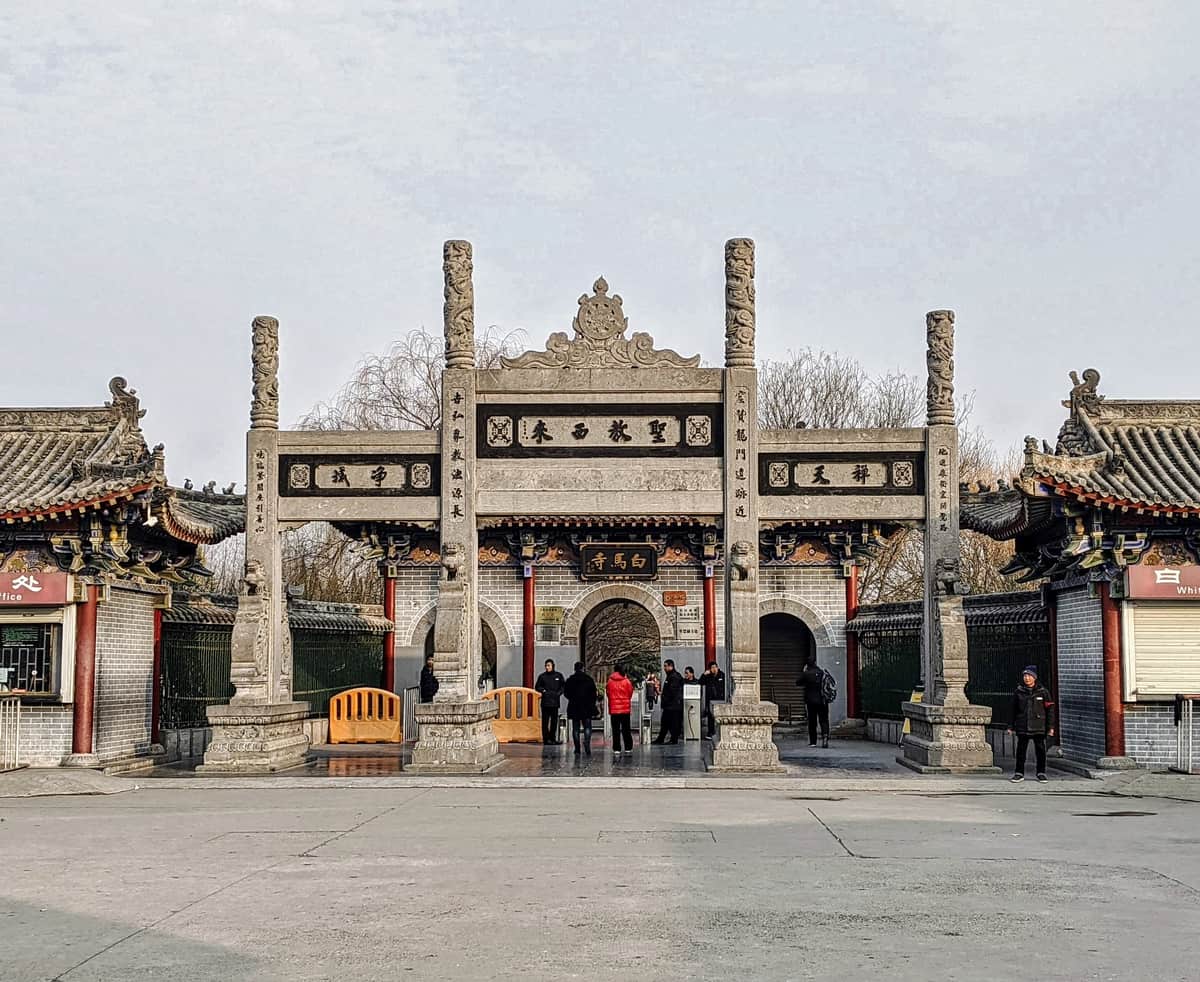
You’re standing in front of two stone horses that look like they’ve seen a thousand winters, because, well, they basically have. They aren't just decorations. These statues at the entrance of the White Horse Temple in Luoyang represent the very moment Buddhism hitched a ride into China nearly two millennia ago. Most people breeze past them to get to the "Instagrammable" Thai or Indian sections, but that’s a mistake. Honestly, the real magic isn't in the new gold leaf; it’s in the cracked bricks of the Clear Cool Terrace where the first sutras were painstakingly translated from Sanskrit into Chinese.
Why the White Horse Temple is actually the "Cradle"
It all started with a dream. Emperor Ming of the Han Dynasty supposedly saw a golden man flying above his palace in 64 AD. His advisors, probably trying to sound smart, told him it was the Buddha from the West. So, the Emperor sent envoys. They didn't just find scriptures; they found two Indian monks, Kasyapa Matanga and Dharmaratna.
They came back to Luoyang in 67 AD.
The monks weren't traveling light. They had a white horse loaded with scrolls and statues. To show his thanks, the Emperor built them a place to stay and work. He named it the White Horse Temple to honor the animal that did the heavy lifting. By 68 AD, the first official Buddhist temple in China was open for business.
If you’re looking for the original Han Dynasty wood, you won't find it. Fire and war are part of the history here. Most of what you see today—the heavy gates, the sweeping roofs—is a mix of Ming and Qing dynasty architecture. But the layout? That’s ancient. It follows a strict south-to-north axis, a blueprint that almost every Chinese temple has copied for the last 1,900 years.
The International Zone: A weirdly cool detour
Most visitors are shocked when they turn a corner and suddenly feel like they’ve been teleported to Bangkok. To the west of the traditional Chinese halls sits the International Temple Zone. It’s a bit jarring at first. You’ve got a Thai temple with its spiked golden roofs, a Burmese pagoda that looks like a giant bell, and an Indian shrine inspired by the Great Stupa at Sanchi.
It isn't just for show. These were funded by their respective governments to celebrate the White Horse Temple as the starting point of Buddhism’s journey through East Asia.
- The Thai Hall: Completed around 2014, it’s all about bright gold and intricate carvings. It’s the loudest section, visually speaking.
- The Indian Temple: This one is more somber. It’s circular and features a massive dome that feels very different from the square, linear Chinese halls.
- The Myanmar Pagoda: Look for the Shwedagon-style spire. It’s covered in gold leaf that glows like crazy during the "golden hour" just before sunset.
You’ll see monks from all over the world here. It’s one of the few places in China where you can see the different "flavors" of Buddhism—Theravada, Mahayana, and Vajrayana—all sharing the same backyard.
Don't miss the frog that lives in a pagoda
On the east side of the complex stands the Qiyun Pagoda. It’s the oldest structure in Luoyang, rebuilt in 1175 after the original wooden one burned down. It’s 13 stories of grey brick, standing about 25 meters tall.
Here’s the trick: stand about 20 meters south of the pagoda and clap your hands.
Seriously. Do it.
The echo that bounces off the brick tiers sounds exactly like a croaking frog. Locals love this. It’s a bit of ancient acoustic engineering that still works perfectly in 2026. The pagoda itself is actually part of a nunnery, so the vibe on this side of the park is much quieter and more meditative than the main tourist drag.
What most people get wrong about the visit
A lot of travel blogs say you can "do" the White Horse Temple in an hour. You can't. Not if you want to actually feel the place.
If you just rush through the Hall of Heavenly Kings and the Hall of the Great Buddha, you’re missing the layers of history. In the Hall of Mahavira, there are 18 Arhat statues made of "hollow lacquer." They date back to the Yuan Dynasty (that's the 1200s). They’re incredibly light—some weigh only about 5kg—but they look solid and heavy. The level of detail in their faces is haunting.
Also, look for the tombs of the two original Indian monks. They are buried right there in the temple grounds. It’s a rare honor, and their mounds are simple, round, and covered in green grass. There’s something deeply moving about standing next to the final resting place of two guys who walked thousands of miles just to share a philosophy they believed in.
Getting there and surviving the crowd
Luoyang has modernized fast. You can grab a taxi from the Longmen Grottoes for about 40-50 RMB, or take Bus 56 from the city center for a few coins.
Pro Tip for 2026: Avoid the Peony Festival in mid-April if you hate crowds. Yes, the flowers are beautiful, but the temple becomes a sea of selfie sticks. If you go in late September, the weather is crisp, the incense smoke hangs perfectly in the air, and you might actually get a moment of silence in the "Silent Teahouse" (Zhiyu Chashe) near the back.
Actionable insights for your trip
- Step over the threshold: Never step on the raised wooden door sills. It’s considered disrespectful (basically like stepping on the Buddha’s shoulders).
- Free Incense: Don't buy overpriced sticks from vendors outside. The temple usually provides three free sticks of incense near the main halls.
- The Silent Teahouse: Look for the bamboo path near the Thai Hall. There’s a free teahouse where talking is strictly forbidden. Grab a cup, sit down, and just listen to the wind.
- Photography: Be cool. Photos are usually okay in the courtyards, but don't point your camera directly at the faces of the statues inside the halls. Most monks will politely ask you to stop anyway.
- Clothing: Even in the 2026 summer heat, keep your shoulders and knees covered. It’s a working monastery, not a theme park.
The White Horse Temple isn't just a museum of old stuff. It’s a living, breathing connection to a journey that changed the DNA of Chinese culture forever. Whether you’re there for the history, the weird frog echo, or just a quiet cup of tea, it’s a place that stays with you long after you leave Luoyang.
If you're heading back to the city, stop by the Shenzhou Peony Garden right across the street; it's the perfect way to decompress before hitting the Luoyang night markets for some Water Banquet soup.