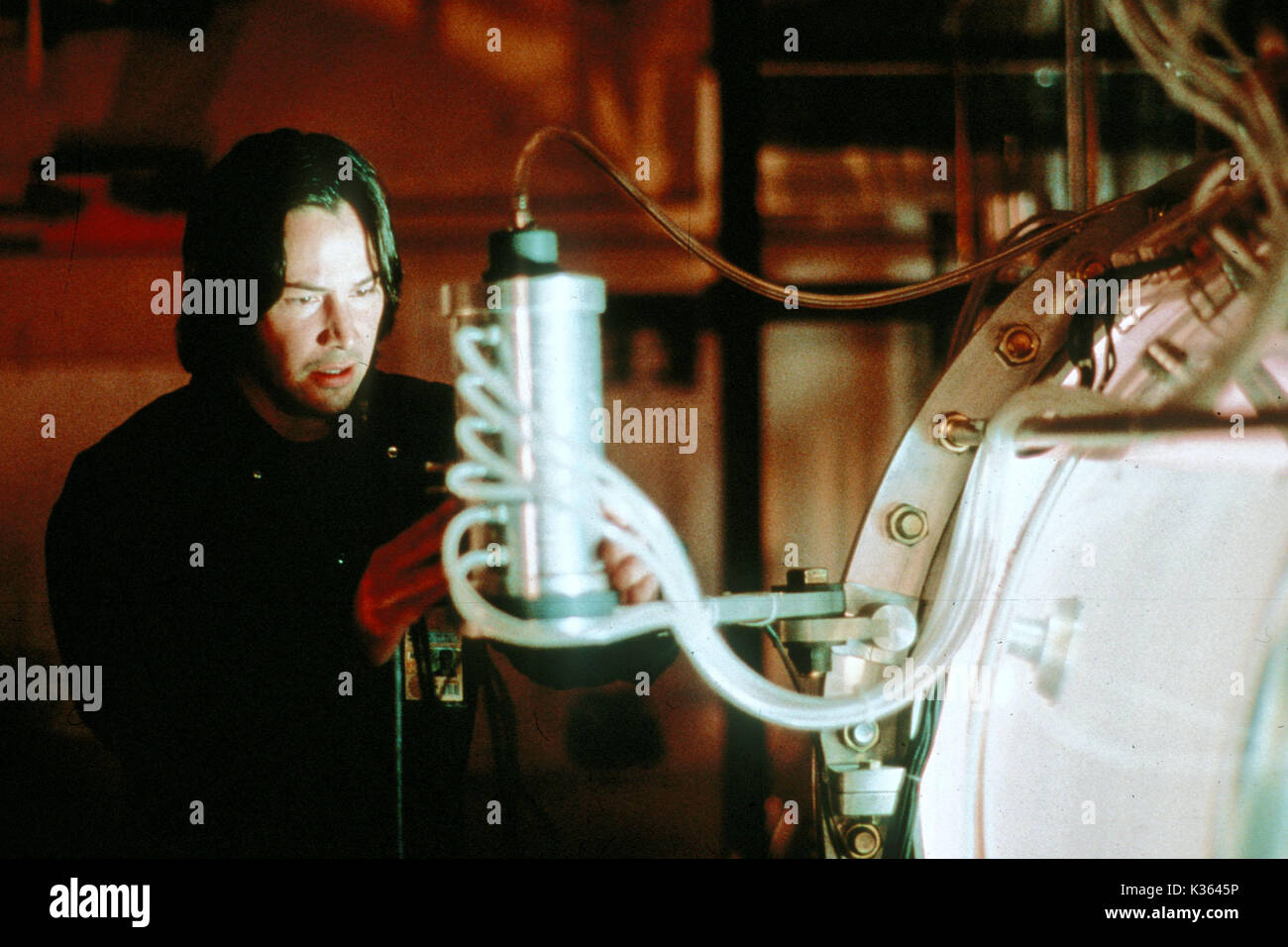
In the summer of 1996, Hollywood was obsessed with things blowing up. Independence Day was flattening cities, and Twister was ripping through the Midwest. Somewhere in the middle of that chaos, a movie called Chain Reaction hit theaters. It starred Keanu Reeves, fresh off the massive success of Speed, alongside a legendary Morgan Freeman and a then-up-and-coming Rachel Weisz.
On paper, it looked like a slam dunk. You had Andrew Davis directing, the guy who just a few years earlier gave us The Fugitive. You had a plot about a "clean energy" breakthrough that could save the world.
Instead, the movie kinda just... vanished. Critics mostly hated it. Keanu got a Razzie nomination. Today, it’s often relegated to the bargain bin of 90s techno-thrillers. But if you actually sit down and watch it now, there's something weirdly prophetic and charming about it. It’s a movie that tried to do "smart action" before that was really a thing, and honestly, it deserves a second look.
The Plot: Hydrogen, Murder, and a Very Cold Chicago
Basically, Keanu plays Eddie Kasalivich. Now, people love to joke that Keanu Reeves playing a scientist is a stretch, but the movie actually plays it smart. Eddie isn’t some Nobel-winning physicist; he’s a machinist. He’s the guy who builds the hardware that the "real" scientists use.
He’s working at the University of Chicago on a project to extract energy from water—specifically hydrogen. It’s the holy grail of green tech. One night, while messing around with sound frequencies (this is where the "science" gets a bit 90s-movie-magical), Eddie finds the missing piece. He stabilizes the reaction.
The team celebrates with way too much champagne. But the party doesn't last. A few hours later, Eddie returns to the lab to find his mentor murdered, a high-tech bomb ticking away, and a conspiracy that goes all the way to the top.
The lab doesn't just explode; it levels eight city blocks. It’s a massive, visceral sequence. From there, Eddie and Dr. Lily Sinclair (Rachel Weisz) are framed for the disaster and forced to go on the run.
Why Critics Originally Hated It
When Chain Reaction came out, the reviews were pretty brutal. It currently sits at a measly 18% on Rotten Tomatoes. Roger Ebert famously gave it two and a half stars, saying that by the end, he "didn't have a clue" what the movie was actually about despite the "swell photography."
The biggest complaint? It felt like a diet version of The Fugitive.
Think about it. You’ve got:
- A protagonist wrongly accused of a crime.
- A relentless pursuit by federal agents.
- A conspiracy involving a massive organization.
- Andrew Davis directing the whole thing.
The movie definitely suffers from "been there, done that" syndrome. Plus, the script underwent some massive changes during production. Keanu has actually gone on record saying he regretted parts of the film because his character was originally supposed to be a married man with a kid, giving him way more emotional stakes. Instead, they turned him into a loner on a motorcycle.
The Weird Science of Bubble Fusion
Here is where it gets interesting. While the movie uses "sound frequencies" as a plot device, it was actually tapping into a very real scientific controversy from that era.
In 1989, two scientists named Stanley Pons and Martin Fleischmann claimed they had achieved "cold fusion"—basically nuclear energy on a tabletop. The world went nuts for about five minutes before the scientific community realized the results couldn't be replicated.
Chain Reaction is essentially a "what if" story based on that scandal. What if someone did find a way to make it work, and the government (or the oil lobby) tried to bury it? It’s a classic 90s cynical take on power, but in 2026, when we're actually seeing massive breakthroughs in fusion energy, it feels surprisingly relevant again.
Filming in a Chicago Deep Freeze
If the movie looks cold, that’s because it was. They filmed in Chicago during a record-breaking winter. We’re talking sub-zero temperatures that made the equipment freeze up.
There’s a famous scene where Keanu and Rachel Weisz have to cross a moving drawbridge. That wasn't just a studio set; they actually filmed on the Michigan Avenue Bridge. The icy, gray aesthetic of the film isn't just a stylistic choice—it was the reality of the production.
They also shot at the Argonne National Laboratory. The production crew actually built a massive, multi-million dollar "fake" lab inside a warehouse, but many of the tunnels and industrial backgrounds you see are real. That authenticity is one of the film's strongest points. Even if the plot is a bit messy, the world feels heavy and real.
Morgan Freeman and the "Is He Good or Bad?" Trope
You can't talk about this movie without mentioning Paul Shannon, played by Morgan Freeman.
Freeman is doing what he does best: being incredibly calm and authoritative. But unlike his role in The Shawshank Redemption, he’s playing a much more ambiguous character here. He’s the head of the foundation funding the research, but he also has ties to the CIA.
Is he a mentor? A villain? A "greater good" pragmatist? The movie keeps you guessing, and Freeman’s performance is easily the best thing in the film. He brings a level of gravitas that honestly the script doesn't always earn.
The "Keanu on a Bike" Factor
Let's be real: Keanu Reeves on a motorcycle is a cinematic archetype at this point.
In Chain Reaction, his motorcycle isn't just a cool prop; it’s his primary means of escape during that massive Chicago explosion. There's a shot where he’s outrunning a shockwave that Digital Domain (the VFX house behind Apollo 13) worked on. For 1996, the CGI was top-tier.
The movie also features a bizarre, high-speed chase involving airboats on a frozen lake. It is objectively ridiculous. It makes no sense why the villains would have airboats ready to go in rural Wisconsin, but it’s the kind of "90s action logic" that you just have to lean into.
Is It Worth a Rewatch?
Honestly? Yes.
If you go in expecting The Matrix or John Wick, you’ll be disappointed. But if you want a solid, middle-budget thriller with great actors and a cool "conspiracy" vibe, it hits the spot. It’s also fascinating to see a young Rachel Weisz holding her own in one of her first big American roles.
What most people get wrong about Chain Reaction is assuming it’s just a dumb action movie. It actually tries to engage with the politics of energy and the ethics of scientific discovery. Sure, it wraps those ideas in explosions and bridge jumps, but the core idea—that cheap, clean energy would be a threat to the status quo—is a conversation we’re still having today.
What to do if you're curious about the real science:
If the "water to energy" plot actually sparked your interest, you don't have to rely on 90s movie logic. Here is how you can actually dive into the real-world versions of what Eddie was trying to build:
- Research ITER and Fusion Ignition: Look up the recent breakthroughs at the National Ignition Facility. We are actually getting closer to the "limitless energy" dream, though it involves lasers the size of football stadiums rather than a machinist's workbench.
- Look into the "Hydrogen Economy": Companies are currently trying to use "green hydrogen" to power ships and planes. It's not as explosive as the movie suggests, but it is a massive part of the current climate strategy.
- Watch "The Fugitive" back-to-back: If you really want to see how Andrew Davis evolved as a director, watch The Fugitive and then Chain Reaction. You'll see the exact same camera movements and pacing, but with two very different approaches to the "man on the run" story.
You can usually find Chain Reaction streaming on platforms like Tubi or Disney+ (depending on your region). It’s the perfect "rainy Sunday afternoon" movie. Just don't expect the physics to make much sense once the airboats show up.