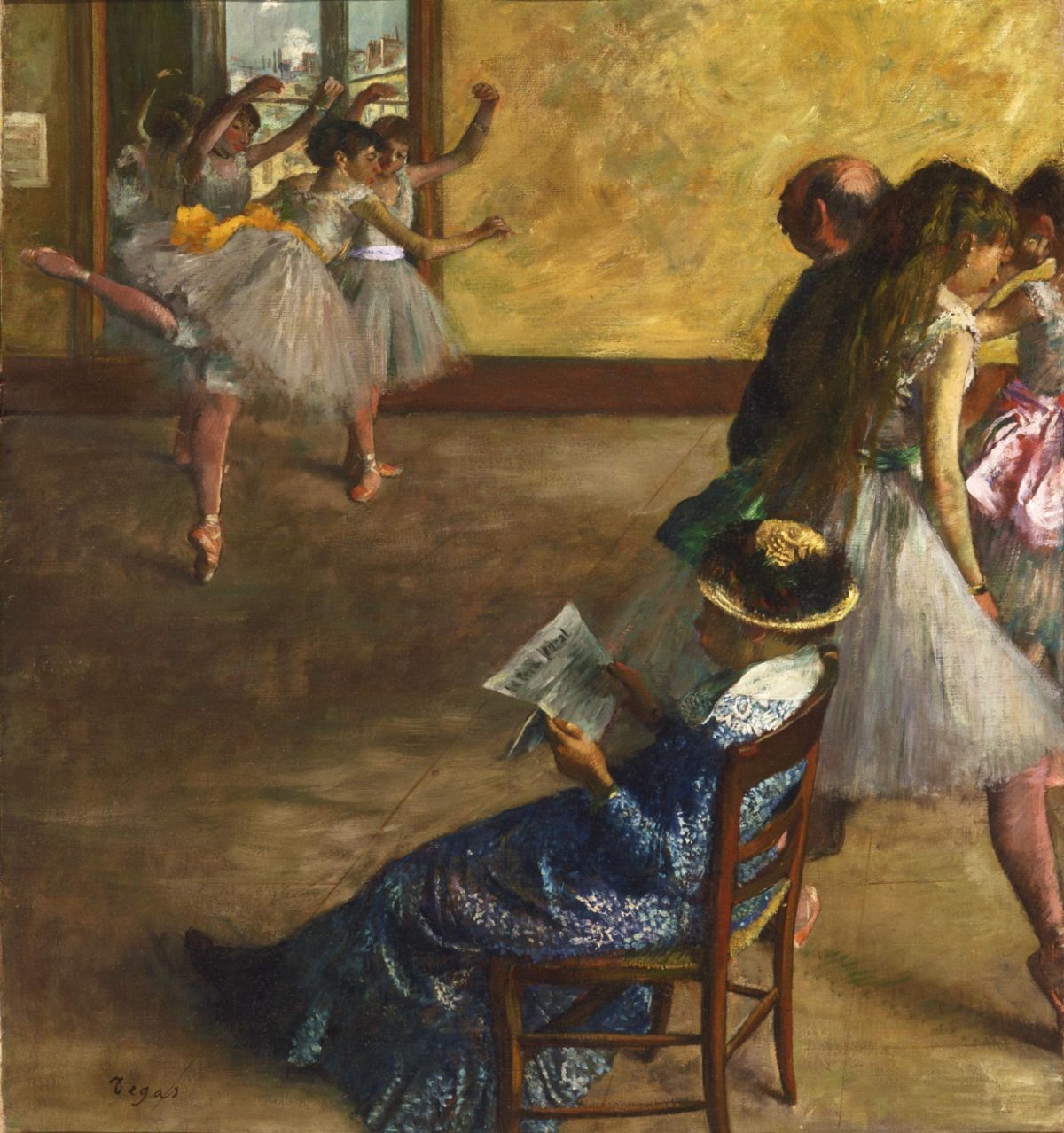
You’ve seen it on umbrellas. It’s on tote bags, tea towels, and cheap dorm room posters. Edgar Degas’s The Ballet Class (or La Classe de danse) is so ubiquitous that we’ve basically stopped looking at it. We see a bunch of girls in white tutus and think "Oh, how pretty, how French, how classical."
But honestly? That’s not what’s happening here. Not even close.
Degas wasn't some wide-eyed fan of the stage. He didn't care about the glamour of the performance. He was obsessed with the grind. He liked the sweat, the sore muscles, the boredom, and the weirdly transactional nature of the 19th-century Paris Opera. If you look closely at this painting—the one finished around 1874 that now sits in the Musée d'Orsay—it’s actually kind of gritty. It’s a workplace study.
The first thing you notice is the space. It’s huge. Degas uses this sharp, diagonal floorboard trick to suck your eyes right into the back of the room. It feels cavernous and maybe a little cold. This isn't a recital; it's a rehearsal under the watchful, slightly terrifying eye of Jules Perrot.
Perrot was a real guy, by the way. A legendary ballet master. In the painting, he’s standing there leaning on a long wooden staff. He looks tired. The girls look even more tired. One is scratching her back. Another is adjusting her earring. One is slumped over. It’s the universal body language of "When is this shift over?"
The Dark Reality Behind the Tutus
We have to talk about the "Opera Rats." That’s what they called these girls: petits rats. Most of them came from crushing poverty. Ballet wasn't a hobby for the wealthy in 1870s Paris; it was a grueling career path for working-class girls whose mothers hoped they’d catch the eye of a wealthy patron.
Look at the background of The Ballet Class. You’ll see some shadowy figures—mothers. These women weren't just there for emotional support. They were stage moms in the most intense sense, acting as agents, protectors, and sometimes negotiators. The Paris Opera was a place where art and high-society solicitation blurred together.
Degas captures this tension perfectly. There’s no spotlight. No applause. Just the rehearsal room's dusty light and the repetitive thud of slippers on wood. He once famously said that people call him the painter of dancing girls, but he really wanted to "capture movement" and "observe life." He was a voyeur of the mundane.
Compositional Chaos (On Purpose)
Degas was a bit of a rebel when it came to framing. He was heavily influenced by Japanese prints (Ukiyo-e) and the brand-new medium of photography. This is why the painting feels "cropped."
See how some of the dancers are cut off at the edges? That was radical for the time. Traditional painters wanted everything centered and balanced. Degas wanted it to feel like a snapshot. He wanted you to feel like you just walked through the door and caught them off guard.
Why the Floor Matters
The floor takes up almost half the canvas. Why? Because for a dancer, the floor is everything. It’s the instrument. By painting the wide, empty expanse of the floorboards, Degas emphasizes the physical distance between the dancers and the master. It creates a sense of isolation. Even though the room is crowded, every girl seems to be in her own head.
- The Colors: Notice the contrast between the sheer, airy white of the tutus and the heavy, dark wood of the room.
- The Details: Look at the watering can in the corner. That wasn't just a random prop. Dancers used it to wet the floor so they wouldn't slip. It’s a tiny detail that screams "I actually spent time in this room."
- The Master: Jules Perrot’s position is central, yet he feels like a relic. The world is moving around him, but he’s the anchor of the old-school discipline.
Misconceptions About Degas and His Subjects
People think Degas loved the ballet. In reality, he might have just liked the access. He was a "subscriber"—one of the wealthy men who had seasonal tickets and, crucially, backstage passes. This allowed him to watch the rehearsals and hang out in the wings.
There's a common myth that he was a cruel man. While he was definitely a curmudgeon and had some pretty regressive political views later in life, his paintings of dancers show a weird kind of empathy. He doesn't paint them as goddesses. He paints them as workers. He captures the moments they think no one is watching.
He didn't paint this on-site, though. He did sketches at the Opera, sure, but the actual painting of The Ballet Class happened in his studio. He used models, sometimes the same girl for multiple figures, and meticulously reconstructed the scene. It’s a carefully choreographed "un-choreographed" moment.
The Technical Brilliance of the 1874 Masterpiece
If you compare this version to the one in the Metropolitan Museum of Art (which he started earlier but finished later), the Orsay version is much more focused on the teacher. The lighting is cooler.
Degas was experimenting with oil paint in a way that mimicked pastel. He wanted that soft, chalky texture for the tutus. He’d layer the paint and then scratch into it or use a dry brush to get that translucent look. It’s why the dresses look like they’re made of actual air and tulle, while the skin of the dancers looks solid and heavy.
A Quick Reality Check on the "Class"
This wasn't a beginner class. These were the "Classe des Examens." These girls were competing for spots in the company. The stakes were incredibly high. If you didn't make the cut, you went back to the slums or worked in a laundry—which was Degas's other favorite subject to paint.
When you see the girl in the front-center, stretching her leg out, she’s not just posing. She’s trying to stay limp. She’s trying to survive the session.
Why It Still Matters Today
The Ballet Class is one of the most important pieces of the Impressionist movement, even though Degas hated being called an Impressionist. He preferred "Realist" or "Independent."
It matters because it broke the rules. It showed that "high art" didn't have to be about kings or battles or mythological gods. It could be about a girl in a sweaty rehearsal room scratching her back. It turned the "lowly" work of a dancer into something worth hanging in a gallery.
It’s also a reminder of the "male gaze," a term we use a lot now. Degas was a man observing a female world. There is a power dynamic there that you can’t ignore. The presence of the male teacher and the male patrons (who are often hinted at in other versions) reminds us who was in charge of this environment.
How to Appreciate the Painting Next Time You See It
Don't just look at the tutus.
Look at the feet. Look at the way they’re turned out in "second position" or just resting awkwardly. Look at the ribbons. Each dancer has a different colored ribbon—yellow, blue, red. It was a way to tell them apart in a sea of white.
Check out the architecture. The high windows, the ornate molding. It’s a temple of art, but it’s also a factory.
Actionable Insights for Art Lovers:
- Visit the Musée d'Orsay: If you're ever in Paris, see it in person. No digital screen can capture the texture of the paint. The scale is larger than you think, and the "depth" of the room is much more intense.
- Compare the Versions: Look up the Met’s version (The Dance Class) and the Orsay’s version side-by-side. Notice how the perspective shifts. It’s a masterclass in how a painter can change the entire "vibe" of a room just by moving the "camera" a few feet.
- Read the Social History: If you want to dive deeper, look into the history of the Paris Opera in the 1870s. Understanding the "subscription" system changes how you see every single Degas dancer.
- Look for the "Ugly": Challenge yourself to find the least "pretty" thing in the painting. Is it the tired face of a dancer? The scuffed floor? The watering can? Finding the imperfections is how you find the truth in Degas’s work.
Degas didn't want to give us a fantasy. He gave us the truth of the ballet: it’s beautiful, yes, but it’s mostly hard, repetitive, and exhausting work. That’s why The Ballet Class remains a masterpiece. It refuses to lie to us.
To truly understand the impact of this work, examine the way Degas uses negative space—the "empty" parts of the floor—to direct your attention. It is a lesson in visual storytelling that transcends the subject of dance itself. Study the peripheral figures; the stories are often hidden in the edges of the canvas, not just the center.