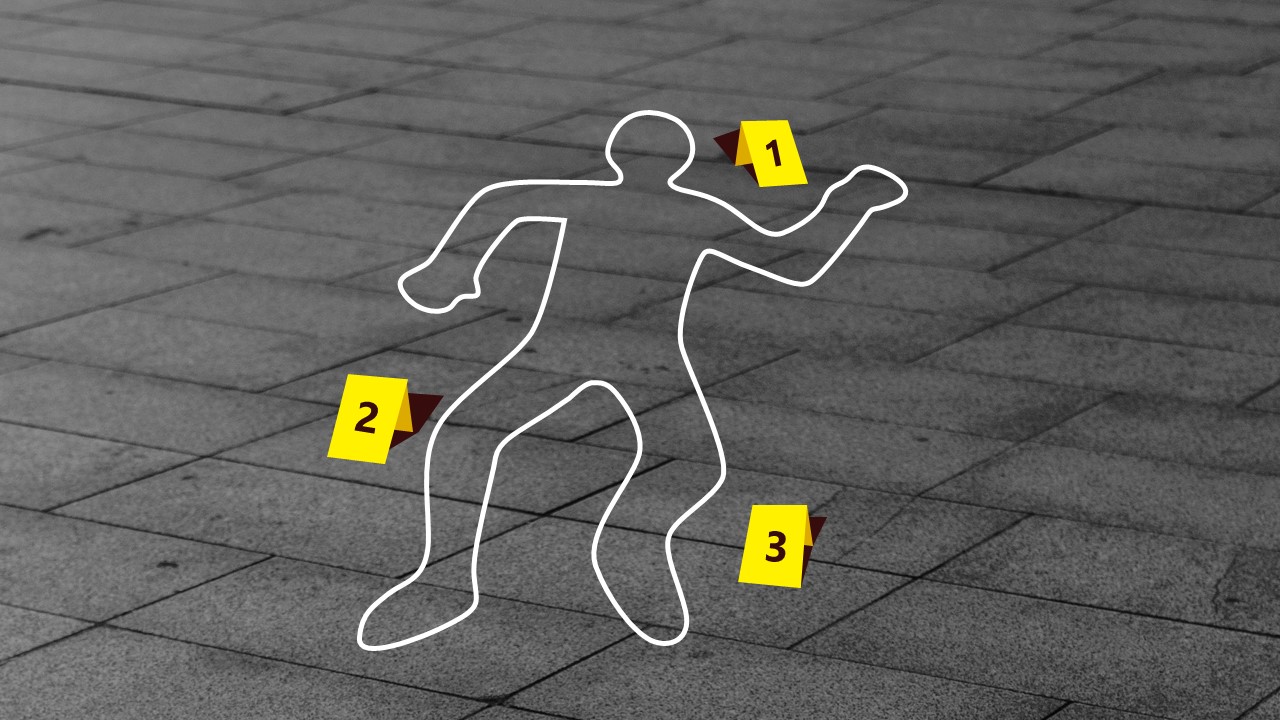
You’ve seen it a thousand times in old noir films. A detective stands over a chalk-drawn silhouette on a rainy sidewalk while jazz plays in the background. It’s iconic. It’s moody. Honestly, it's also mostly a myth. If you walk onto a active scene today and start drawing a body crime scene outline with a piece of Crayola, the lead forensic tech is probably going to have a literal meltdown.
Real death investigation is messy. It’s surgical.
In the actual world of forensic science—the kind practiced by the FBI’s Evidence Response Teams or local CSI units—the "chalk outline" has been dead for decades. But the concept of the outline? That’s still the backbone of every single homicide case. We just don't use chalk anymore. We use geometry, lasers, and high-resolution mapping.
The goal hasn't changed since the days of Sherlock Holmes: you need to preserve the exact spatial relationship between the decedent and the environment before the body is moved. Once that person is zipped into a bag and taken to the morgue, the scene is "broken." You can't go back. You have to get the outline right the first time, or the entire reconstruction falls apart in court.
The Death of Chalk and the Rise of Precision Mapping
Why did we stop using chalk? Contamination.
Think about it. If you’re trying to find a microscopic droplet of the killer’s perspiration or a stray carpet fiber, the last thing you want to do is scrub a giant piece of limestone all over the floor. It ruins the DNA. It messes with the chemical analysis. It's a disaster.
Modern investigators use what’s called a "coordinate method" or "triangulation" to create a digital body crime scene outline. They pick two fixed points—like the corners of a room or a specific door frame—and measure the distance from those points to specific "landmark" parts of the body. Usually, this means the top of the head, the elbows, the knees, and the heels.
By the time they're done, they have a series of data points that can recreate the body's exact position down to the millimeter.
Lately, many agencies have upgraded to 3D laser scanners like the Leica RTC360. These things are incredible. You set the scanner on a tripod, it spins around, and it captures millions of data points in minutes. It creates a "point cloud." It’s basically a digital ghost of the room. You can "walk" through the scene in VR years later. The body crime scene outline isn't a drawing anymore; it's a three-dimensional mathematical model that can be rotated and analyzed from the perspective of the shooter or a witness.
What an Outline Actually Tells an Investigator
It’s not just about where the person fell. It’s about how they got there.
A body is a piece of evidence. Maybe the most important piece. When a forensic pathologist looks at the body crime scene outline, they’re looking for "positional markers." If the victim is face down (prone) but the post-mortem lividity—that’s where the blood settles after the heart stops—is on their back, guess what?
The body was moved.
Somebody changed the scene.
Without a perfect record of the original position, a defense attorney will tear the prosecution to shreds. They’ll claim the investigators were sloppy. They'll argue that the victim actually tripped, or that the blood spatter doesn't align with the "official" story.
I remember reading a case study from the American Academy of Forensic Sciences where the outline of a victim’s hand was the smoking gun. The hand was tucked under the torso in a way that would have been physically impossible if the person had fallen naturally after being shot. It proved the killer had rolled the body over to check for a wallet. That tiny detail in the spatial outline turned a "random mugging" theory into a "premeditated execution" reality.
The Psychological Weight of the Silhouette
There is something deeply human about seeing the space where a life ended.
Even in digital formats, the body crime scene outline serves a secondary purpose: it grounds the jury. In a courtroom, looking at raw photos of a deceased person can be overwhelming. It triggers a "disgust response" that sometimes makes people tune out or get too emotional to think clearly.
But a diagram?
A clean, mapped-out outline of the body’s position relative to the shell casings and the furniture allows a jury to be objective. It turns a tragedy into a puzzle. It lets them see the physics of the crime.
Common Misconceptions People Still Have
Most people think the outline is the first thing done. Wrong.
First comes the "walkthrough." Then the photography. Then the "overall" shots. The body crime scene outline is actually part of the mid-to-late stage of scene processing. You don't touch the body—not even to trace it—until the medical examiner or coroner gives the okay. In many jurisdictions, the body technically belongs to the ME, while the room belongs to the police. It’s a delicate legal dance.
- Chalk is never used. Seriously. Not even for "fun." It’s a liability.
- Tape isn't common either. You might see it in training, but in a real lab or scene, tape leaves adhesive residue.
- The "Outline" includes the surroundings. A body doesn't exist in a vacuum. If there’s a knife three feet away, the measurement from the hand to that knife is part of the "outline" logic.
How Professionals Create the "Digital Outline" Today
If you’re curious about how this actually looks on the job, it’s less about art and more about spreadsheets.
- Establishing a Baseline: They run a long measuring tape across the room. This is the "North-South" line.
- Taking Rectangular Coordinates: They measure how far "up" the baseline a point is, and then how far "out" (at a 90-degree angle) it is.
- Photogrammetry: They take hundreds of overlapping photos. Software like Agisoft Metashape then stitches these into a 3D model.
- The Sketch: A hand-drawn sketch still happens. It's usually on graph paper. It looks messy to the untrained eye, but it contains "the numbers."
The numbers don't lie. A photo can have perspective distortion. A video can be blurry. But if the measurement says the victim's left pinky was 42 inches from the radiator, that's a hard fact.
Actionable Insights for Forensic Enthusiasts and Students
If you're looking to understand this field or perhaps even enter it, don't focus on the drawing. Focus on the math.
- Study Geometry: Understanding angles and triangulation is more important than being a good artist. Forensic mapping is all about "spatial relationships."
- Learn CAD Software: Most modern police departments use Computer-Aided Design (CAD) to turn their field notes into the final body crime scene outline for court. Programs like AutoCAD or specialized forensic versions are the industry standard.
- Master Photography: You can't have a good outline without "scale photography." This involves placing a L-shaped ruler (an ABFO No. 2 scale) next to evidence to ensure the digital outline is sized correctly.
- Read the Manuals: Check out the Standard Guide for Crime Scene Investigation by ASTM International. It’s dry, sure, but it’s the actual "bible" for how this stuff is documented legally.
The next time you see a chalk outline on a TV show, you can officially roll your eyes. You know better. The real body crime scene outline is a complex, invisible web of measurements and data points that hold the truth of a person’s final moments. It’s not about art; it’s about accountability.
To truly appreciate the precision required, look into the "Link Method" of searching scenes, which often dictates how these outlines are integrated into the larger search pattern. Documentation is the only thing that stands between a "cold case" and a closed one.