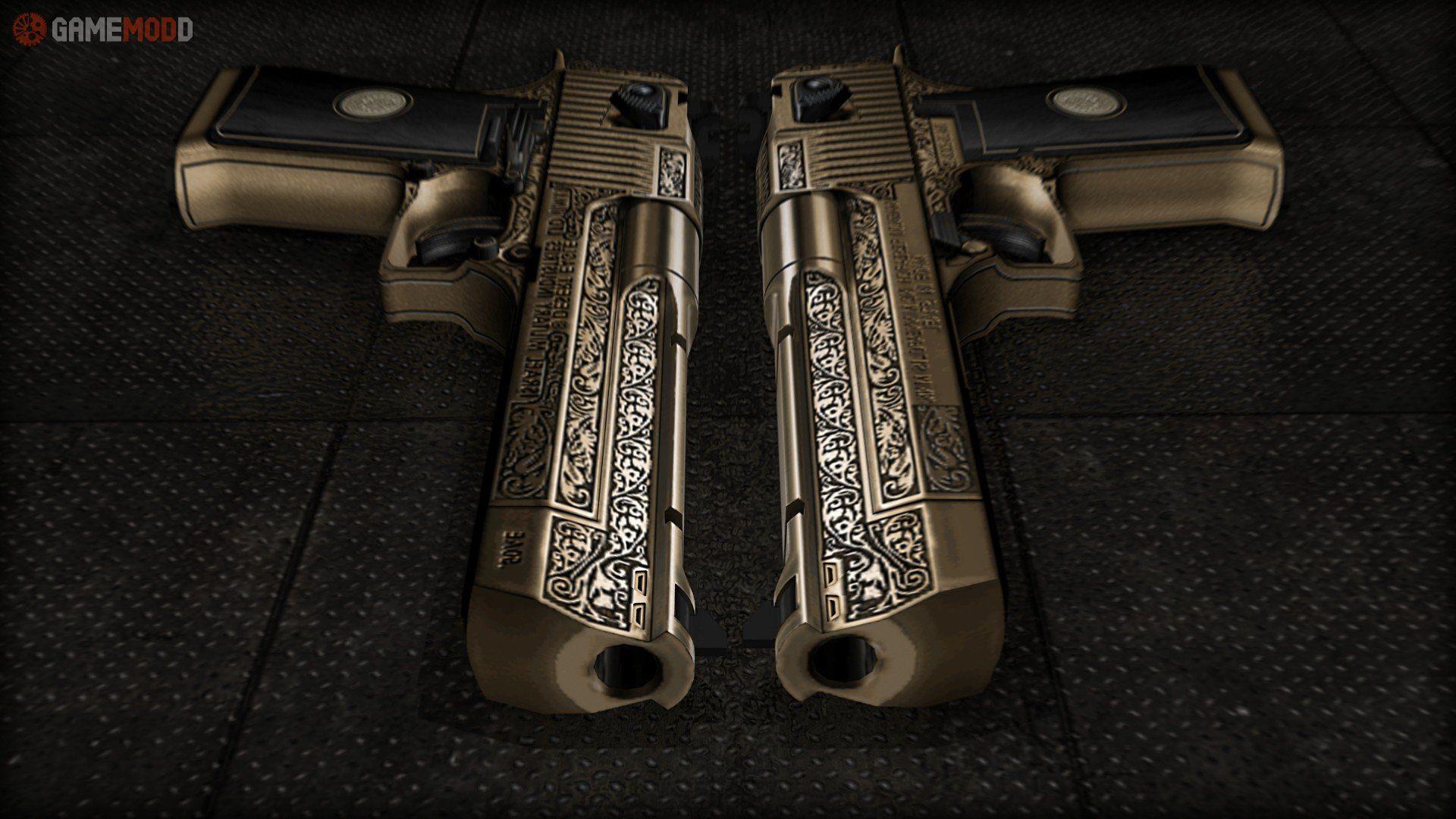
Let’s be real. Nobody buys a gold plated Desert Eagle because they need a practical sidearm for home defense or a subtle piece for the local gun range. If you wanted practical, you’d buy a Glock 19 or a Sig P320. No, you buy a 24k gold-slathered .50 Action Express hand-cannon because you want people to look at you. It is the ultimate "look at me" firearm. It’s loud. It’s heavy. It’s arguably the most ridiculous thing you can legally put in a holster.
Magnum Research, the folks behind this beast, have turned a massive semi-auto pistol into a cultural icon. It’s been in every action movie since the 80s. It’s the gun your favorite video game character pulls out when things get serious. But when you add that shimmering, mirror-finish gold plating, the Desert Eagle transcends being a mere tool and becomes a statement piece. It’s basically functional jewelry that happens to be able to stop a grizzly bear.
The Reality of Owning a Gold Plated Desert Eagle
Most people think the gold finish is just a fragile spray-on paint job. It isn't. Magnum Research uses a genuine 24k gold plating process over the carbon steel frame and slide. It looks incredible under the fluorescent lights of a gun shop, but the second you get it into the real world, things change. Fingerprints are your new worst enemy. Seriously, if you even think about touching the slide without gloves, you’re going to see a greasy smudge that mocks your investment.
Weight is the other thing. A standard .50 AE Desert Eagle weighs about 4.5 pounds empty. Add a magazine and that gold finish, and you’re basically carrying a small dumbbell. It’s a workout. If you try to shoot this one-handed like they do in the movies, you’re probably going to end up with a very expensive piece of gold-plated steel hitting you in the forehead. The recoil is legendary, but honestly, the weight of the gun actually helps soak some of that up. It’s a push more than a snap, but it’s a big push.
Why the .50 AE Chambering Matters
You can get a gold plated Desert Eagle in .357 Magnum or .44 Magnum, but why would you? If you’re going for the gold, you have to go for the big bore. The .50 Action Express (AE) was designed by Evan Whildin of Action Arms in the late 80s. It’s a rebated rim cartridge, which means the rim is the same size as a .44 Magnum, allowing the gun to swap calibers with just a barrel and magazine change.
Shooting .50 AE is an experience. It’s expensive—sometimes three or four dollars a round depending on the market. Every time you pull the trigger, you’re basically firing the price of a cheap taco downrange. But the muzzle flash? It’s massive. The sound? It’s a concussive thud that clears out the lanes next to you at the indoor range. People will stop and stare. That’s kind of the whole point of owning a golden gun, isn't it?
Maintenance is a Nightmare
Keeping that gold finish pristine requires more than just a quick wipe with an oily rag. In fact, some oils can actually mess with the luster over time if they have harsh solvents. You need a microfiber cloth. You need specialized cleaners. And you definitely shouldn't be holster-drawing this thing repeatedly unless you want "holster wear" to ruin your $2,500+ investment. Most of these guns spend 99% of their lives in a velvet-lined case or a glass display box. They are "safe queens" in the truest sense of the word.
Pop Culture and the "Villain Gun" Stereotype
We can’t talk about this gun without mentioning Snatch or the Matrix. It’s the quintessential villain weapon. There’s something inherently intimidating about a giant gold pistol. It suggests the person holding it has too much money and not enough fear. It’s the "Final Boss" of the gun world.
Interestingly, the gold version specifically gained a massive resurgence in popularity thanks to Call of Duty. For an entire generation of shooters, "Gold Camo" was the ultimate unlock. When those gamers grew up and got disposable income, they wanted the real thing. Magnum Research leans into this. They know their market isn't just collectors; it's people who grew up seeing this thing as the pinnacle of digital power.
Practical Considerations (If There Are Any)
If you are actually going to shoot your gold plated Desert Eagle, you need to know about the "limp wrist" issue. Because the Desert Eagle is gas-operated—much like an M16 rifle—it requires a very solid platform to cycle correctly. If you don't hold it with a death grip, the energy of the slide won't cycle the next round. You’ll get a "stovepipe" jam. It’s embarrassing to have a jam on a gold gun. It ruins the vibe.
- Ammo Sensitivity: These guns hate cheap, underpowered ammo. They need the hot stuff to cycle that heavy gold slide.
- Gas Port Clogging: Never, ever shoot unjacketed lead bullets. The lead will shave off into the gas port and turn your semi-auto into a very expensive gold club.
- Spring Replacement: The recoil springs in these are stout but they do wear out. If the gun starts feeling "sluggish," it’s time for a refresh.
Is It a Good Investment?
Financially? Probably not as good as a diversified index fund. But guns, especially unique ones like the Tiger Striped Gold or the Polished Gold Desert Eagle, tend to hold their value remarkably well. They don't make them in massive quantities. If you look at auction sites or secondary markets like GunBroker, you’ll see that used gold Eagles often sell for nearly the same price as new ones, provided the finish isn't scratched to hell.
There is a niche market for these. Collectors who want the "Trinity" (Gold, Chrome, and Tiger Stripe) are always looking. It’s a "flex" purchase. In a world where everyone is buying black polymer pistols that all look the same, the gold Eagle stands alone. It’s unapologetic. It’s tacky. It’s beautiful. It’s a contradiction in a box.
How to Buy and What to Look For
If you’re ready to drop the cash, don’t just buy the first one you see. Check the plating. Magnum Research offers different "levels" of gold. There’s the Titanium Gold, which is a bit more durable because it's a TiN (Titanium Nitride) coating that just looks like gold. Then there’s the actual 24k Gold Plate. The TiN version is actually better if you plan on shooting it, as it’s much harder and resists scratches. The 24k version is strictly for the display case.
Check the barrel length too. The standard is 6 inches. You can get a 10-inch barrel, but then the gun starts looking like something out of a cartoon. Stick to the 6-inch for the classic silhouette. Make sure it comes with the original hard case and the specialized tool for disassembly. You’ll need that tool, trust me. Taking this thing apart without it is a recipe for scratched gold.
Actionable Steps for the Potential Owner
Owning a gold plated Desert Eagle is a responsibility. You are now the "Gold Gun Guy" at your range.
- Buy a high-quality microfiber cloth immediately. Keep it in the case. Never touch the gun without knowing where that cloth is.
- Source your ammo in bulk. Don't wait until you get to the range to buy .50 AE. You’ll pay a premium. Look for Hornady Custom or Underwood ammo for the best cycling performance.
- Learn the "Fixed Barrel" Grip. Unlike a Glock where the barrel tilts, the Desert Eagle barrel is fixed. Your grip needs to be firm but your arms shouldn't be stiff. Let your joints act as shock absorbers.
- Decide on the finish. If you want a shooter, get the Titanium Gold (TiN). If you want a trophy, get the 24k Gold Plate. Knowing the difference will save you a lot of heartbreak when the first cleaning solvent touches the metal.
- Verify the Generation. Most new ones are the Mark XIX. These are the most reliable and have the integrated picatinny rail on top for optics, though putting a red dot on a gold gun feels like putting a bumper sticker on a Ferrari.
At the end of the day, this gun is about joy. It's about the absurdity of mechanical engineering pushed to its aesthetic limit. It’s a heavy, shiny, loud piece of American (and Israeli) history that serves no purpose other than to be awesome. And sometimes, in a world of practical choices, that’s more than enough.