You know the feeling. You’re standing in a gas station, scanning the rows of neon-colored bottles, and for a split second, you’re looking for something that isn't there anymore. It’s that jagged, chaotic, sort of ugly-but-beautiful green and red mess. I’m talking about the old Mtn Dew logo, specifically that 1990s and early 2000s era that defined a whole generation of "Xtreme" sports and late-night gaming sessions.
Before it became the sleek, minimalist "Mtn Dew" we see on shelves today, the brand had a personality that felt almost dangerous. Or at least as dangerous as a caffeinated corn syrup drink could be. It wasn't just a logo; it was a vibe. It was the visual equivalent of a Nu-Metal riff. And honestly? A lot of people want it back.
The Hillbilly Roots Nobody Remembers
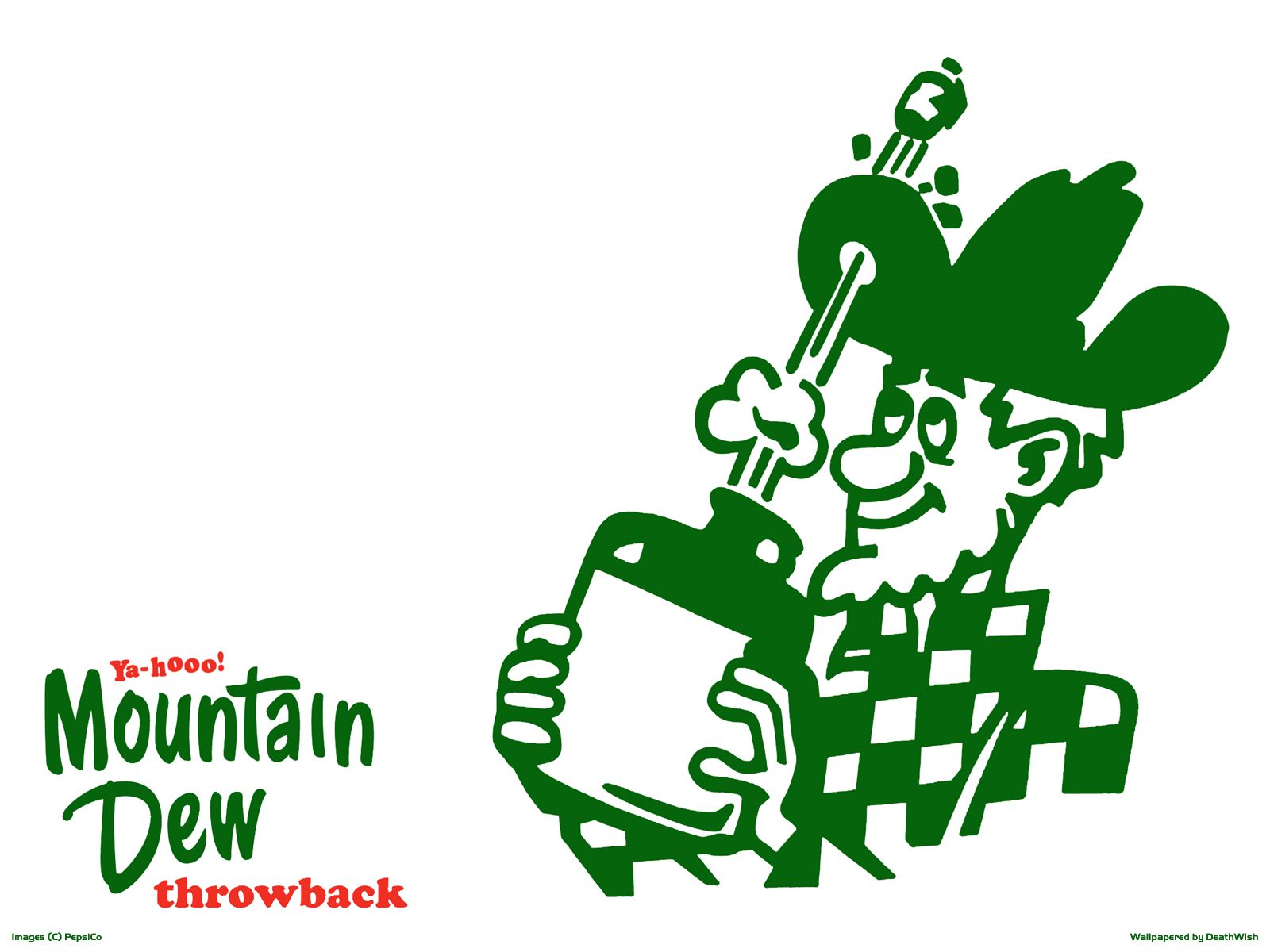
Most people think of Mountain Dew as a high-octane fuel for teenagers, but the old Mtn Dew logo started in a place that couldn't be further from an Xbox 360. Barney and Ally Hartman, two brothers from Tennessee, created the drink in the 1940s as a mixer for whiskey.
The name itself was literally slang for moonshine.
Back then, the logo featured a cartoon hillbilly named "Willy" holding a rifle and standing next to a mountain shack. It was kitschy. It was rural. It looked like something you’d see on a vintage postcard from the Great Smoky Mountains. When PepsiCo bought the brand in 1964, they kept the "mountain" theme but started moving away from the moonshine jokes.
By the late 1960s and 70s, the logo transitioned into a more "hippie-friendly" aesthetic. The fonts were rounded. The colors were a soft green and red. It looked like it belonged on a picnic blanket, not a skateboard. But that all changed in the 90s.
The Era of the Jagged Edge
If you close your eyes and think of the old Mtn Dew logo, you’re probably picturing the 1999 version. This was the "Mountain Dew" with the sharp, uneven lettering. The "M" looked like a jagged peak, and the "W" trailed off into a sharp point.
This was a massive shift in marketing.
Brands across the world were trying to capture the "Extreme" aesthetic. Think Tony Hawk’s Pro Skater. Think the X-Games. PepsiCo realized that if they wanted to dominate the youth market, they couldn't be the drink of hillbillies or picnic-goers anymore. They needed to be the drink of the kid who just jumped his bike off a roof.
The typography was intentionally messy. It broke the rules of traditional graphic design. In a world where most logos were becoming cleaner and more corporate, Mountain Dew went the opposite direction. It felt loud. It felt like it was screaming at you. And it worked. By the time the early 2000s hit, Mountain Dew wasn't just a soda; it was the unofficial sponsor of gamer culture.
Why the Change to "Mtn" Felt Like a Betrayal
In 2008, everything changed. PepsiCo decided to "modernize." They shortened the name to "Mtn Dew" and smoothed out all those beautiful, jagged edges.
The new logo featured a sleek, tilted "M" and a very corporate-looking lowercase "n." It was clean. It was symmetrical. It was... boring. To many long-time fans, this felt like the brand was selling out its soul to fit into a more refined, tech-focused world.
Why did they do it? Market research usually points toward "shelf visibility" and "brand scalability." Basically, the old logo was hard to read if it was small on a screen or a social media icon. The new, blockier design popped more on a smartphone.
But something was lost in that translation. The old Mtn Dew logo had a certain grit to it. It didn't care if it was perfectly legible; it cared if it looked cool on a hoodie. The modern version feels like it was designed by a committee in a glass office building. It’s effective, but it lacks the "kick" of the original.
The Return of Retro: Why Nostalgia is Winning
Lately, you might have noticed something interesting. If you walk into a grocery store, you’ll see "Mountain Dew Real Sugar" (formerly Throwback). It features that 1970s rounded logo. You’ll see limited-edition releases that use the 90s jagged font.
Companies are realizing that nostalgia is a more powerful marketing tool than "modernity."
We’re seeing a massive trend where brands like Burger King, Pizza Hut, and even Kia (though they went the modern route and people hated it) are looking back to their heritage. People are tired of the "flat" design era. We want texture. We want personality. We want the old Mtn Dew logo because it represents a time when things felt a little less polished and a little more fun.
Designers call this "re-branding for the heart." When you see that old green and red script, your brain isn't just processing a beverage brand. It’s processing memories of summer vacations, Halo 2 LAN parties, and the specific smell of a Blockbuster Video. You can’t manufacture that with a sleek new font.
The Technical Design of the "Xtreme" Era
Let’s get nerdy for a second. The 1999 logo was a masterpiece of "anti-design."
If you look at the kerning (the space between letters), it’s almost non-existent. The letters overlap. The red "Dew" sits in a drop-shadow that creates a sense of 3D depth. Most modern logos are 2D because they look better on a flat OLED screen. But the old logo felt like an object. It felt like it had weight.
The color palette was also incredibly specific. It used a very high-contrast "Electric Green" and a deep "Crimson Red." This color combination is technically jarring to the human eye—red and green are opposites on the color wheel. Usually, you’re told not to use them together in high saturation because they "vibrate" against each other.
Mountain Dew did it anyway. They wanted that vibration. They wanted the logo to feel like it was buzzing with energy.
What to Look for if You’re a Collector
Because the old Mtn Dew logo is such a cultural touchstone, vintage merchandise is actually becoming a legitimate hobby. If you’re hunting for old cans or memorabilia, there are a few things to keep an eye on:
- The "Willy" Cans: Anything from the pre-1970s era featuring the hillbilly character is basically the holy grail for soda collectors. These can go for hundreds of dollars depending on the condition.
- The 1990s Vertical Cans: For a brief period, the logo was printed vertically on the can. These are iconic because they coincided with the "Do the Dew" ad campaigns featuring the "Dew Guys" (the mountain climbers).
- Misprints: Because the 90s logo was so complex, there were occasional runs where the red and green didn't align perfectly. Collectors love these "off-register" cans because they look even more chaotic than the intended design.
How to Get the Old Vibe Back Today
You don't have to spend your life savings on eBay to see the old Mtn Dew logo again. PepsiCo has been pretty smart about "fan service" lately.
First, look for the "Real Sugar" variety. It’s almost always available in the US and uses the classic 1970s-1980s logo. It’s the closest you’ll get to the "pre-modern" era on a daily basis.
Second, keep an eye on the "Dew Store" online. They frequently drop "Legacy" merchandise. They know the 90s aesthetic is peaking right now, so they’ve been releasing hats, shirts, and even coolers that use the jagged 1999 font.
Lastly, check out the "World of Dew" fan communities. There are people out there who have archived every single variation of the logo, from the Tennessee roots to the weird experimental logos used in international markets like Japan and New Zealand.
The old Mtn Dew logo wasn't just about selling sugar water. It was a visual marker for a specific moment in time when "cool" meant being loud, slightly messy, and totally unapologetic. While the new "Mtn" branding is efficient and clean, it’ll never have the same soul as that jagged green mountain we all grew up with.
Next Steps for the Nostalgic:
If you want to dive deeper into the history of beverage design, start by searching for "soda brand evolution" on sites like LogoDesignLove or the Museum of Brands. You’ll see that Mountain Dew isn't the only one—nearly every major brand from the 90s is currently grappling with how to bring back their "ugly-cool" roots without looking dated. If you’re a designer, try experimenting with "anti-design" principles: ignore the grid, overlap your letters, and don't be afraid of a little chaos. Sometimes, the most memorable way to stand out is to stop trying to be so perfect.