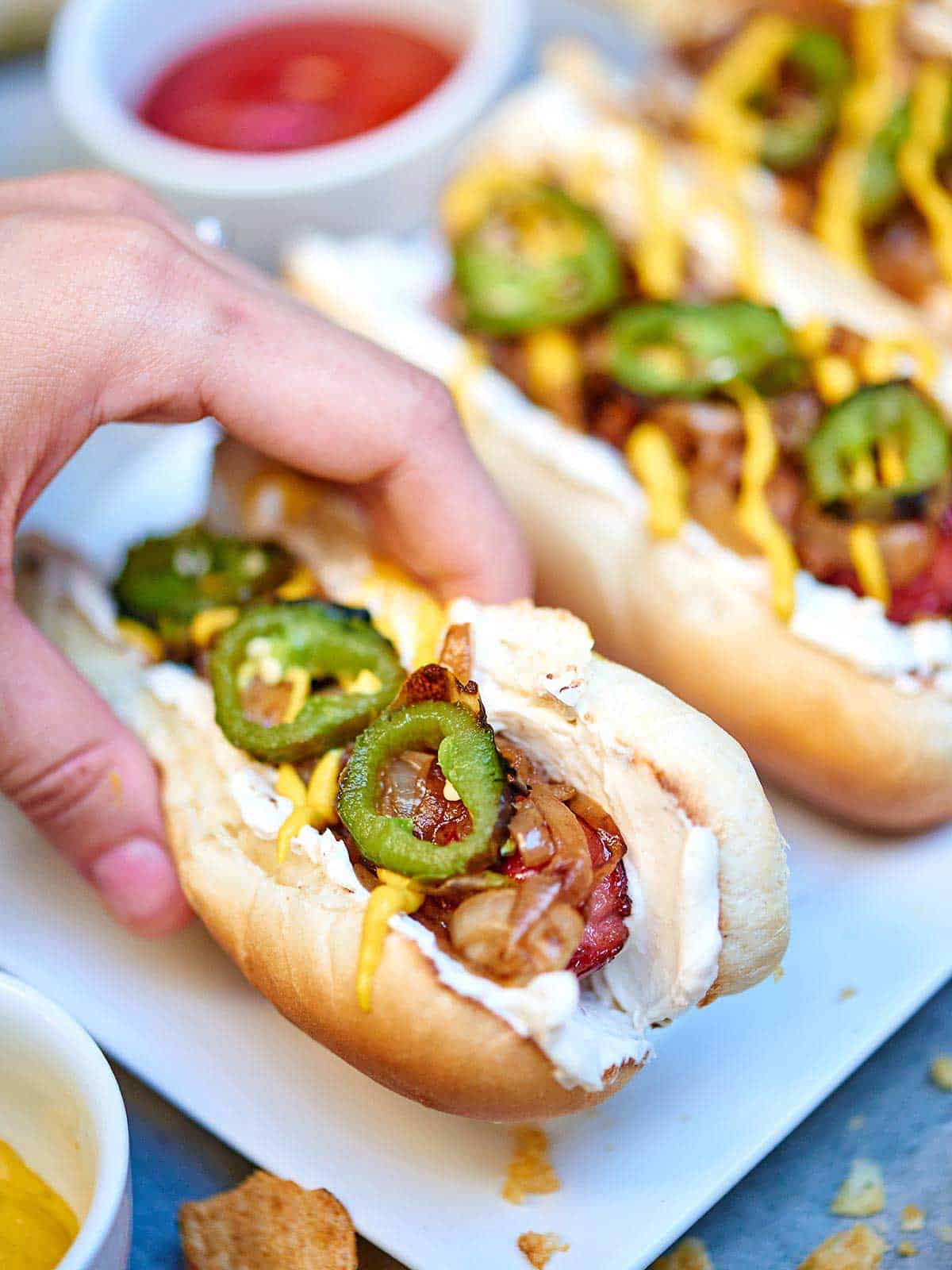
You’re standing outside a music venue in Capitol Hill at 1:00 AM. The air is misty, predictably, and the smell of charred onions is basically aggressive. It hits you before you even see the cart. That’s the birthplace of the Seattle dog. If you tell someone from Chicago or New York that you’re about to put cream cheese on a frankfurter, they’ll probably look at you like you’ve lost your mind. Honestly? I get it. It sounds wrong. It sounds like a culinary accident. But the Seattle hot dog recipe isn't just a local quirk; it’s a masterclass in fat, acid, and salt balance that somehow conquered the Pacific Northwest.
Most people think you just smear some Philadelphia on a bun and call it a day. That's a mistake. A real Seattle dog is about the interplay between the cool, velvet texture of the cheese and the sharp, spicy bite of jalapeños and brown mustard. It’s a late-night street food staple that has survived decades of food trends because it hits every single taste bud at once.
The Secret History of Cream Cheese on Meat
We have to talk about Hadley Long. Back in the late 1980s, Long ran a bagel cart called Hadley’s Best Bagels in Pioneer Square. He was trying to sell bagels to the bar crowd. It wasn't really working. Bagels are a bit too much work when you’re three beers deep. So, he pivoted. He started putting hot dogs on bialys—which are basically bagels without the hole—and added cream cheese because, well, he already had a ton of it for the bagels.
It took off. Soon, the bialy was swapped for a standard bun to make it cheaper and easier to eat on the move, but the cream cheese stayed. By the 90s, during the height of the Grunge era, these carts were everywhere. If you were at a Soundgarden or Pearl Jam show, you were eating one of these afterward. It became part of the city's DNA. It’s not just food; it’s a cultural artifact of a time when Seattle was the center of the universe.
The Authentic Seattle Hot Dog Recipe Breakdown
If you want to do this at home, don't overcomplicate it, but don't cut corners on the specific ingredients. This isn't a gourmet dish. It’s street food.
The Meat Matters
You need an all-beef hot dog. Preferably one with a "snap." When you bite into it, the casing should resist just a little before the juices hit. Some people use Polish sausages or bratwursts, which is a popular variation at places like Joe’s Grilled Onions, but the classic Seattle hot dog recipe usually starts with a high-quality beef frank. Split it down the middle (butterfly style). This is non-negotiable. You want more surface area for charring.
The Cream Cheese Delivery System
Street vendors don't use a knife. They use a caulking gun filled with softened cream cheese. It’s efficient. It’s fast. For your kitchen, just make sure your cream cheese is at room temperature. If it's cold, it won't melt into the meat, and you’ll just have a weird, cold lump in your sandwich. You want that schmear to get slightly gooey from the heat of the grilled dog.
The Onions Are the Soul
You can't just raw-dog the onions. They have to be caramelized. Not "slightly softened," but dark, jammy, and sweet. In Seattle, vendors cook these in bulk on a massive flat-top grill, often using a bit of oil or even a splash of beer to deglaze the surface. The sweetness of the onions cuts through the heavy fat of the cream cheese.
Variations That Locals Actually Eat
- The Jalapeño Kick: Fresh slices are better than pickled, though both work. The heat is necessary to break up the richness.
- The Condiment Rule: Brown mustard is the standard. Ketchup is generally frowned upon, though nobody’s going to arrest you. Sriracha has become a modern "third-wave" addition that actually fits the flavor profile perfectly.
- The Bun: A standard hoagie roll or a sturdy brioche bun. It needs to be toasted. If the bun is cold, the whole experience falls apart.
Why Science Says This Combination Works
There’s a reason your brain craves this specific combo. It’s a texture thing. Most hot dogs are soft and salty. By adding cream cheese, you’re introducing a massive amount of lactic acid and fat. Lactic acid acts as a flavor enhancer. When that fat coats your tongue, it carries the spicy capsaicin from the jalapeños and the pungent vinegar from the mustard more effectively across your palate.
Also, the "Butterfly Cut" isn't just for show. By splitting the dog, you create a "valley" for the cream cheese to sit in. This ensures that every single bite has a 1:1 ratio of meat to cheese. It’s engineered for maximum flavor delivery. If you just put the cheese on the bun, it gets lost. If you put it on top of a round dog, it slides off. The split is the engineering marvel of the Pacific Northwest.
Common Mistakes to Avoid
Don't use low-fat cream cheese. Just don't. It doesn't melt the same way, and the texture becomes grainy when it hits the hot meat. You need the full-fat, brick-style stuff.
Another huge error? Forgetting to toast the bun. A Seattle dog is heavy. It's wet from the onions and the cheese. A flimsy, untoasted white bread bun will disintegrate within three minutes. You need that toasted crust to act as a structural barrier.
Lastly, watch your onion heat. If you burn them until they're bitter, they'll ruin the sweetness that's supposed to balance the salt. Low and slow is the game. If you're in a rush, you're not making a real Seattle dog.
Taking Action: Your Weekend Project
To truly master the Seattle hot dog recipe, you should try a "build-off." Start with the base and then experiment.
- Prep the Onions first. They take the longest. Slice two large yellow onions thinly and toss them in a pan with a tablespoon of oil and a pinch of salt. Let them go for at least 20 minutes on medium-low.
- Butterfly the franks. Slice them lengthwise but don't go all the way through. You want a hinge.
- Grill the meat. Get a nice char on the inside of the "flap."
- Softened Cheese. While the meat is cooking, make sure your cream cheese is pliable.
- Assembly. Spread a thick layer of cream cheese on the toasted bun. Place the hot dog directly onto the cheese. Pile the onions on top. Add jalapeños. Finish with a streak of spicy brown mustard.
Eat it immediately. This isn't a dish that travels well. It’s meant to be consumed while it’s still steaming, preferably standing up, just like you would on a rainy sidewalk in Seattle.
For those looking to explore further, check out local legends like Monster Dogs or Dante's Inferno Dogs if you ever visit the city. They’ve been the gold standard for years. Understanding the history of street food in the PNW reveals a lot about how cities develop their own unique culinary identities through sheer necessity and what's available at 2 AM.