You’ve seen it on Instagram. You've definitely seen it on a CrossFit gym wall or a LinkedIn "hustle culture" post. It’s that one quote that makes you feel like you should be doing something bigger with your life. But here’s the thing: most people just skim the surface of the Theodore Roosevelt quotes man in the arena speech without actually knowing why it was said or what Roosevelt was really trying to do in that moment.
He was in Paris. The year was 1910. Roosevelt had just finished a literal year-long safari in Africa, and he was basically the most famous person on the planet. He stood up at the Sorbonne and delivered a speech officially titled "Citizenship in a Republic." It was long. It was dense. But one paragraph—just one—ended up immortalized in history.
It’s about the critic. Or rather, why the critic doesn't actually matter.
The Raw Power of the "Man in the Arena"
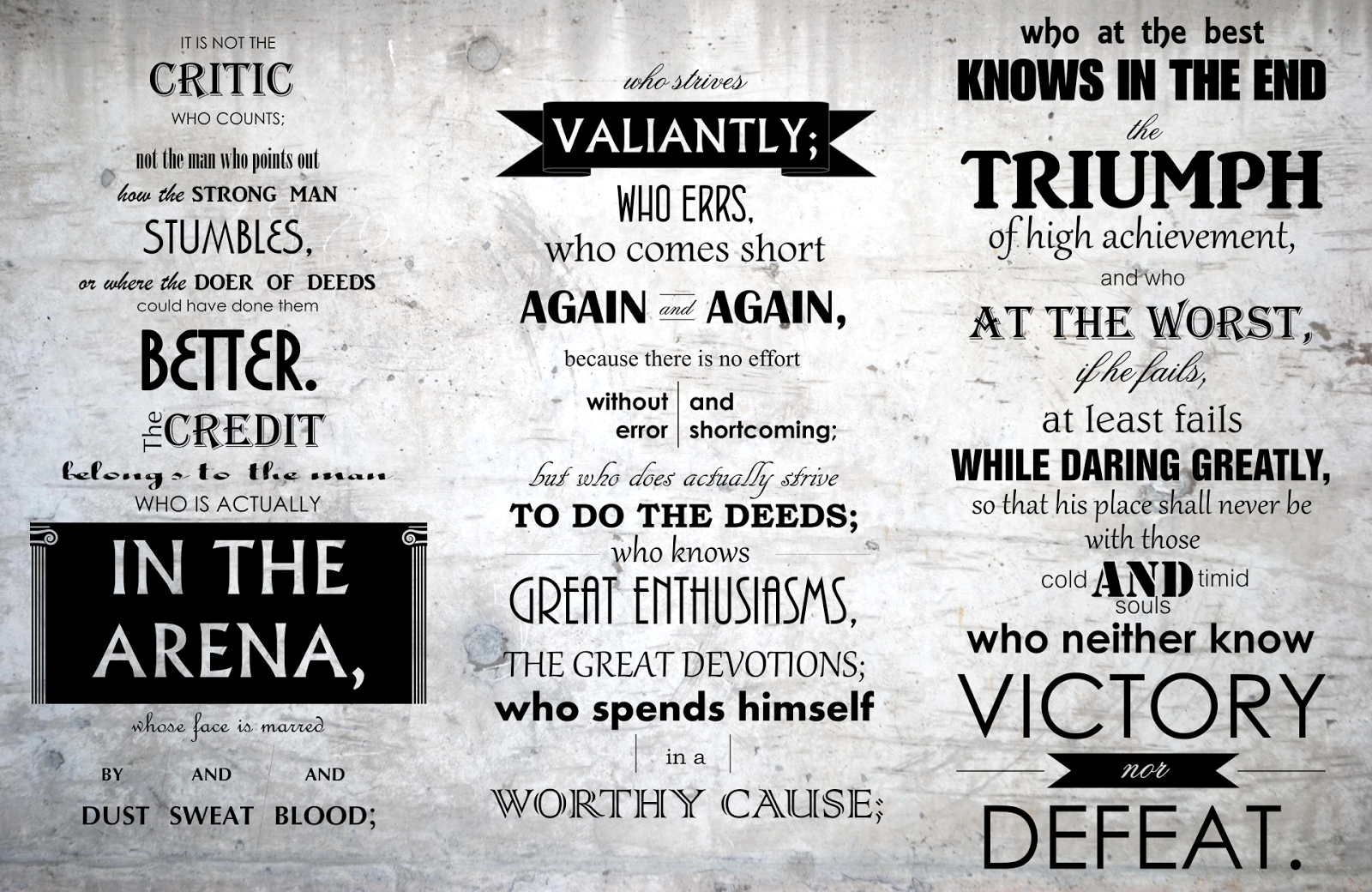
"It is not the critic who counts; not the man who points out how the strong man stumbles, or where the doer of deeds could have done them better." That's how it starts. Roosevelt wasn't just being poetic; he was being defensive and aggressive all at once. He was tired of the "cloistered" intellectuals in Paris who sat around sipping wine and judging men of action.
The credit, he said, belongs to the man who is actually in the arena. The guy whose face is "marred by dust and sweat and blood." Think about that for a second. This isn't about looking good on camera. It’s about being messy. It’s about failing. Roosevelt specifically mentions the "shortcoming" and the "err." He knew that if you're actually trying to build a business, raise a family, or change a law, you’re going to look like an idiot at least 40% of the time.
Honestly, it’s a grit manifesto.
Most people forget that Roosevelt lived this. He wasn't some soft politician born into a suit. As a kid, he was sickly and asthmatic. He literally breathed his way into a stronger body through sheer force of will. When his wife and mother died on the same day—Valentine's Day, no less—he didn't just go to therapy. He moved to the Badlands and became a rancher. He knew what it felt like to have his face in the dirt.
Why We Keep Quoting This in 2026
We live in a world of professional critics. Social media has turned everyone into a judge sitting in the nosebleed seats. It’s so easy to tweet a snarky comment about a CEO’s failure or a filmmaker’s flop. Roosevelt’s words act as a shield against that noise.
Brené Brown, the famous researcher, basically built a second career on this specific quote. She realized that vulnerability isn't about winning; it's about showing up when you can't control the outcome. That is the essence of the arena. If you aren't in the arena getting your butt kicked, she argues, she’s not interested in your feedback. Roosevelt would have loved that.
The speech wasn't just for the "great" men of history, though. It was for the everyday citizen. He believed that a republic—a democracy—only works if the people are willing to get their hands dirty. If everyone is too afraid of being judged to try anything, the whole system collapses.
The Misconceptions You Probably Have
A lot of people think this quote is an excuse to ignore all criticism. It’s not. Roosevelt wasn't saying you should be an arrogant jerk who never listens. He was saying you shouldn't listen to the spectators. There’s a massive difference between the coach on the sidelines and the random guy in the third row screaming that you're a loser.
Also, it’s not just about winning. Roosevelt says that even if the man in the arena fails, at least he fails while "daring greatly." That’s the line. Daring greatly. It means the attempt itself has value, regardless of the ROI or the public reception.
How to Actually Use This Wisdom
So, how do you take these Theodore Roosevelt quotes man in the arena vibes and actually do something with them? You can't just put it on a coffee mug and call it a day.
First, identify your arena. Is it a new career path? A difficult conversation you've been avoiding? A creative project you're scared to post? Once you’re in it, expect the dust and sweat. If you aren't feeling some level of discomfort, you’re probably still in the stands.
Second, check your "critic" filter. When someone gives you feedback, ask yourself: Are they in an arena? If they are also taking risks and doing the work, listen to them. If they are just pointing out where the "strong man stumbles" from the safety of their keyboard, let it go.
Third, embrace the "cold and timid souls" part of the speech. Roosevelt had zero respect for people who knew "neither victory nor defeat." He thought a life lived in the middle—safe, quiet, and unjudged—was a wasted life. It's better to be wrong and bloody than to be "right" and bored.
The Realistic Downside
We have to be honest here. Being the man in the arena is exhausting. Roosevelt died at 60. He pushed himself so hard, his body basically gave out. There is a cost to the "strenuous life." You will get scars. Some of them won't heal. But the alternative—the "grey twilight"—sounded like a nightmare to him.
It’s also worth noting that Roosevelt’s worldview was very much tied to his time. He was an imperialist. He loved war a bit too much. He had views that wouldn't fly today. But this specific piece of advice? It transcends the 1900s. It’s human psychology at its most basic level.
Actionable Steps for the Modern Arena
Stop waiting for the "perfect" time to start. There is no such thing as a clean arena.
- Pick one "Daring Greatly" task today. Do the thing you're afraid will make you look stupid. Send the email. Post the draft.
- Audit your circle. Look at the people you allow to criticize you. If they don't have skin in the game, their opinion is background noise.
- Document the "Dust and Sweat." Instead of only sharing your wins, be honest about the stumbles. It takes the power away from the critics when you own the mess first.
- Read the full speech. Don't just stick to the quote. Look up "Citizenship in a Republic." The context about duties and character makes the "arena" part hit even harder.
Theodore Roosevelt didn't write those words to be a caption. He wrote them as a challenge. The arena is always open. It's loud, it's messy, and the seats are full of people waiting for you to trip. Get in there anyway.