It is a specific kind of heartbreak. You know the one. It’s that feeling when you realize a part of your life—a person, a place, a version of yourself—is just gone. It isn't coming back. Sir Elton John and his long-time lyricist Bernie Taupin captured this perfectly in 2001. Honestly, This Train Don’t Stop There Anymore is probably the most honest song Elton John ever released.
Most people think of the 70s when they think of Elton. They think of the sequins, the giant glasses, the stadium-filling energy of Goodbye Yellow Brick Road. But this song? This is the sound of a man looking in the mirror at 54 and realizing the circus has left town. It’s stripped back. It’s raw. It’s the centerpiece of his "comeback" album, Songs from the West Coast, and it serves as a brutal resignation to the passage of time.
If you’ve ever felt like the world moved on without asking your permission, this track is your anthem.
The Story Behind the Lyrics
Bernie Taupin didn't write this as a generic sad song. He wrote it about Elton. Or rather, he wrote it about the "Elton John" persona that the world consumed for decades. By the late 90s, Elton had been through the wringer. He was sober, he was aging, and the music industry was pivoting toward boy bands and teen pop.
The central metaphor is a train station. For years, Elton was the train—high speed, unstoppable, carrying everyone along for the ride. But the lyrics flip that. He’s now the guy standing on the platform, watching the "starship" (a clear nod to his 70s excess) fly past. When he sings "I used to be the main express," he isn't bragging. He’s grieving.
Bernie has always had this uncanny ability to write Elton’s diary before Elton even knows what he’s feeling. In a 2001 interview with ABC News, Elton admitted that when he first read the lyrics, they hit him like a physical blow. He realized he couldn't sing like a "young pup" anymore. He had to sing like a man who had seen the bottom of a bottle and the top of the charts and realized neither of them could stop the clock.
That Music Video: Justin Timberlake as Elton
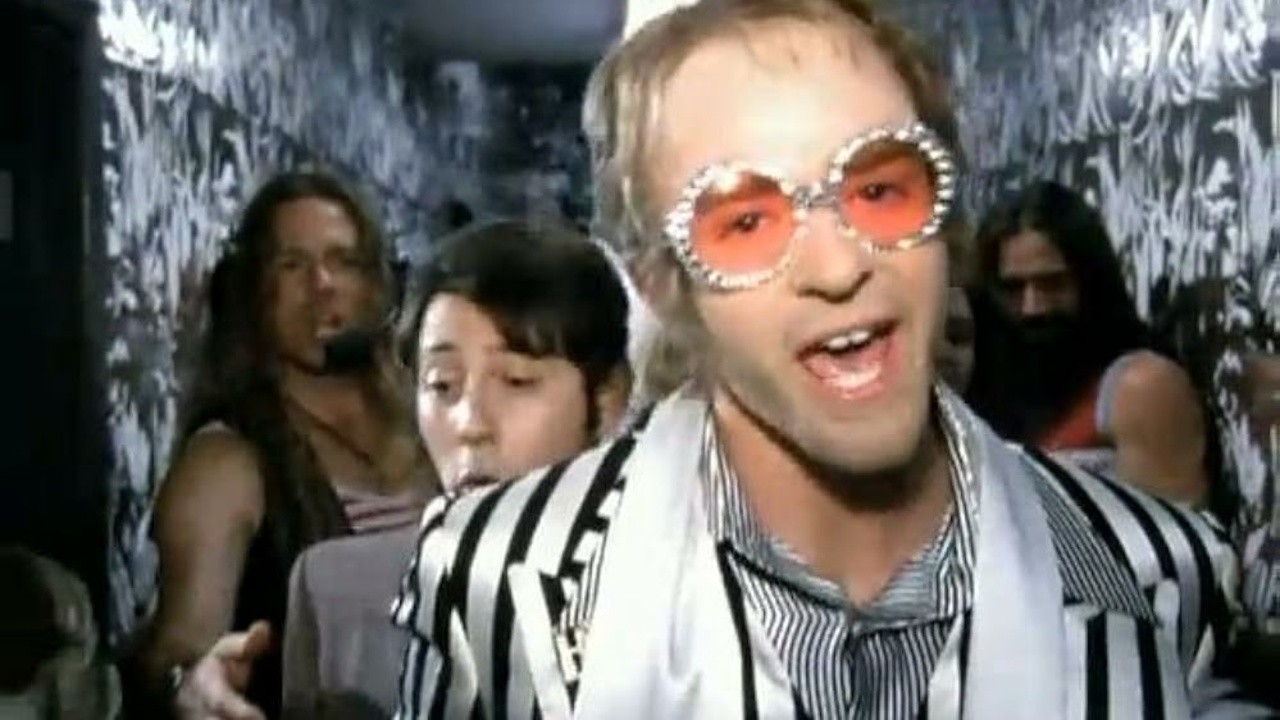
You can't talk about This Train Don’t Stop There Anymore without talking about the visual. Directed by David LaChapelle, the music video is a masterpiece of meta-commentary. It features a young Justin Timberlake playing a 1970s-era Elton John.
It’s jarring.
Seeing Timberlake in the rhinestones and the fur coats captures the kinetic, almost frantic energy of Elton’s youth. But the song playing over these images is the modern, gravelly-voiced Elton. The contrast is the whole point. While the "young Elton" is backstage being mobbed by fans and photographers, the lyrics are telling us that the person inside that costume is tired. He’s done.
It’s a clever trick. It uses a contemporary pop star (Timberlake was at his peak with *NSYNC at the time) to represent the ghost of a former pop star. It highlights the cyclical nature of fame. One day you’re the main express; the next, you’re the station everyone whistles past.
Why the Piano Matters More Than the Glitz
Musically, the track is a return to form. After a decade of heavily produced, synth-heavy 80s and 90s hits, Elton went back to the basics. He recorded Songs from the West Coast using vintage instruments. We’re talking real upright pianos, harmoniums, and analog setups.
The piano part in This Train Don’t Stop There Anymore isn't flashy. There are no "Bennie and the Jets" staccato chords here. It’s soulful. It’s gospel-tinged. It sounds like something that would be played in a dusty bar at 2 AM.
- The Tempo: It’s slow, but it has a heartbeat.
- The Vocals: Elton’s voice had changed by 2001. It was lower, thicker, and carried the weight of his years. He doesn't reach for the high falsettos of his youth because he doesn't need to. The gravity is in the grit.
- The Arrangement: Produced by Patrick Leonard, the track breathes. There’s space between the notes, which allows the lyrics to land with maximum impact.
Honestly, it’s one of the few times Elton sounds completely vulnerable. He’s not performing; he’s confessing.
A Career Turning Point
Before this song, many critics thought Elton was heading into the "legacy act" phase of his career—just playing the hits at Caesar's Palace until he retired. Songs from the West Coast changed that narrative. It proved he still had something to say.
The song resonates because it addresses a universal truth: obsolescence. Whether you’re a rock star or a retired teacher, there comes a point where you realize the world’s "main express" is no longer your ride. You’re on a different track now.
It’s interesting to compare this to "Rocket Man." In 1972, he was lonely in space, but he was still a "Rocket Man." In This Train Don’t Stop There Anymore, he’s firmly on the ground. He’s checked out of the fame game. There is a profound sense of relief in that realization, even if it's wrapped in melancholy.
What Most People Get Wrong About the Meaning
A common misconception is that the song is about a failed romance. It’s easy to hear "you" and think it’s a breakup song. But it’s not.
The "you" in the song is the audience. It’s the public. It’s the fame itself.
When he says "I don't want to hear it anymore," he’s talking about the constant noise of the industry. He’s talking about the pressure to be the "showman" when all he wants to do is sit at a piano and be a musician. It’s a song about boundaries. It’s about deciding that the "train" of celebrity culture doesn't get to stop at his life anymore. He’s closed the station.
Legacy and Impact
Years later, this song remains a staple of his live sets, though it hits differently now that he’s officially retired from touring. During his Farewell Yellow Brick Road tour, the song served as a poignant bookend. It wasn't a sad goodbye; it was an honest one.
It’s also been covered by various artists, though few can capture the specific weariness Elton brings to the original. It requires a certain amount of life experience to sing those lyrics and make them believable. You have to have lost something to understand why the train stopped.
How to Appreciate the Song Today
If you want to really "get" this track, don't listen to it as a background pop song.
- Listen to the 1970s hits first. Spend thirty minutes with "Crocodile Rock" or "The Bitch Is Back." Get that high-energy, colorful Elton in your head.
- Read the lyrics to "This Train" before pressing play. Focus on the line: "I've finally died to win the prize." It’s one of Taupin’s sharpest stabs at the cost of stardom.
- Watch the video. Look at Timberlake’s performance not as an impression, but as a ghost story.
- Pay attention to the silence. Listen to the gaps between the piano chords in the bridge. That’s where the real emotion lives.
This Train Don’t Stop There Anymore is a reminder that growing older isn't just about losing things. It’s about gaining the clarity to know which trains are worth catching and which ones you’re happy to let pass you by.
Next Steps for Music Fans:
To truly understand the "Late-Era Elton" style, listen to the full Songs from the West Coast album back-to-back with his 1970 self-titled album. You will hear the echoes of his younger self in the piano melodies, but with a refined, adult perspective that only thirty years of fame can produce. If you are a songwriter, analyze Bernie Taupin's use of "industrial" metaphors (trains, engines, stations) to describe human emotions; it is a masterclass in thematic consistency. Finally, seek out the live version from Elton's One Night Only concert to hear how the song translates without the studio polish—it’s even more heartbreaking in person.