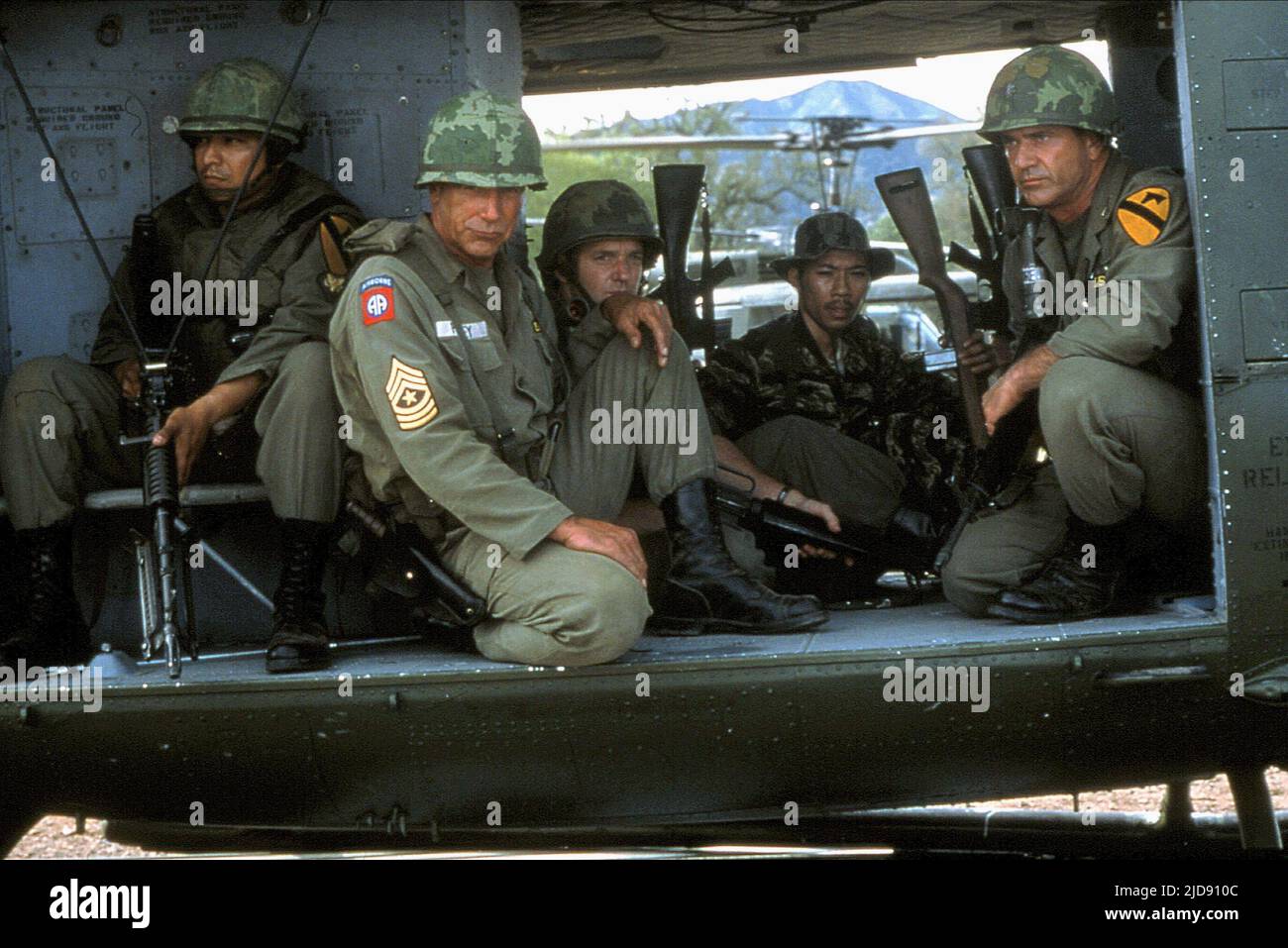
Honestly, it’s been over twenty years since We Were Soldiers Mel Gibson first hit theaters, and the conversation around it hasn’t really slowed down. Most war movies from the early 2000s feel like time capsules now. They’re either too shiny or too cynical. But this one? It sits in this weird, gritty middle ground. People still argue about whether it’s a masterpiece of realism or just another "hero complex" flick.
If you’ve watched it recently, you know the vibe. It’s loud. It’s brutal. It’s got that 2002 film grain that makes everything look like a dusty memory. But underneath the pyrotechnics, there’s a massive amount of historical weight that most viewers completely breeze over.
The Real Hal Moore vs. Mel Gibson
Mel Gibson plays Lt. Col. Hal Moore. In real life, Moore was a bit of a legend. He wasn't just a "tough guy" for the cameras; he was a Harvard-educated student of international relations who obsessed over the history of the 7th Cavalry.
You see this in the film when he’s staring at those old books. He knew he was leading the same unit George Custer led to a massacre at Little Bighorn. That’s a heavy shadow to walk under.
The movie does a decent job of showing his "first on the ground, last off" philosophy. It sounds like a Hollywood cliché, right? Except Moore actually did that. He was the first boots-on-the-ground at LZ X-Ray in the Ia Drang Valley on November 14, 1965.
What People Get Wrong About the Ending
Here is where things get messy. If you watch the movie, you see this massive, triumphant bayonet charge. Mel Gibson is leading his men, they’re sweeping the North Vietnamese Army (NVA) off the field, and it feels like a total victory.
That never happened.
In the real Battle of Ia Drang, there was no cinematic final charge that cleared the valley. While Moore’s 1st Battalion held their ground at LZ X-Ray, the NVA didn’t just vanish. In fact, the day after Moore's unit was extracted, a sister unit (the 2nd Battalion) was ambushed at LZ Albany.
It was a bloodbath.
The movie basically ignores the tragedy at LZ Albany to give the audience a "win." It’s understandable from a screenwriting perspective, but if you talk to any veteran who was there, they’ll tell you the real ending was a lot more hollow and haunting than the movie suggests.
Why We Were Soldiers Mel Gibson and the "Broken Arrow" Scene is Terrifyingly Accurate
One thing the movie absolutely nailed was the "Broken Arrow" sequence. For those who aren't military nerds, "Broken Arrow" was a code used when a U.S. unit was being completely overrun. It basically meant: Drop everything you have on my position right now.
The chaos of that scene—the napalm, the friendly fire, the screams—isn't just for drama. Joe Galloway, the reporter played by Barry Pepper, was actually there. He was the only civilian to receive a Bronze Star for valor in the Vietnam War.
The Joe Galloway Factor
Galloway’s involvement is probably why the movie feels so much more personal than Black Hawk Down or Pearl Harbor. He co-wrote the book We Were Soldiers Once… and Young with Hal Moore.
He didn't just watch from a distance. He literally carried a wounded soldier out of a napalm fire. Think about that. You’re a journalist with a camera, and suddenly you’re grabbing the ankles of a kid whose skin is peeling off because of a misplaced American bomb.
The movie shows this. It’s one of the hardest things to watch, but it’s 100% based on Galloway’s real-life trauma.
The Gear, the Dirt, and the Sound
Director Randall Wallace didn't want the actors looking like they just stepped out of a trailer.
- The cast went through a "celebrity-wimp" boot camp.
- Sam Elliott (playing Sgt. Maj. Plumley) actually wore his wedding ring on his dog tags, just like the real Plumley did.
- The sound designers used 10,000 recorded gunshots to make the firefights feel oppressive.
It wasn't just about the shooting, though. The movie spent a significant amount of time on the "Home Front." You see the yellow cabs delivering telegrams to the wives at Fort Benning.
In 1965, the Army didn't have a protocol for notifying families of deaths on such a large scale. They literally sent taxi drivers to deliver those "we regret to inform you" letters. It was heartless and messy. Watching Keri Russell’s character take over that responsibility is maybe more gut-wrenching than the actual battle scenes.
The Controversial Legacy of the Film
Critics often bash We Were Soldiers Mel Gibson for being "too patriotic" or "sentimental." And yeah, the slow-motion waving flags can be a bit much.
But there’s a detail most people miss.
The film starts and ends with the Vietnamese perspective. It shows Lt. Col. Nguyen Huu An (the NVA commander) as a brilliant, tactical peer to Moore, not some faceless villain. The movie is actually dedicated to the soldiers on both sides who died in that valley.
That was unheard of in 2002.
Actionable Insights for History Buffs and Cinephiles
If you want to actually understand what happened beyond the 138-minute runtime, here’s how to do it:
- Read the Book: Seriously. We Were Soldiers Once… and Young by Moore and Galloway is significantly more detailed and covers the LZ Albany disaster that the movie skipped.
- Watch the "Making Of" Documentaries: The footage of the real Hal Moore visiting the battlefield years later with his former NVA enemies is more moving than anything Mel Gibson did on screen.
- Research LZ Albany: If you only know the movie, you only know half the story. Look up the ambush of the 2/7th Cavalry to see the "hidden" side of the Ia Drang campaign.
- Listen to Joe Galloway’s Interviews: His first-hand accounts of the napalm incident provide a level of "E-E-A-T" (Experience, Expertise, Authoritativeness, and Trustworthiness) that no Hollywood script can match.
The film isn't perfect. It's got that "Hollywood gloss" that sanitizes the ending. But in terms of capturing the sheer, terrifying confusion of the first major clash between the U.S. and the NVA, it remains one of the most honest attempts we've ever seen. It’s about the men next to you. It always was.
To get the full picture of the Ia Drang Valley, you should compare the casualty reports of LZ X-Ray against those of LZ Albany to understand why both sides claimed victory in a battle that arguably had no winners.